 Meredith Angwin
Former utility chemist.
Meredith Angwin
Former utility chemist.
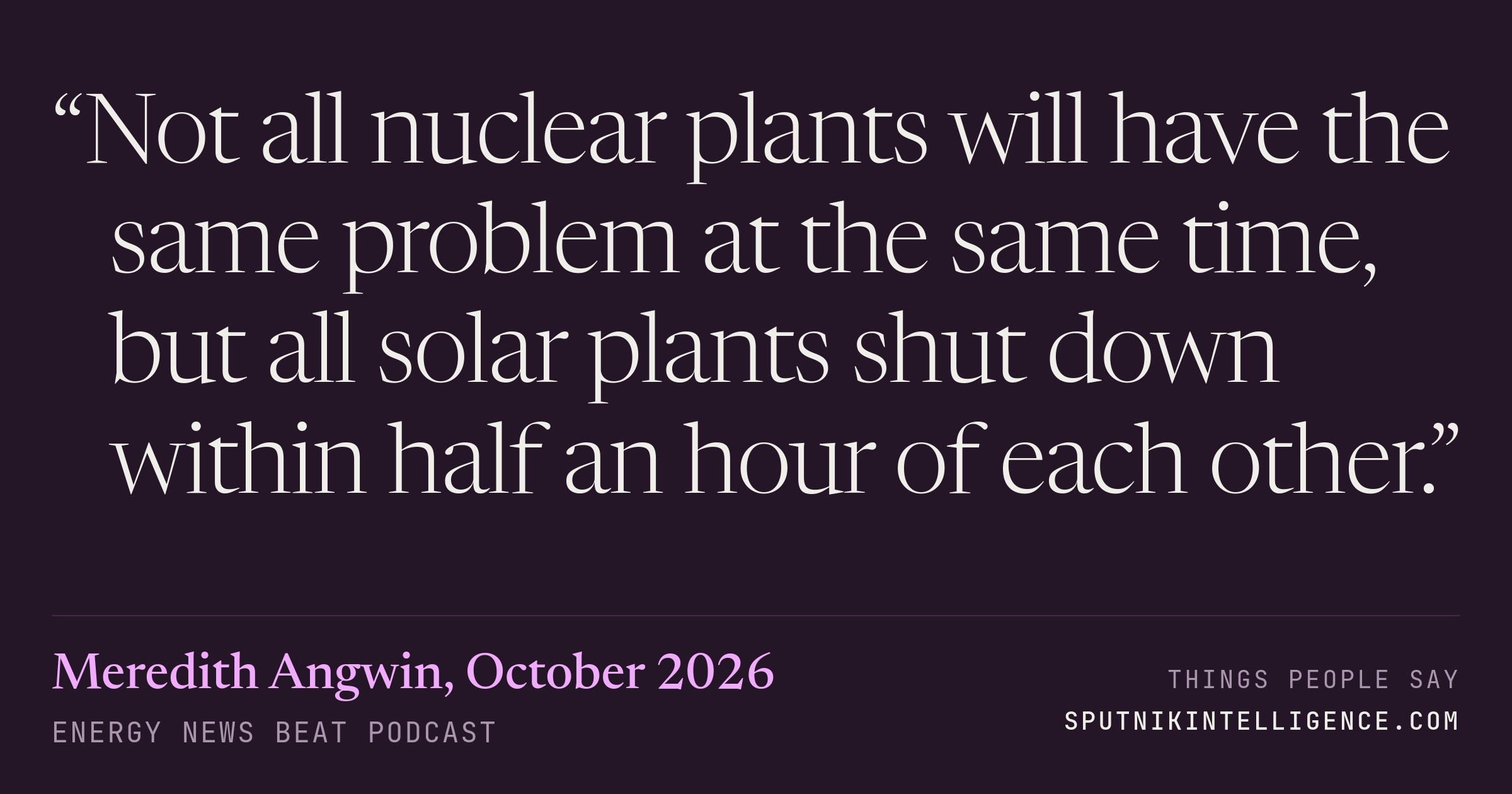
“Not all nuclear plants will have the same problem at the same time, but all solar plants shut down within half an hour of each other.”
Energy News Beat · Climate & Energy · October 2026
Angwin was recalling the argument she met when she campaigned to keep a nuclear plant open in Vermont: it's one big plant, so what happens if it goes offline? Her answer is that grids are built with spare capacity above peak load for exactly that case. The failure the reserve can't cover, she says, is one that hits every plant of a kind at once.
Transcript
I would, that's true that they are blue states and they're having problems. And I'm sure there's some kind of connection, but I just want to say that you can be very blue state-like and still be very in favor of reliable electricity provided by reliable sources. I mean, it is possible to be both. And you say, oh, you've got to give me an example. I can't give you a
let's look at Texas. Texas ERCOT, here's where Texas has done things right and they've done things wrong. Texas ERCOT during Storm Uri had a failure and people died and they learned from their mistake. During that time, natural gas froze. They had a lot of problems. The wind didn't show up. They froze. So they had a, that was 2020 or 2121 when storm winterstorm Erie happened. They fixed all those problems. And Texas ERCOT now has 183 gigawatts of name plate capacity. A lot of that is wind. A lot of that is, and they had 92 gigawatts two weeks ago hit the grid. That was the largest they've ever had. During that time period, all the solar came offline right at dusk and the wind was dead. We had enough storage that brought in 10 megawatts of storage that saved the grid until the natural gas could come online. And then the wind gigawatts, thank you. And then the gigawatts came online in order to save it. But if the wind had not picked up around 3 a.m., the Texas ERCOT would have had another problem, even though they have 180 gigawatts of name plate capacity. So you can have the capacity, but you're still going to have problems if the wind doesn't show up or the sun doesn't shine and it's not balanced right.
One of the things is that when I was trying to support our local nuclear plant, Vermont Yankee in Vermont, when I lived in Vermont, now I live in New Jersey. But at any rate, when I was trying to support it, people would say, well, you know, it's a big plant. And if it goes offline, what do we do then, huh? And I said, well, yeah, well, the grid is designed to have about 120% of the peak load available so that if a plant goes offline or if the load goes higher than any other peak had been, it's between 110, 115. It isn't always 120. I said, so, you know, it's designed for that. It's designed for that. And then, so the idea that a nuclear plant will go offline and everything will go to heck, it isn't a reasonable thing. The thing is that not all nuclear plants will have the same problem at the same time, but all solar plants shut down within half an hour of each other.
Really? Well, there's this
thing called sunset. I called it common mode failure, but people get really upset when I say sunset is common mode failure for some plants.
Oh, I love that. I'm going to start using that. That one is a common load failure. It is. It's a common load instead of common law.
More from Energy News Beat