Meredith Angwin

Things Meredith Says on Podcasts

Former utility chemist. Current author and advocate.

Where to Find Them

Meredith Angwin writes The Electric Grandma . They have also been a guest on Energy News Beat , The Great Simplification with Nate Hagens , Odd Lots , TFTC: A Bitcoin Podcast , The Nemeth Report’s Substack and Kaoboy Musings .

Recently: “The Two Grids: Why Policy is Breaking Physics” on Energy News Beat (October 2026); “Meredith Angwin and the Two Grids in Hurley” on The Electric Grandma (August 2026); “A Tale of Two Transmission Lines” on The Electric Grandma (July 2026); “Talking Grids with the Electric Grandma: Meredith Angwin on Northeast Blackouts & Virtual Power Plants” on The Nemeth Report’s Substack (July 2026); “Ships and Yachts” on The Electric Grandma (February 2026); “Kaos Theory Episode 12: Meredith Angwin” on Kaoboy Musings (February 2026).

What They Said

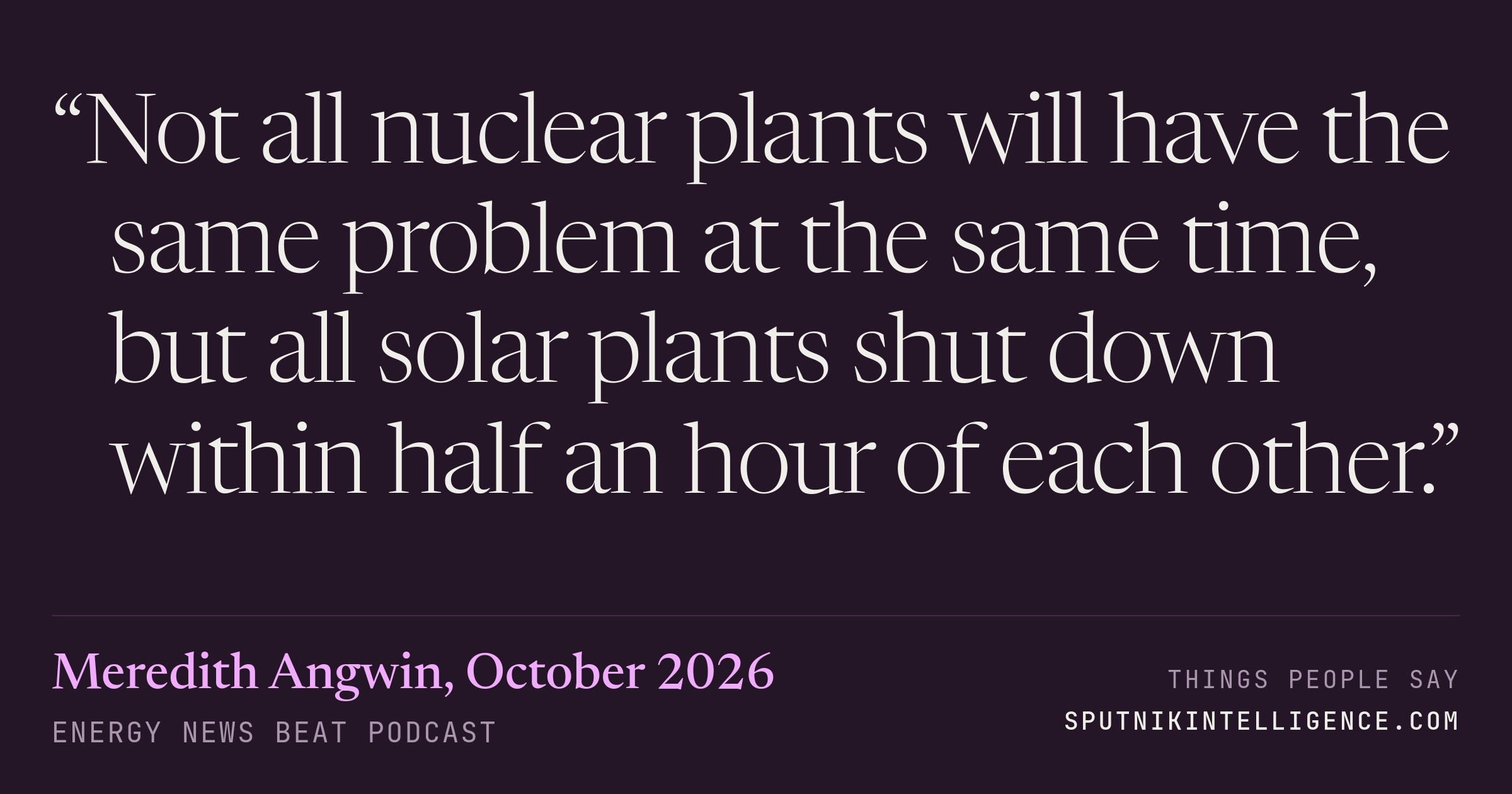
“Not all nuclear plants will have the same problem at the same time, but all solar plants shut down within half an hour of each other.” — Meredith Angwin, Energy News Beat

Angwin was recalling the argument she met when she campaigned to keep a nuclear plant open in Vermont: it's one big plant, so what happens if it goes offline? Her answer is that grids are built with spare capacity above peak load for exactly that case. The failure the reserve can't cover, she says, is one that hits every plant of a kind at once.

Energy News Beat · 2026-10-03 Permalink → Listen →
Energy News Beat
Meredith Angwin

I would, that's true that they are blue states and they're having problems. And I'm sure there's some kind of connection, but I just want to say that you can be very blue state-like and still be very in favor of reliable electricity provided by reliable sources. I mean, it is possible to be both. And you say, oh, you've got to give me an example. I can't give you a

Stu Turley

let's look at Texas. Texas ERCOT, here's where Texas has done things right and they've done things wrong. Texas ERCOT during Storm Uri had a failure and people died and they learned from their mistake. During that time, natural gas froze. They had a lot of problems. The wind didn't show up. They froze. So they had a, that was 2020 or 2121 when storm winterstorm Erie happened. They fixed all those problems. And Texas ERCOT now has 183 gigawatts of name plate capacity. A lot of that is wind. A lot of that is, and they had 92 gigawatts two weeks ago hit the grid. That was the largest they've ever had. During that time period, all the solar came offline right at dusk and the wind was dead. We had enough storage that brought in 10 megawatts of storage that saved the grid until the natural gas could come online. And then the wind gigawatts, thank you. And then the gigawatts came online in order to save it. But if the wind had not picked up around 3 a.m., the Texas ERCOT would have had another problem, even though they have 180 gigawatts of name plate capacity. So you can have the capacity, but you're still going to have problems if the wind doesn't show up or the sun doesn't shine and it's not balanced right.

Meredith Angwin

One of the things is that when I was trying to support our local nuclear plant, Vermont Yankee in Vermont, when I lived in Vermont, now I live in New Jersey. But at any rate, when I was trying to support it, people would say, well, you know, it's a big plant. And if it goes offline, what do we do then, huh? And I said, well, yeah, well, the grid is designed to have about 120% of the peak load available so that if a plant goes offline or if the load goes higher than any other peak had been, it's between 110, 115. It isn't always 120. I said, so, you know, it's designed for that. It's designed for that. And then, so the idea that a nuclear plant will go offline and everything will go to heck, it isn't a reasonable thing. The thing is that not all nuclear plants will have the same problem at the same time, but all solar plants shut down within half an hour of each other.

Stu Turley

Really? Well, there's this

Meredith Angwin

thing called sunset. I called it common mode failure, but people get really upset when I say sunset is common mode failure for some plants.

Stu Turley

Oh, I love that. I'm going to start using that. That one is a common load failure. It is. It's a common load instead of common law.
Speaker names from our own diarization · position estimated from where the line sits in the episode
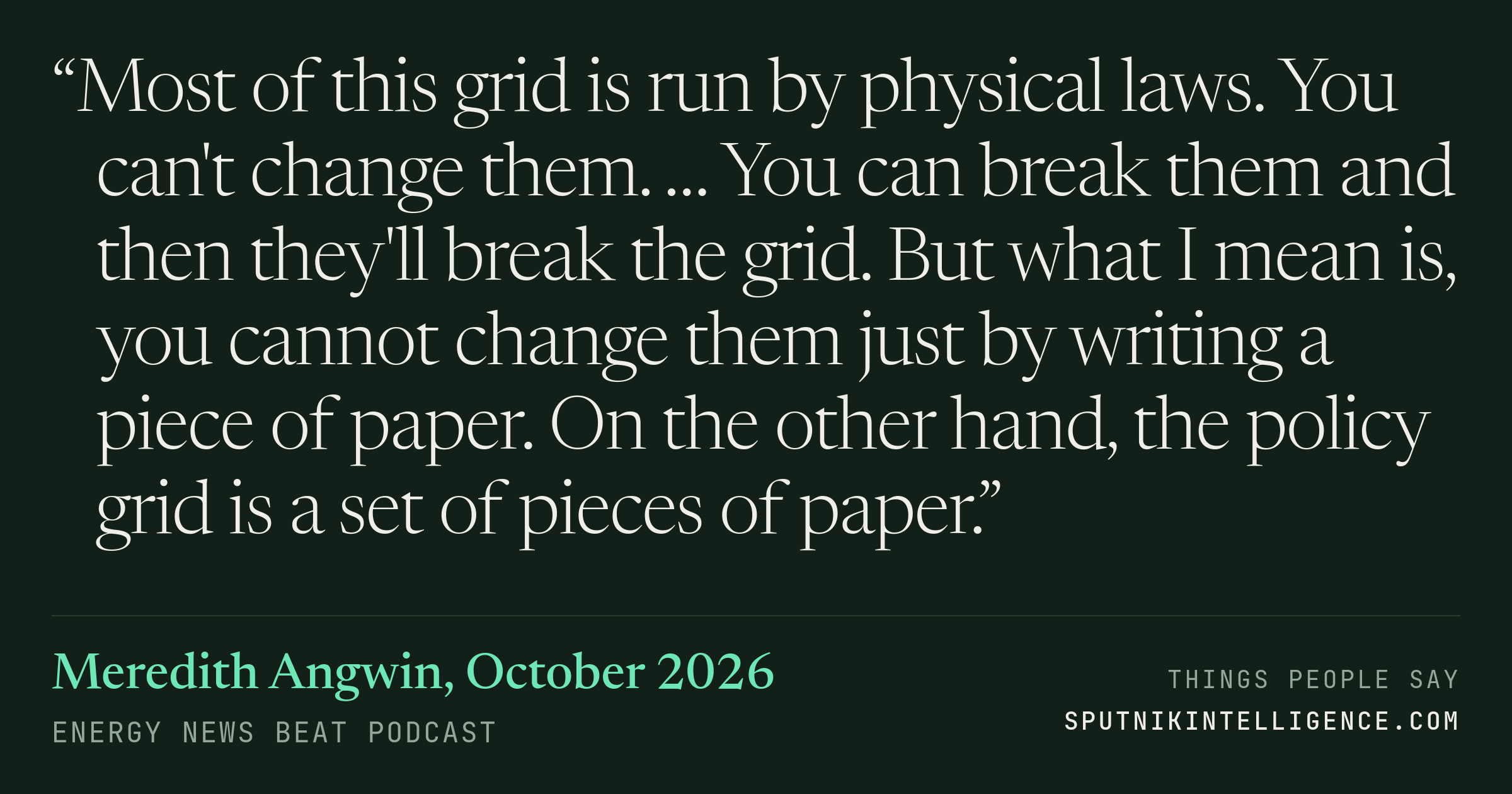
“Most of this grid is run by physical laws. You can't change them. … You can break them and then they'll break the grid. But what I mean is, you cannot change them just by writing a piece of paper. On the other hand, the policy grid is a set of pieces of paper.” — Meredith Angwin, Energy News Beat

Angwin was explaining her idea that there are two grids: the physical one of wires, substations and rotating machinery, and the "policy grid" of net metering rules, renewable standards and certificates. She says the policy grid is mostly about how the physical grid gets paid. Her complaint is that news coverage describes the paper one, so people take it for the real thing.

Energy News Beat · 2026-10-03 Permalink → Listen →
Energy News Beat
Meredith Angwin

it was at a church. And we don't really know why it was at a church, but because it was originally planned to be at a school. And Alex had, of course, Alex and his co-worker Fox, they're the founders of the New York Energy Alliance. Alex and Fox had done everything to clear to get to the school. And all of a sudden, the school decided that it wasn't going to allow them to use the school. And meanwhile, they'd made all kinds of arrangements and so forth and so on. But luckily, they were able to get a local church to host it.

Stu Turley

Oh, that's way cool. One of the key points that you have on here, you've got several slides. And tell us what you were thinking when you had the discussion going on here with two grids, fiscal and policy.

Meredith Angwin

Well, I have a theory that there are three. Well, it's beyond a theory. I have a theory that there are three fatal errors that a grid can make, which I call the fatal trifecta. And one of them is putting in too many renewables without really thinking about how they're going to be backed up or where the inertia and the other types of support that regular rotating machinery gives to a grid. So at any rate, I say, look, you know, the trouble is that there are two grids. Real grid. You can look out your window and you can see it. You can see a transmission, you can see a substation, you can see linemen sometimes. You are an end user, and most of this grid is run by physical laws. You can't change them. You know, you can't, you can break them and then they'll break the grid. But what I mean is, you cannot change them just by writing a piece of paper. On the other hand, the policy grid is a set of pieces of paper. It is paper that requires metering, renewable portfolio standards, aims at net zero within a certain number of years, sets up renewable energy certificates and so forth. It's a whole bunch of paper. And when you get right down to it, it's mostly about how the physical grid is paid. So, for example, if you net metering allows home solar to get more per kilowatt hour than some other source does, you know. So, that sort of thing, it's all about how the grid is paid. And unfortunately, one of the things is that the policy grid is what's usually described, usually reported on. And I can see why nobody wants to know about the phases of electricity on the grid. I mean, they really, if you really want to put people to sleep, let's go there, but we won't. But what I mean is the policy grid can be explained to anybody who's used to following any other policy argument, which means that everybody thinks it's the grid. I mean, in other words, if you're just an end user and reading the paper, you may not even think about the physical grid because everything's going to be about changes to the policy grid.

Stu Turley

And you don't notice it until it's not working.

Meredith Angwin

That's right.

Stu Turley

And then the policy, you bring up probably the single biggest issue that I think we face right now. And that is people don't understand that the renewable wind and solar with the additional burden that they put on balancing authorities because natural gas turbines either spin up or nuclear turbines spin up or coal turbines, and that puts extra wear and tear on those turbines to the tune of millions upon millions of dollars that grid utilities have to spend additional money, which goes to the grid funds, which is consumers, because spinning up a turbine and spinning it down and spinning it up and spinning it down is very expensive because of the wear and tear on those turbines. We now have a five-year wait on turbines.

Speaker names from our own diarization · position estimated from where the line sits in the episode

Collections They Appear In