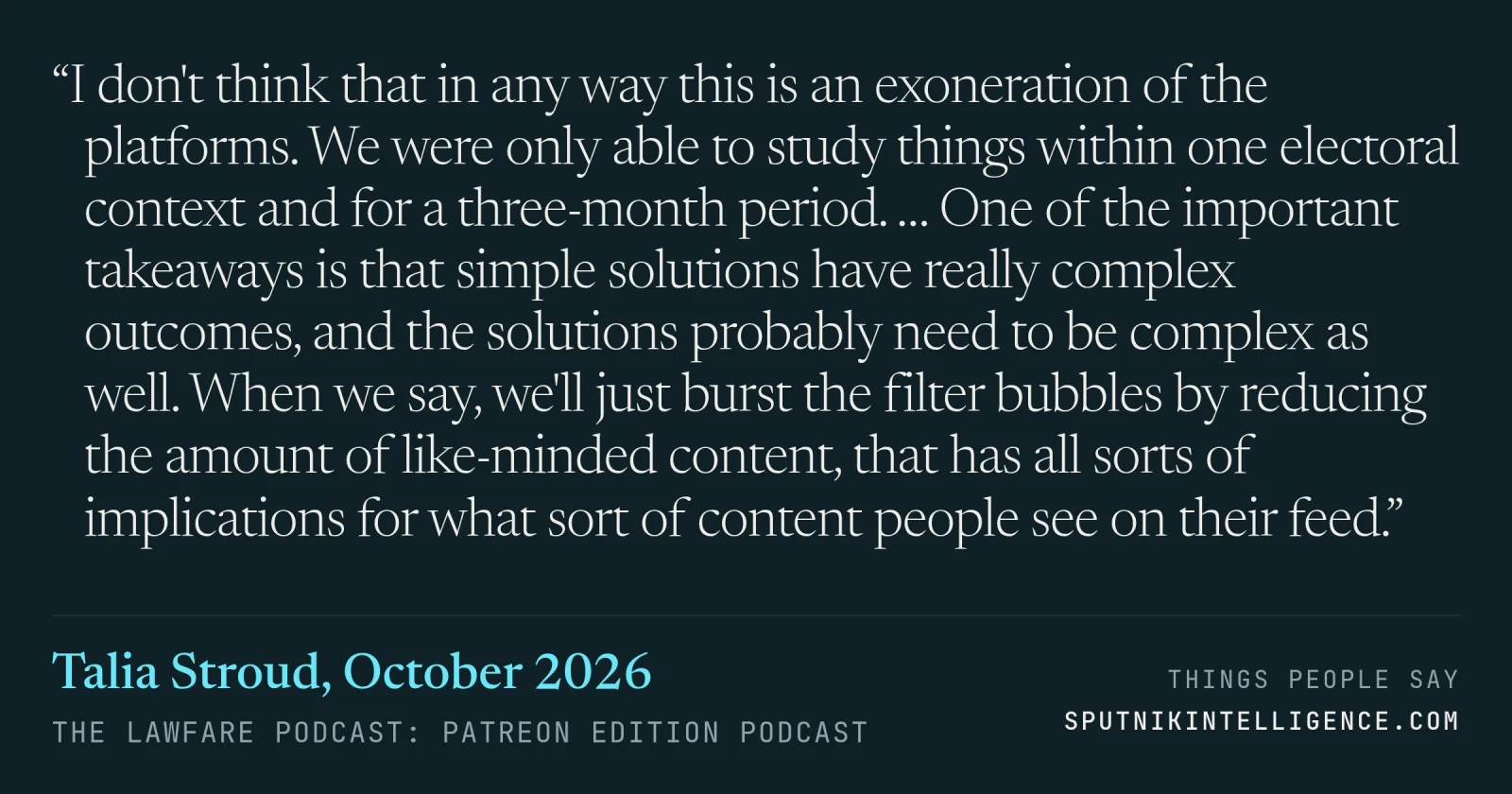
“I don't think that in any way this is an exoneration of the platforms. We were only able to study things within one electoral context and for a three-month period. … One of the important takeaways is that simple solutions have really complex outcomes, and the solutions probably need to be complex as well. When we say, we'll just burst the filter bubbles by reducing the amount of like-minded content, that has all sorts of implications for what sort of content people see on their feed.”
The Lawfare Podcast: Patreon Edition · US Politics · October 2026
Context
The host asked whether findings of little attitude change amount to an exoneration of Facebook and Instagram. Stroud rejects that reading, stresses the limits of a three-month, single-election study, and argues the received wisdom about easy fixes did not hold up.
Transcript
public, and the public, which has bigger questions than the scientific research can answer. And so, that's why, in part, why we appreciate the opportunity to come on a podcast like this to talk about what we can and cannot conclude from these findings.
…of platforms, but perhaps they don't change how we experience politics outside those platforms. Those aspects of design may not change our political beliefs and our engagement with others. Again, to massively oversimplify this very complicated discussion, is this an exoneration of the platforms?
Yeah, it's a good question. I don't think that in any way, this is an exoneration of the platforms. Again, we were only able to study things within one electoral context and for a three-month period. So, there's lots of things that we aren't able to answer. But I do think that this makes an important point, which is we manipulated things about what was happening on the platforms. And the results of those didn't show massive shifts in terms of what people were thinking. And I think that was the received wisdom before this: oh, you could just make these, you know, couple of changes and maybe that would have these profound effects. And so, I think one of the important takeaways is that simple solutions have really complex outcomes. And the solutions probably need to be complex as well. And when we say, oh, well, we'll just burst the filter bubbles by reducing the amount of like-minded content, for example, that has all sorts of implications for what sort of content people see on their feed. And then, in this study, at least, we don't find any evidence that that does have a net effect on people's political attitudes in the aftermath. So, I don't think it exonerates them. And I think that it says to everyone that solutions to any ills that might be caused by the platforms…
Right. And I mean, there's also stuff in the studies that I think is not particularly flattering to Facebook. So, for example, that resharing seems to elevate the amount of untrustworthy sources. There's information in there that indicates that content that is flagged by Facebook fact checkers as…
And so when we say, look, our research obviously can't answer this huge question, but let me tell you what it can answer, what we have, you know, what we have learned here. Hopefully that tones it down a little bit because it's like, oh, this isn't, are we exonerating the platforms or are we not…
this project. One contribution is everything we're talking about now. We now have knowledge we didn't have. We are going to, going forward, know much more about social media and the 20 or Facebook and Instagram anyway, and the 2020 election than we'll ever know about what happened in 2016. And…
More from The Lawfare Podcast: Patreon Edition