 Paul Ford
Writer and co-founder of Aboard, who has published essays and stories on Ftrain.com since 1997 and writes about software, AI and vibe coding.
Paul Ford
Writer and co-founder of Aboard, who has published essays and stories on Ftrain.com since 1997 and writes about software, AI and vibe coding.
“The paragraphs are always the exact same length. They're very balanced. Everything is very smooth and they keep making it smoother and smoother... Thought is very jagged. It does not organize itself nicely into paragraphs... when it takes those rough edges away, you no longer can really see a mind at work.”
Rosenfeld Review Podcast · User Experience · May 2026
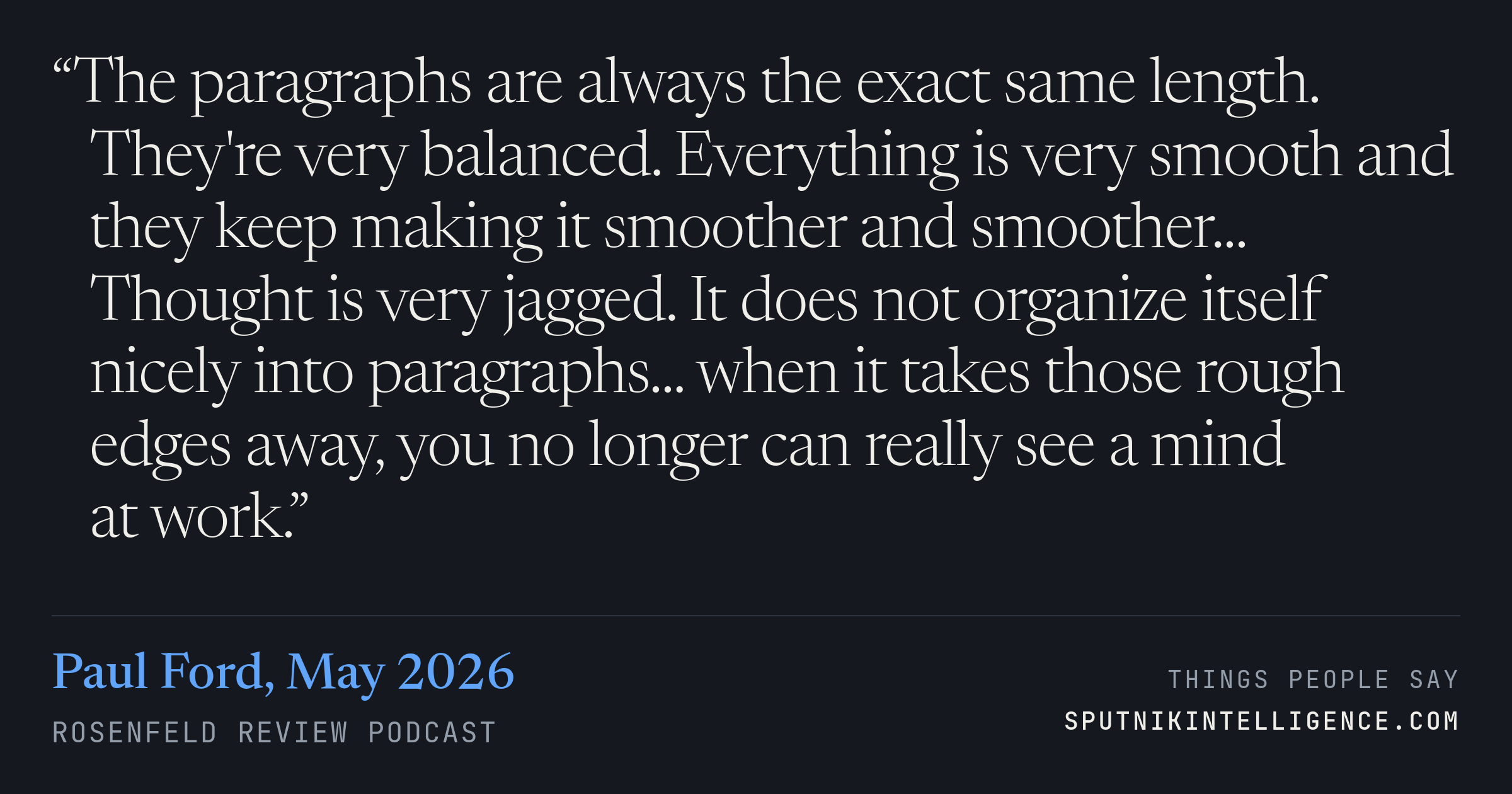
Lou Rosenfeld asks Paul what rules he had for using AI before Claude Code arrived. Paul says he dropped most of them, but he still does not let AI write for him. This is his description of what AI-edited prose looks like next to a human manuscript.
Transcript
This is a tricky one. First of all, I mean, AI as we mostly experience is made of language. So that's hard too, because it tends to dominate every conversation. You can't talk to anybody in technology now without talking about AI. Like it's just impossible. And so part of my last year has just been to kind of give up and just be like, all right, this is it. Like I fought for a little bit. I was like, I'm not going to let it write for me. And I don't. But like, I just had like a set of rules. And then Claude Code showed up. And I'm like, oh, boy, this is a little bit game over. You're not going to put, it's not that I lean into it and I go like, oh my God, here it is. We all have to get on board. Just, I just have a good sense. I think you do too. There's certain things that just won't go back in the box. And when Claude Code showed up, I was like, that won't be going back in the box. There's just no way that you can make coding radically easier in a world where coding is worth trillions of dollars and touches every aspect of society and people are going to be able to reject that. Like it's just going to go everywhere. And I think we're seeing that, right? You just, whether you like it or not or want it or not or whatever, this is an inescapable technology. So
what were the rules that you had until Claude Code?
Well, I think, so first of all, I was very against it doing any kind of research for me. I still don't let it write for me in any way. I just think that's important. I'm a writer. People increasingly, as I write for places, they ask for AI disclosure statements and things like that. And so it's, so I think it's happening more and more. And I think more and more professionals are getting used to writing with AI. Like, you know, people in the trades and people in industry are really taking it for granted that it's going to edit their work and help them summarize and so on. But you know what? I'll tell you what I noticed is just the paragraphs are always the exact same length. They're very balanced. Everything is very smooth and they keep making it smoother and smoother. And if you, if I threw you a manuscript right now that I'd written, you've looked at probably two trillion manuscripts in your life. So have I. And they're jagged. You just see thought. Thought is very jagged. It does not organize itself nicely into paragraphs. You do that later sometimes, but ultimately things have rough edges. And so when it takes those rough edges away, you no longer can really see a mind at work. And so I just feel like I have an implicit contract with anyone who might read me or listen to me that it would be my jagged, slightly broken, imperfect brain that doesn't have access to everything. And it sort of goes to like, what is language for, right? Like what do we communicate and read for? I mean, there's a lot of different theories. I have a very simple one, which is people read in order to understand, like to get access to tools and understand how to live their lives. And I think that even applies to like op-eds in the paper. Like you're reading. Fiction, maybe. No, I think that's right. You're looking for frameworks that you can apply in order to make sense of your own experiences. And so because of what AI is as a technology, it cannot do that. But what it can do is put out code. And so I would say like a rule that I had that I don't follow anymore. So the company follows it, but I don't. So the company that we have is sort of an AI consultancy, partially because we were building a bunch of... Aboard. Yeah. But we were, sorry, yes. Aboard.com. Go to it. It is a, it is, I forget to, I forget to market. I am the co-founder of it. We're a group of people who we've built a lot of products and we've built a lot of custom tools and a lot of acceleration things. But the reality is in a world where product is very easy to spin up, the relationship is getting more and more important. So we're leaning back into it as old agency people. Like, let's just help people because I. Can give you five CRMs before I leave this room. I don't need you. You don't need to hire me to implement the very special one. You need me to listen and understand what you need and then turn around software very quickly. So at work, we still review all the outputs very carefully. But if I'm hacking together a prototype, I don't look at the code inside. And I think like maybe a year ago, I would have said, of course, I will. Of course, I'll read every line. But the speed at which it produces pretty large platforms, cloud code in particular. I just want to see what's on the screen, look at the database outputs. But ultimately, it's become a better, not a better coder than many of the people I work with, but it's definitely a better coder than me. It's not a better hacker. Like I'm still good at putting stuff together. I'm good at product. But like from a like, you know, lines of JavaScript point of view, I think it's probably better than I. So
better than you, but are you using it mostly for prototyping? Are you actually creating? No, I'm
creating large complicated systems that, and, and so, you know, there's, it's all the classic rules. Like you limit your, your exposure to, uh, uh, you know, where can data come in? Where can what do, you know, what are sort of the post endpoints? Where can people log in? Where is authentication necessary? I think one good threshold would be I would have no problem releasing something vibe-coded that is essentially read-only, right? Like it doesn't have personal information. It's reading from a database of facts or articles or statements. Go ahead and throw that up because the worst thing that will happen is they'll just hack you and use your computer, right? They're not going to be able to get anybody's information. The minute personal information comes in, then it gets really serious. At the same time, like, you know, I'm never going to implement, just because of the way the web worked for the last 10 years, I'm never going to implement auth again. I'm going to use an external law server. I'm never going to implement payments again. I'm going to use Stripe. So the surface is actually, you can really narrow your risk when you're working with this stuff. And then you kind of can let it go and see what it comes up with.
So what about agents in that whole risk scenario?
More from Rosenfeld Review Podcast