 Ben Thompson
Writes Stratechery, a subscription newsletter analyzing the business strategy behind tech and media companies, and has built a reputation for framing how platfo...
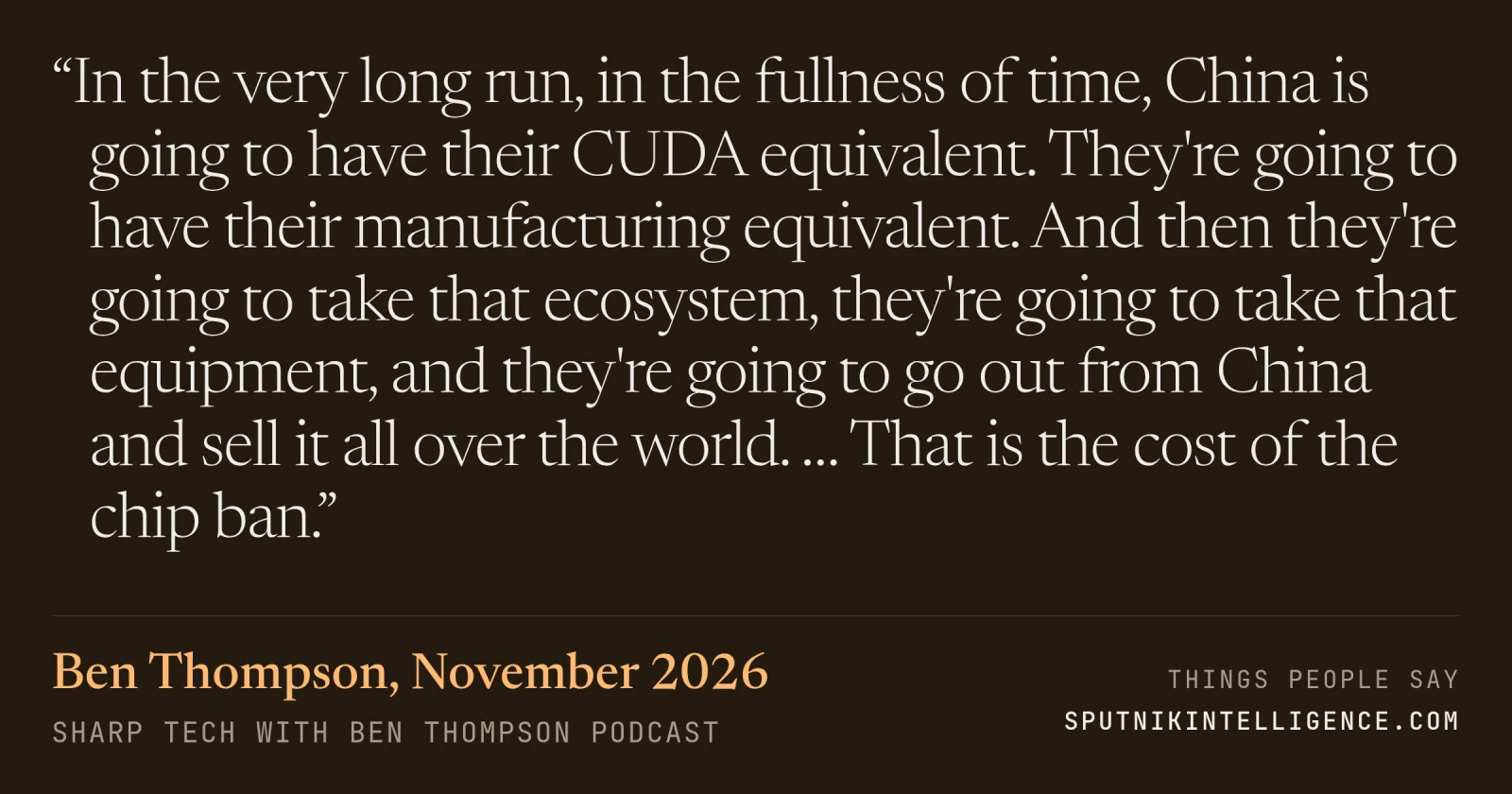
“In the very long run, in the fullness of time, China is going to have their CUDA equivalent. They're going to have their manufacturing equivalent. And then they're going to take that ecosystem, they're going to take that equipment, and they're going to go out from China and sell it all over the world. … That is the cost of the chip ban.”
Sharp Tech with Ben Thompson · Tech Strategy & Big Tech · November 2026
Context
Thompson argues against the hardline chip ban, which is now expected to tighten after Jensen Huang's exit from Nvidia. His point is that the US used to sell older technology abroad so other countries never had to build their own, and a ban pushes China to build a full alternative stack.
Transcript
…an ecosystem for Windows Phone. It didn't work. If Microsoft can't do it, is the Chinese government be able to do it? No, why? Because Android was right there because iPhones were right there. If NVIDIA chips are right there, the Chinese government is not going to bring an alternative into being.
…What an own goal from the United States. And every six months, there are reports about Chinese breakthroughs on the manufacturing side, EUV, what have you, Huawei chips. But each cycle here, every six months, every 12 months, they are still so hooked on NVIDIA chips, particularly for training.
In the very long run, in the fullness of time, China is going to have their CUDA equivalent. They're going to have their manufacturing equivalent. And then they're going to take that ecosystem. They're going to take that equipment and they're going to go out from China and sell it all over the world. We have written the deaf. All of our semiconductors, we're getting to that for all our semiconductor equipment for CUDA, for everything. That is the cost of the chip ban. That is why the U.S. policy for ages has been to sell N minus two, N minus three versions to other countries. So they never have the imperative. If you can buy the older generation, it's still way better than what you have. Everyone who needs it isn't going to take the time to help this little startup making a chip. Good luck. I'm going to go buy the two-generational NVIDIA chip, which is a gazillion times better because I need it now for my business. We did this with CPUs. Like you go back. We've done this for all technology. We've done
this with jet engines, with cars. It prevents
competition in the long run, and it makes a ton of money. So you can fuel RD and innovation going forward. And so you maintain, you own the technology. You still have a meaningful advantage because you're on the cutting edge and everyone else isn't. All the people that you're disadvantaging by…
five years. Yeah. It
More from Sharp Tech with Ben Thompson