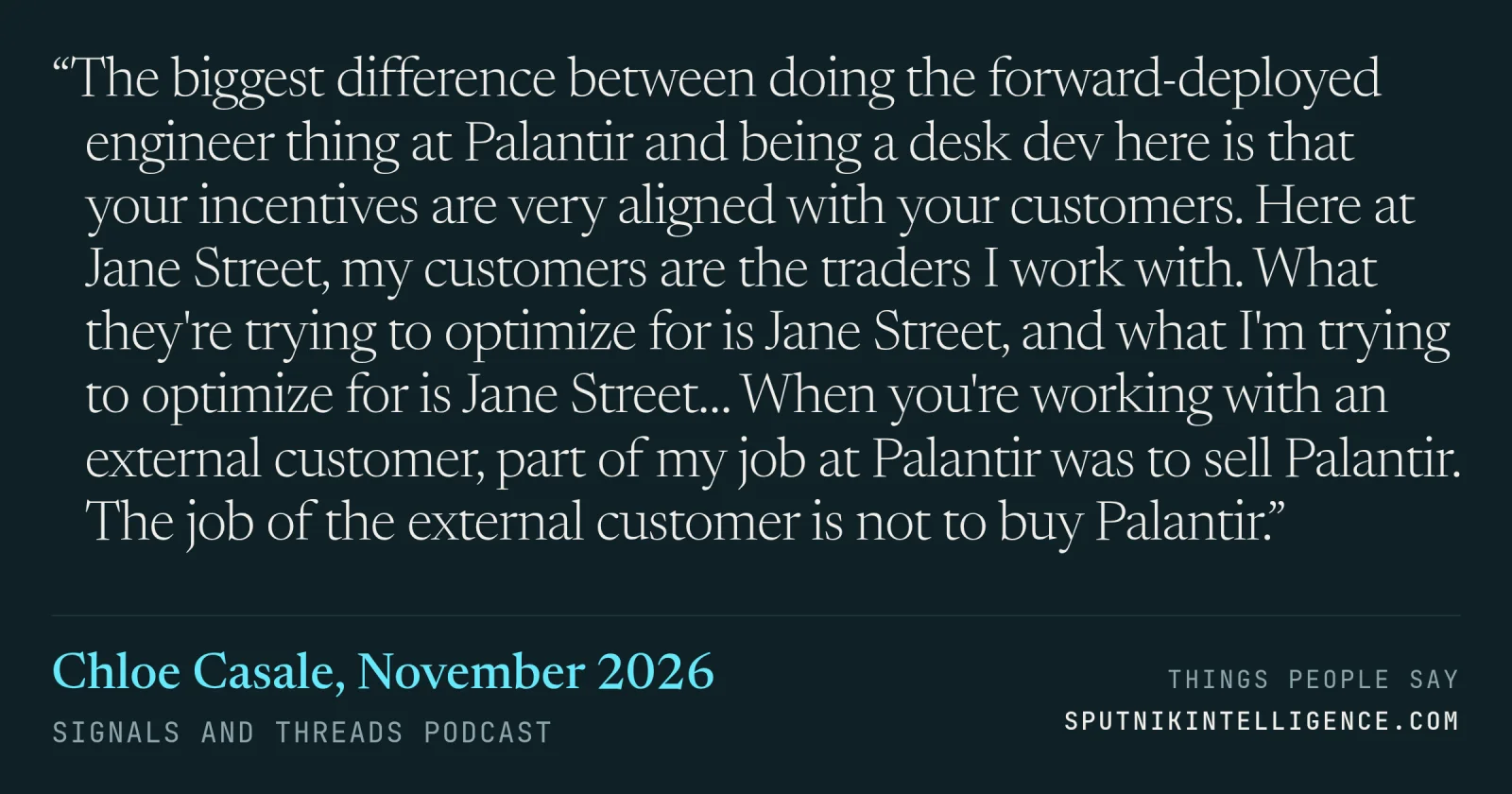
“The biggest difference between doing the forward-deployed engineer thing at Palantir and being a desk dev here is that your incentives are very aligned with your customers. Here at Jane Street, my customers are the traders I work with. What they're trying to optimize for is Jane Street, and what I'm trying to optimize for is Jane Street… When you're working with an external customer, part of my job at Palantir was to sell Palantir. The job of the external customer is not to buy Palantir.”
Signals and Threads · Hands-On Engineering Podcasts · November 2026
Context
Minsky asked how an embedded engineer role at Palantir compares with the same kind of role on a Jane Street trading desk. Casale says internal customers make for franker conversations about what is easy, hard and worth doing.
Transcript
Yeah.
I'm curious, like what, you know, you've now seen similar is shaped roles here and somewhere else. And like, like, how do they differ? I feel like what, you know, what is it, what is it like in different places doing this kind of deeply embedded role?
Yeah. I think the biggest difference between doing the FDE thing at Palantir and I think being a desk dev here is like your incentives are just very aligned with your customers in a way. Like here at Jane Street, my customers are the traders that it is that I work with. The thing that they're trying to optimize for is, you know, Jane Street. And the thing that I'm trying to optimize for is Jane Street. And so there's this thing where our incentives are very aligned. Having all sorts of conversations with traders, I find so much easier than I did with customers because you can have these very open and honest and frank conversations with like a trader at Jane Street about things that are like easy, things that are hard, things that I think are going to take a lot of time versus a little bit of time. And like you can prioritize things together in a way that when you're working with like an external customer, part of, you know, my job at Palantir is to sell Palantir. Right. The job of the external customer is not to buy Palantir.
It's to like do their job the best they can do.
And so I would have to think a lot harder about, okay, well, what kinds of things am I bringing to a customer? Like what kinds of things do I want to present as easy? Are those things actually easy? Wasn't necessarily always true. And kind of having those incentives a little bit misaligned, I think…
Are there any things about how Palantir structured the forward deployed story that seem like different? Like there's obviously like you're pointing of ways in which it's just structurally different. The incentive structures are different. But like putting that part aside for a second, are there…
More from Signals and Threads