 Justin Wolfers
Professor of economics and public policy at the University of Michigan, a non-resident senior fellow at the Brookings Institution, and author of a widely used i...
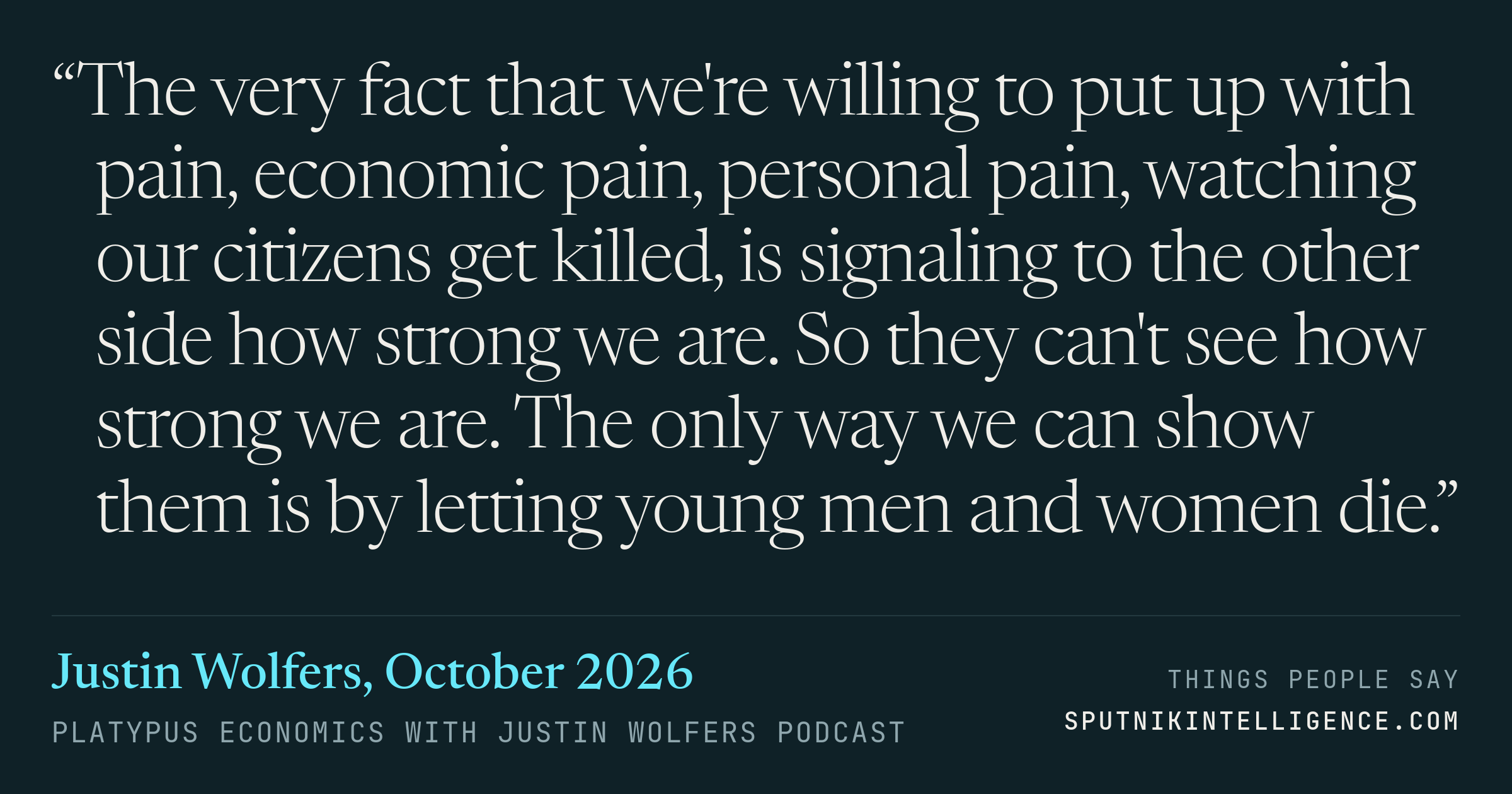
“The very fact that we're willing to put up with pain, economic pain, personal pain, watching our citizens get killed, is signaling to the other side how strong we are. So they can't see how strong we are. The only way we can show them is by letting young men and women die.”
Platypus Economics with Justin Wolfers · Money & Markets · October 2026
Wolfers was explaining the economics of conflict. Under efficient bargaining, both sides should skip the war and go straight to the outcome. When each side can't see the other's strength, though, suffering becomes the only way to signal it. He added that war is still "the dumbest thing in the world."
Transcript
…and yell at each other all night and get to an outcome, avoid the screaming and just get to the outcome. All of these forms of conflict are ultimately completely avoidable. We have come a long way from talking about G7 oil prices. And that was just your very first question. I'm sorry, Augusta.
…right. This is interesting. I mean, doesn't it? I guess the follow-up to that is, if that's the theory of conflict, doesn't that imply that you have to know who would win or what side would prevail? I mean, isn't that an important part of the process to getting to an outcome is the conflict part?
…better for us too. And it's all very simple. In a world in which I can't see what's going on with the other side, I might not realize how strong they are. And so I might turn up and say, I'm going to lieball them. And they're going to be like, no, that's terrible. And so there's a different theory of war, which is what's going on is basically what Iran's doing right now or what the US is doing. The very fact that we're willing to put up with pain, economic pain, personal pain, watching our citizens get killed, is signaling to the other side how strong we are. So they can't see how strong we are. The only way we can show them is by letting young men and women die. So that would be, that's the part of semester when we talk about information asymmetry. What if both sides don't know the same thing? And that's important. And in some sense, that's an economic theory that can help us understand how war might be not the dumbest thing in the world, right? It might be necessary. It's the only way to show your strength. But I still want to come back and remind you…
Right.
And the world needs oxygen. So, that doesn't do it. So, I do think that the underlying idea of releasing diesel can help. Then, there's what's the longer-term solution? If you don't like vulnerability to energy shocks, then some degree of energy independence. Now, the U.S. actually does have some…
No. I do. But I have, I have in my life. I've had a car.
More from Platypus Economics with Justin Wolfers