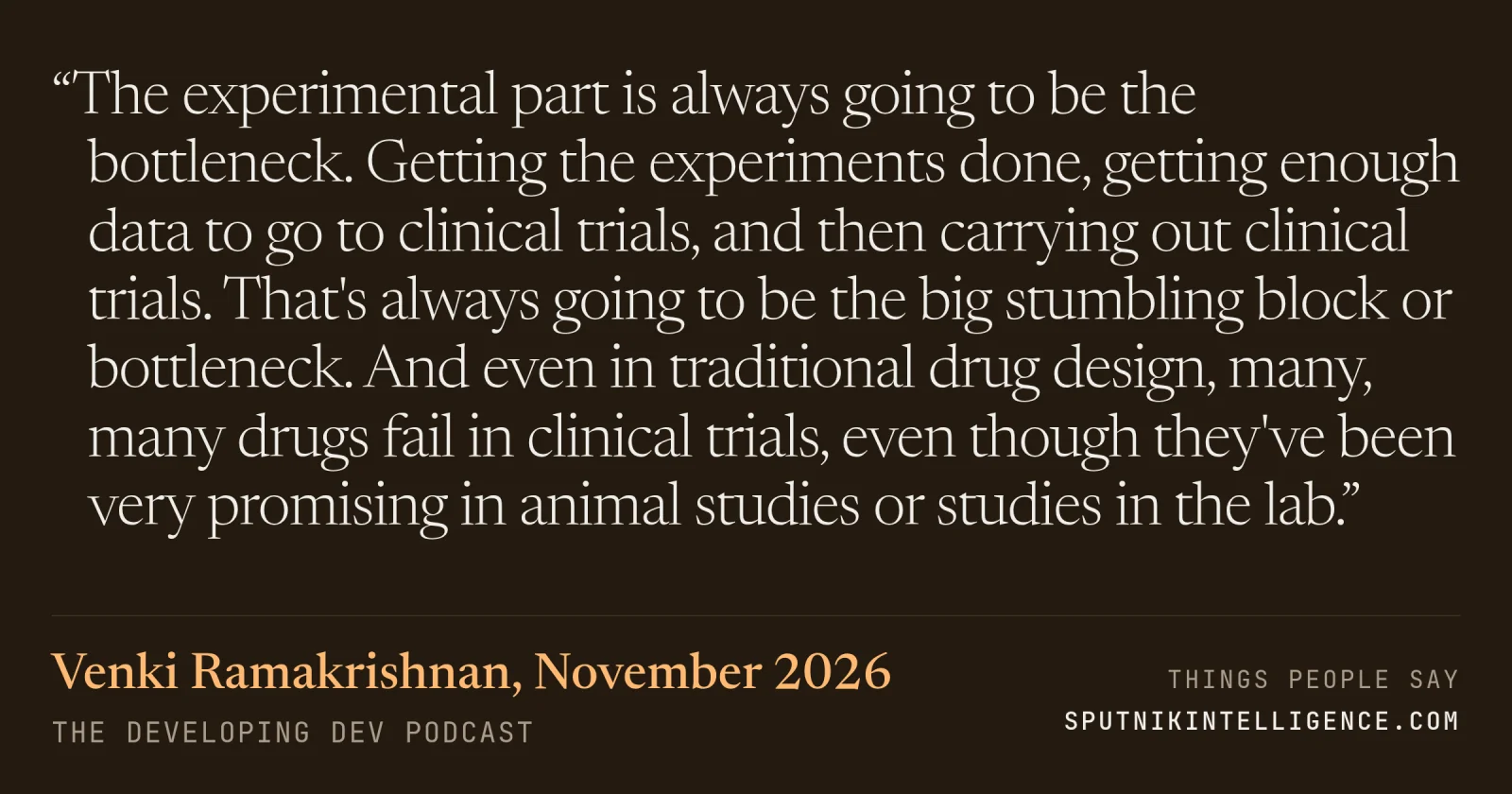
“The experimental part is always going to be the bottleneck. Getting the experiments done, getting enough data to go to clinical trials, and then carrying out clinical trials. That's always going to be the big stumbling block or bottleneck. And even in traditional drug design, many, many drugs fail in clinical trials, even though they've been very promising in animal studies or studies in the lab.”
The Developing Dev · Software Engineering & Infra · November 2026
Context
Asked about the steps of designing a drug, the Nobel-winning biologist grants that AI can propose candidate molecules faster, but argues that the slow physical steps of testing and trials remain the real limit.
Transcript
…but we need clinical trials. We need actual experimental proofs of principle, that actually brings a drug out onto the market and showing that AI has accelerated the process. Now, I think people in the field are optimistic, but I think you have to really wait for the results, I would say.
When you think of that process of actually finding a molecule that blocks that critical pocket in the protein, what is the work that the steps that you take to actually design a drug?
Well, okay, so AI can come up with a bunch of molecules that it thinks will fit based on recognizing patterns of interaction and so on that it's been trained on, right? And then of those molecules, some of them may have toxic side effects. The question is whether AI can predict toxicity. In some cases, it can, but I'm not sure it can do it in all cases. And then the molecules have to be... You have to be able to synthesize them in an easy way, and then you have to test them. So the experimental part is always going to be the bottleneck. Getting the experiments done, getting enough data to go to clinical trials, and then carrying out clinical trials. That's always going to be the big stumbling block or bottleneck. And even in traditional drug design, many, many drugs fail in clinical trials, even though they've been very promising in animal studies or studies in the lab. And so I think it'll become clearer in a few years how efficient and how much better it is. But I would say the people in the field are very optimistic.
It sounds like AI could maybe help in the search phases or the brute force of actually...
Yes, that's the whole premise, is that it can speed up and make that initial filter much more efficient. So that's the hope. And I think, you know, we have to wait a few years and see how it's panning out.
But even if that was a perfect, let's say it was an oracle. It could just give you something that you know binds. There's still all these downstream steps in the physical. Oh, yeah,
More from The Developing Dev