VR

Venki Ramakrishnan

Things Venki Says on Podcasts

Where to Find Them

Venki Ramakrishnan writes StarTalk Radio . They have also been a guest on 80,000 Hours Podcast , Ground Truths , Night Science , The Peterman Post , The Developing Dev , FranklinCovey On Leadership , Discovery and The Peterman Pod .

Recently: “Nobel Prize Winner: AI’s Impact On Drug Discovery And Biology | Venki Ramakrishnan” on The Developing Dev (November 2026); “Nobel Prize Winner: AI’s Impact On Drug Discovery And Biology | Venki Ramakrishnan” on The Peterman Post (November 2026); “Nobel Prize Winner: AI’s Impact On Drug Discovery And Biology | Venki Ramakrishnan” on The Peterman Pod (November 2026); “Do We Have to Die? with Venki Ramakrishnan” on StarTalk Radio (July 2025); “Do We Have to Die? with Venki Ramakrishnan” on StarTalk Radio (July 2025); “Venki Ramakrishnan: Aging, Longevity, and the Science That Could Change Everything” on FranklinCovey On Leadership (June 2025).

What They Said

“Physicists often will want to go into biology and want to predict everything from first principles. And you can't do that. Every system has its own scale of complexity. Just because you can solve the Schrodinger equation for a simple system doesn't mean you can then start applying it to understand memory, like the brain, even though they're all governed by the laws of quantum mechanics ultimately.” — Venki Ramakrishnan, The Peterman Post

Asked for the main differences between physics and biology, Ramakrishnan, who trained as a physicist himself, says biology is settled by experiment and needs control experiments. This is his criticism of physicists who move into biology and keep thinking like physicists.

The Peterman Post · 2026-11-09 Permalink → Listen →
The Peterman Post
Venki Ramakrishnan

…Are your colleagues going to be good? Are they going to be stimulating? Do they have the infrastructure that you need to get top-level science done? So those are the things you should look out for. And there are lots of places like that. And they'll vary depending on what area you're interested in.

Ryan Peterman

I thought it might be interesting since you deeply studied physics and biology to ask you what do you think the main differences are between the subjects, aside from the obvious subject matter.

Venki Ramakrishnan

Well, biology is very complex. So you have a lot of questions in biology are settled by experiment. It's very hard to predict theoretically what will happen. Although, as we discussed, you know, with AI and computational methods, people are trying to do more prediction computationally. But it is a highly complex system. And in the end, you need experiments to settle what's going on. And I would say, because it's so complex, if you want to study the effect of something, how do you know that whatever changes you see are because of whatever you did or it's not just some random thing? So in biology, you always have to do control experiments. You add your factor, see what happens, and then you see what happens if you don't add the factor. So you have to carefully design control experiments. And of course, in medicine, this is why you have randomized clinical trials which have proper controls. That's an even more complex system, like a human being, because we're all highly variable and so on. But in physics, you can construct an experiment that's extremely simple, where the answer, you can, from the result, you know exactly what's happening. So physicists often don't think about control…

Ryan Peterman

In a QA somewhere, someone asked you why you got interested in physics. And you replied that when you were young, physics and math were logical and pure in a sense, and biology was more memorization.

Venki Ramakrishnan

Oh, yeah, the way it was taught, especially in India where I grew up, was it was all rote memorization. And I never got a sense of biology as a kind of interesting detective puzzle. And I didn't get that until much later.

Ryan Peterman

Yeah, why is that? When I went to high school as well, it was a similar, there was maybe a tier list of math and physics are kind of the pure ones at the top, and then maybe chemistry and then biology is even more memorization. Is that in the nature of the subject or in the nature of how it's…

Speaker names come from our own diarization. The position is estimated from where the line sits in the episode.
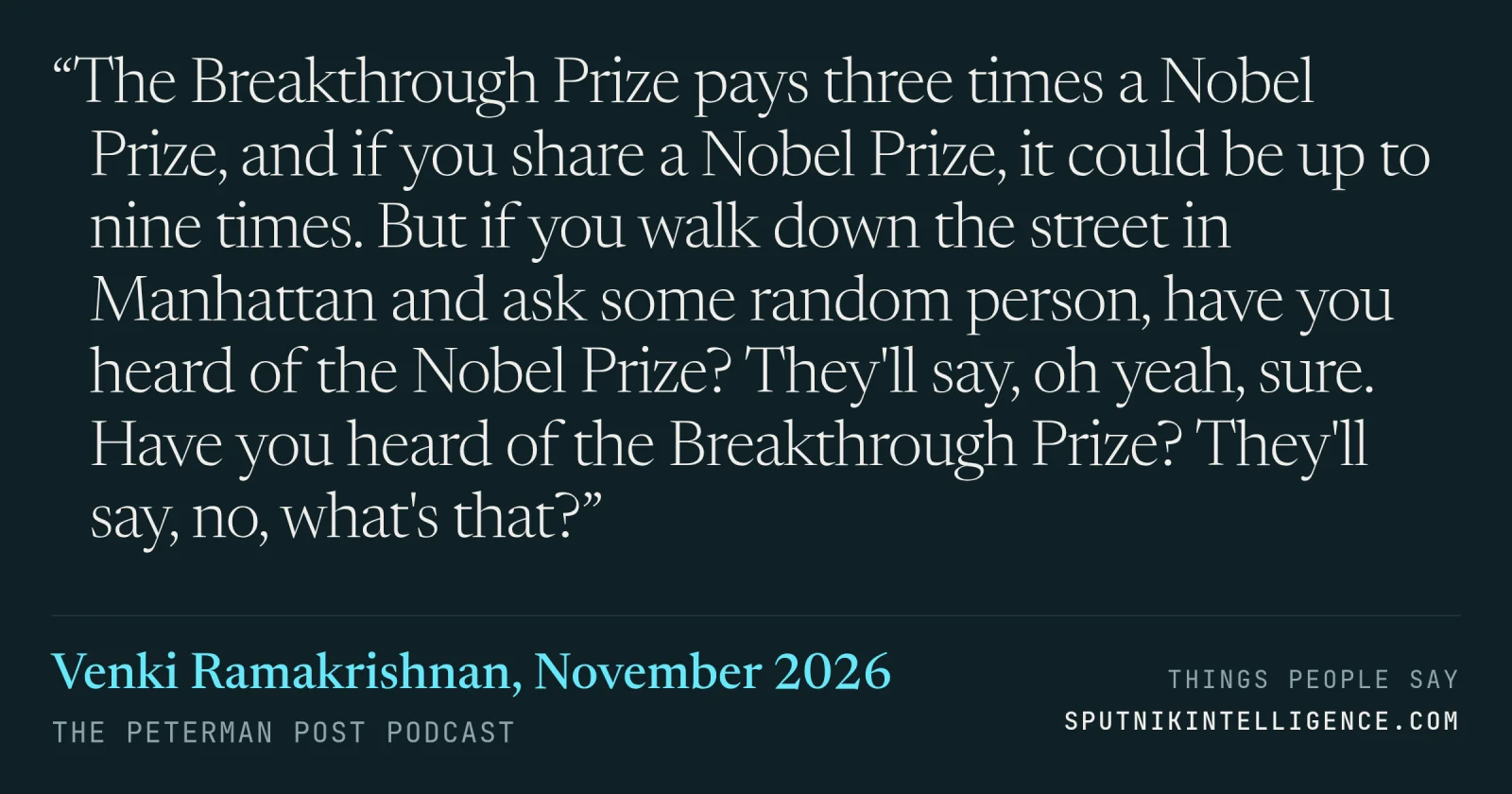
“The Breakthrough Prize pays three times a Nobel Prize, and if you share a Nobel Prize, it could be up to nine times. But if you walk down the street in Manhattan and ask some random person, have you heard of the Nobel Prize? They'll say, oh yeah, sure. Have you heard of the Breakthrough Prize? They'll say, no, what's that?” — Venki Ramakrishnan, The Peterman Post

Asked about 'pre-Nobelitis', his term for the distorted behaviour of researchers who think a Nobel might be coming, Ramakrishnan says society gives too much importance to one award. He then explains why the Nobel's brand outweighs even much richer prizes.

The Peterman Post · 2026-11-09 Permalink → Listen →
The Peterman Post
Venki Ramakrishnan

…you know how to carry out an experiment or a calculation. So I would say skill is different. I mean, a genius means that you're able to see things that are not obvious to the vast majority of people. To see a few steps beyond what's obvious to the field. I think that would be my sort of definition.

Ryan Peterman

…the politics of recognition, especially in the context of the Nobel Prize. And you mentioned these terms of pre-Nobelitis and post-Nobelitis. Basically, when you're getting close to the award, but not quite having it, or you've already won. And I was curious, did you get pre-Nobelitis at any point?

Venki Ramakrishnan

I did. I mean, everybody did. I think, you know, what happens is that you do something important. The first thing you don't think is, oh, you know, I could get a Nobel Prize. That's not what you think about. You think, wow, this is fantastic. But then you get invited to lots of talks, conferences, and so on. And everywhere you go, people say, hey, this could get a Nobel Prize. And then suddenly that kind of warps your own thinking. And then you start thinking, well, okay, it's limited to three people. And there are a whole bunch of people contributing to this field. And then I noticed that in conferences, people who are in this sort of pre-Nobelitis mode, they'll very subtly, you know, talk up their work. And, you know, they won't mention other people's work, especially competitors' work as much and so on. It's a kind of human psychology. And, you know, I just think that it's a little unfortunate. And it's partly the community's fault and society's fault that they give so much importance to this one award. I mean, there are lots of other prizes, you know, the Lasker Prize and Breakthrough Prize. But if you…

Ryan Peterman

Is there a top book that impacted you or maybe a book that you'd recommend to people?

Venki Ramakrishnan

In physics, I really enjoyed Feynman's biographies. Surely you're joking, Mr. Feynman. And then he's also had other short essay books. So I find him a very lively and entertaining writer. In biology, I was very influenced by a book that's highly controversial, which is Jim Watson's The Double…

Ryan Peterman

And then, yeah, last question for you is, if you could go back in time knowing everything you know now, what advice would you give yourself if you were just entering the industry?

Speaker names come from our own diarization. The position is estimated from where the line sits in the episode.
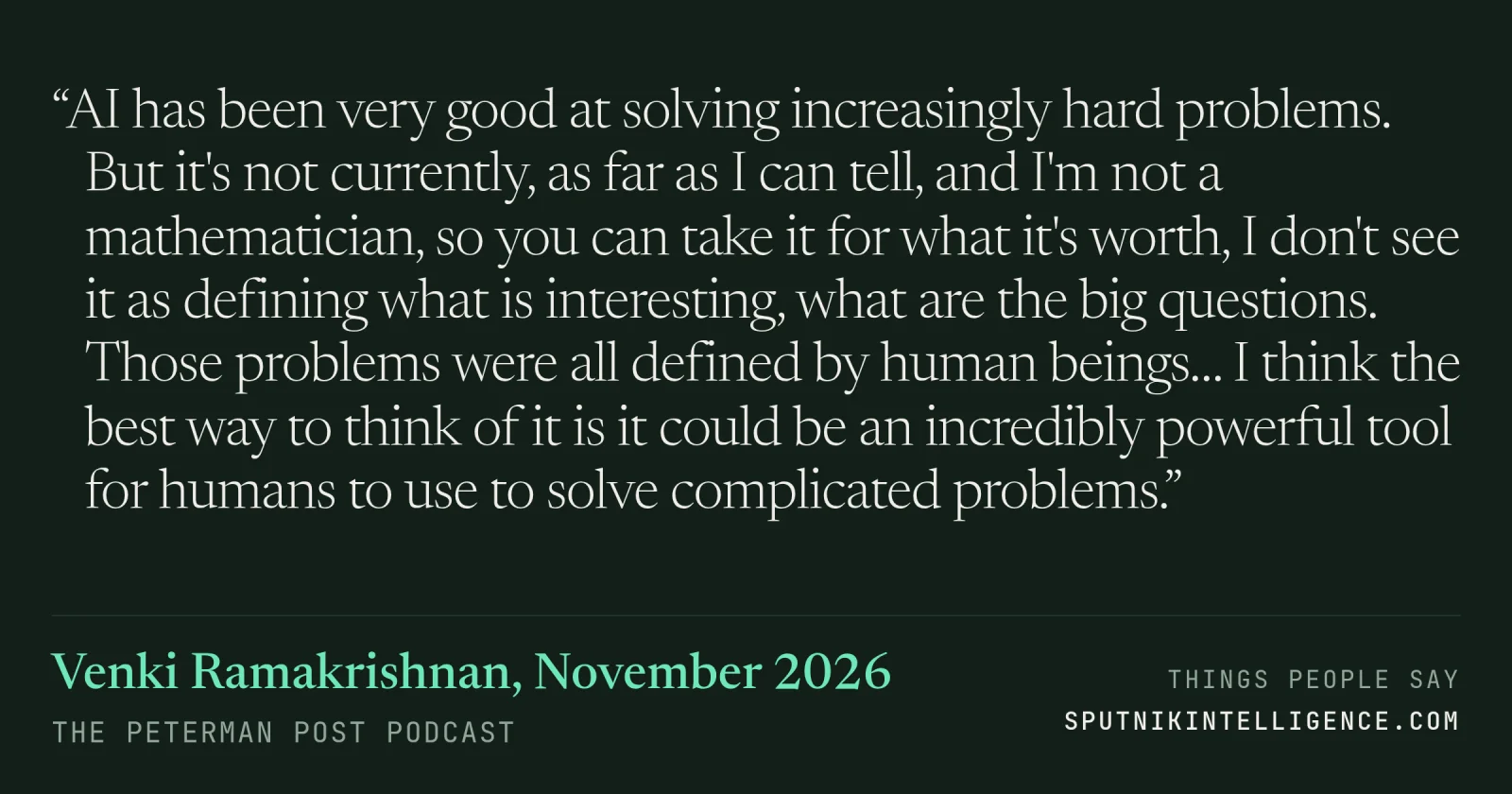
“AI has been very good at solving increasingly hard problems. But it's not currently, as far as I can tell, and I'm not a mathematician, so you can take it for what it's worth, I don't see it as defining what is interesting, what are the big questions. Those problems were all defined by human beings… I think the best way to think of it is it could be an incredibly powerful tool for humans to use to solve complicated problems.” — Venki Ramakrishnan, The Peterman Post

Asked whether models will transform molecular biology the way they are changing math and computer science, Ramakrishnan first says biology is more complex and not a closed system. He then makes this point about who chooses the questions, framing AI as a tool rather than a replacement for human scientific vision.

The Peterman Post · 2026-11-09 Permalink → Listen →
The Peterman Post
Venki Ramakrishnan

…the FDA will say, okay, you can perform it, you can register a clinical trial, but you still have to fund the trial. Somebody has to fund the trial. Somebody has to find the patients. You know, so it's a big process. And, you know, big pharmaceuticals companies are used to doing that sort of thing.

Ryan Peterman

In other fields like math and computer science that are more closed, we see that these models are drastically changing the frontier and the state of the art. Do you expect a similar down the road in molecular biology?

Venki Ramakrishnan

…problems were all defined by human beings. So will AI come to the stage where it says, okay, here are some really new things that we really need to understand. And by the way, here's the solution. That's a different kind of thing. And humans excel at having that forward vision. So if they're going to use AI as a tool, sure, that's great. But to expect AI to just do everything, it's not clear. I think the best way to think of it is it could be an incredibly powerful tool for humans to use to solve complicated problems.

Ryan Peterman

I know in those fields, because the ability to propose a paper, the cost has gone down because of AI. I don't know if you or your peers have noticed in biology or similar fields, is there an influx of papers, maybe AI-assisted in either just the pros or maybe the experimentation?

Venki Ramakrishnan

I don't know because if it happens, it would happen a lot in computational biology and areas like that. Certainly, it's made coding a lot easier. So, you know, that's accelerating science. And we talked about protein prediction. There's now a new program released by DeepMind, which tries to predict…

Ryan Peterman

You got a PhD in physics, and then at some point you did a hard pivot into biology. And I think a lot of people, whether because of sunk cost or some other reason, they might not have the confidence to pivot so hard. What gave you the confidence to switch?

Speaker names come from our own diarization. The position is estimated from where the line sits in the episode.
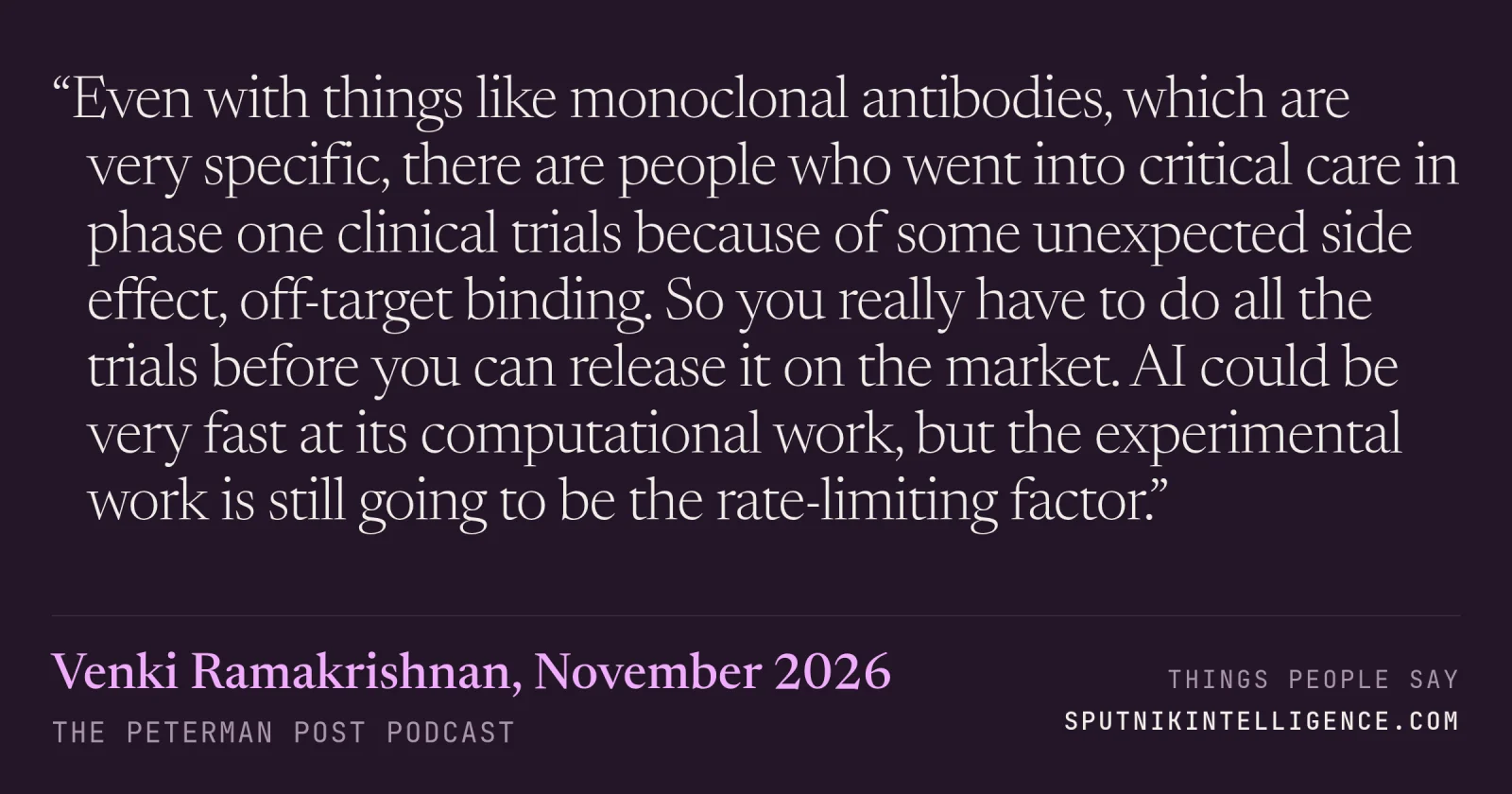
“Even with things like monoclonal antibodies, which are very specific, there are people who went into critical care in phase one clinical trials because of some unexpected side effect, off-target binding. So you really have to do all the trials before you can release it on the market. AI could be very fast at its computational work, but the experimental work is still going to be the rate-limiting factor.” — Venki Ramakrishnan, The Peterman Post

Ryan Peterman asked what would happen if AI were a perfect oracle that could hand you a molecule that binds the target. Ramakrishnan, a Nobel-winning structural biologist, argues the physical-world steps after the computation still set the pace. It's a direct counterweight to claims that AI will rapidly compress drug development.

The Peterman Post · 2026-11-09 Permalink → Listen →
The Peterman Post
Venki Ramakrishnan

Yes, that's the whole premise, is that it can speed up and make that initial filter much more efficient. So that's the hope. And I think, you know, we have to wait a few years and see how it's panning out.

Ryan Peterman

But even if that was a perfect, let's say it was an oracle. It could just give you something that you know binds. There's still all these downstream steps in the physical. Oh, yeah,

Venki Ramakrishnan

definitely. You know, because I can tell you, even with things like monoclonal antibodies, which are very specific, there are people who went into critical care in phase one clinical trials because of some unexpected side effect, you know, off-target binding. So you really have to do all the trials before you can release it on the market. So it's not, you know, AI could be very fast at its computational work, but the experimental work is still going to be the rate-limiting factor. Human biology is complicated. So, you know, it's not, I don't know if it's possible to predict all of those, you know, potential side effects and the kinetics of the drug, how quickly is the drug excreted. You know, these are all things you have to do experimentally at the moment. I mean, in some distant future, you know, maybe we'll reach a world where these things can be predicted, but I don't think we're there today.

Ryan Peterman

Is there enough slots for all the people who have drugs that want to do clinical testing? Well,

Venki Ramakrishnan

they have to fund it and find the patients and so on. So that's the limiting factor. It's not, I mean, the FDA, if you propose, you know, if you have sufficient animal data and, you know, some, you know, animal safety data and a clear rationale, the FDA will say, okay, you can perform it, you can…

Ryan Peterman

In other fields like math and computer science that are more closed, we see that these models are drastically changing the frontier and the state of the art. Do you expect a similar down the road in molecular biology?

Speaker names come from our own diarization. The position is estimated from where the line sits in the episode.
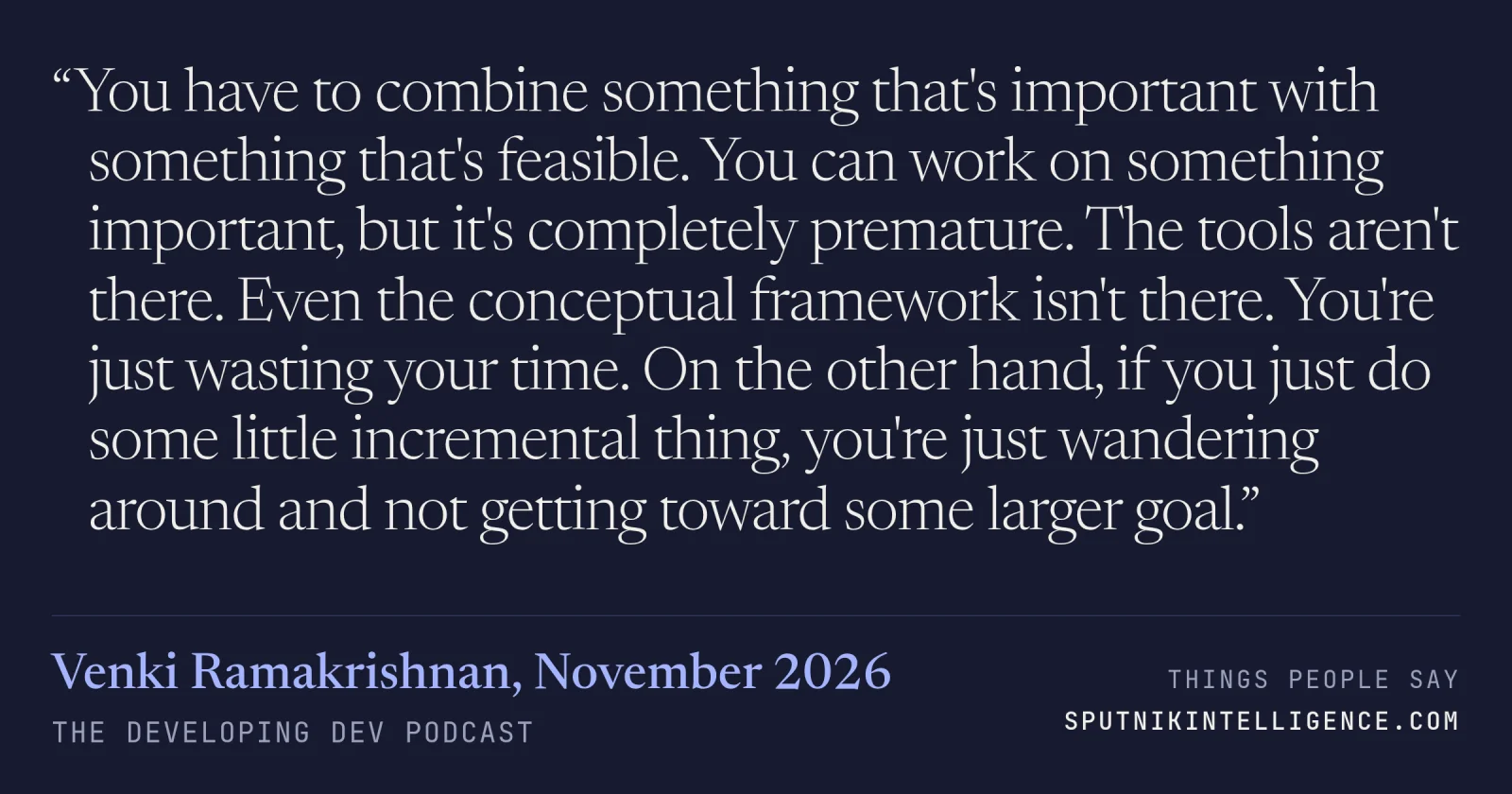
“You have to combine something that's important with something that's feasible. You can work on something important, but it's completely premature. The tools aren't there. Even the conceptual framework isn't there. You're just wasting your time. On the other hand, if you just do some little incremental thing, you're just wandering around and not getting toward some larger goal.” — Venki Ramakrishnan, The Developing Dev

Asked how to pick scientific problems worth solving, which he says is the part AI does not do, Ramakrishnan describes the trade-off between important and feasible.

The Developing Dev · 2026-11-09 Permalink → Listen →
The Developing Dev
Venki Ramakrishnan

…courses because I didn't really know anything. And so I knew what a ribosome was, so I wrote to them and they offered me a fellowship to go to Yale. And that was the start of my sort of ribosome career in 1978. And I sort of, you know, basically, you know, it lasted my whole life, actually.

Ryan Peterman

…you were saying that even if AI accelerates the problem solving, the picking what problems are interesting, picking what problems are important, that at least today is uniquely human and valuable. Do you have any thoughts on how to pick interesting scientific problems to solve and how do you pick?

Venki Ramakrishnan

Well, you know, there are big problems like the origin of life, or, you know, how does the body develop from a single cell into a complicated animal, you know, complicated body, or, you know, how, well, what happens to the brain? And how does the brain work? How does it even make decisions? What's the basis of your feeling of sentience? Things like that. So those are big, complicated questions, but you can't answer them overnight. You know, you have to say, okay, that's a big question. Where do I start? And you have to sort of carve out a path that gets you closer to what you want to do or what you want to answer. And I think that's where the judgment comes in. You have to combine something that's important with something that's feasible. You can work on something important, but it's completely premature. The tools aren't there. Even the conceptual framework isn't there. You're just wasting your time. On the other hand, if you just do some little incremental thing, just wandering around and not getting towards some larger goal. So you have to somehow combine the two. You have to have an overarching vision. And then you have to break it up into steps that are…

Ryan Peterman

I see. If I recall correctly, at the time when you started deeply getting involved in ribosomes, that space was not as booming?

Venki Ramakrishnan

Oh, it had gone through a boom in the 50s and 60s when people had discovered the ribosome. They found out what it did. They found out who the players were. They discovered mRNA. They discovered tRNAs and how all these things come together on the ribosome and make protein. And then the people who…

Ryan Peterman

So when you were picking that unfashionable field, did you have a sense that the technology was advancing enough so that you could solve it, or that was just pure happenstance?

Speaker names come from our own diarization. The position is estimated from where the line sits in the episode.
“I noticed that in conferences, people who are in this sort of pre-Nobelitis mode, they'll very subtly talk up their work and they won't mention other people's work, especially competitors' work as much and so on. It's a kind of human psychology. And I just think that it's a little unfortunate. And it's partly the community's fault and society's fault that they give so much importance to this one award.” — Venki Ramakrishnan, The Developing Dev

Asked whether he ever caught "pre-Nobelitis", his own term for the stretch before winning, Ramakrishnan says everyone does, and argues the prize distorts how scientists behave.

The Developing Dev · 2026-11-09 Permalink → Listen →
The Developing Dev
Venki Ramakrishnan

…you know how to carry out an experiment or a calculation. So I would say skill is different. I mean, a genius means that you're able to see things that are not obvious to the vast majority of people. To see a few steps beyond what's obvious to the field. I think that would be my sort of definition.

Ryan Peterman

…the politics of recognition, especially in the context of the Nobel Prize. And you mentioned these terms of pre-Nobelitis and post-Nobelitis. Basically, when you're getting close to the award, but not quite having it, or you've already won. And I was curious, did you get pre-Nobelitis at any point?

Venki Ramakrishnan

I did. I mean, everybody did. I think, you know, what happens is that you do something important. The first thing you don't think is, oh, you know, I could get a Nobel Prize. That's not what you think about. You think, wow, this is fantastic. But then you get invited to lots of talks, conferences, and so on. And everywhere you go, people say, hey, this could get a Nobel Prize. And then suddenly that kind of warps your own thinking. And then you start thinking, well, okay, it's limited to three people. And there are a whole bunch of people contributing to this field. And then I noticed that in conferences, people who are in this sort of pre-Nobelitis mode, they'll very subtly, you know, talk up their work. And, you know, they won't mention other people's work, especially competitors' work as much and so on. It's a kind of human psychology. And, you know, I just think that it's a little unfortunate. And it's partly the community's fault and society's fault that they give so much importance to this one award. I mean, there are lots of other prizes, you know, the Lasker Prize and Breakthrough Prize. But if you walk down the street, and, you know, by the way, the Breakthrough Prize pays…

Ryan Peterman

Is there a top book that impacted you or maybe a book that you'd recommend to people?

Venki Ramakrishnan

In physics, I really enjoyed Feynman's biographies. Surely you're joking, Mr. Feynman. And then he's also had other short essay books. So I find him a very lively and entertaining writer. In biology, I was very influenced by a book that's highly controversial, which is Jim Watson's The Double…

Ryan Peterman

And then, yeah, last question for you is, if you could go back in time knowing everything you know now, what advice would you give yourself if you were just entering the industry?

Speaker names come from our own diarization. The position is estimated from where the line sits in the episode.
“The experimental part is always going to be the bottleneck. Getting the experiments done, getting enough data to go to clinical trials, and then carrying out clinical trials. That's always going to be the big stumbling block or bottleneck. And even in traditional drug design, many, many drugs fail in clinical trials, even though they've been very promising in animal studies or studies in the lab.” — Venki Ramakrishnan, The Developing Dev

Asked about the steps of designing a drug, the Nobel-winning biologist grants that AI can propose candidate molecules faster, but argues that the slow physical steps of testing and trials remain the real limit.

The Developing Dev · 2026-11-09 Permalink → Listen →
The Developing Dev
Venki Ramakrishnan

…but we need clinical trials. We need actual experimental proofs of principle, that actually brings a drug out onto the market and showing that AI has accelerated the process. Now, I think people in the field are optimistic, but I think you have to really wait for the results, I would say.

Ryan Peterman

When you think of that process of actually finding a molecule that blocks that critical pocket in the protein, what is the work that the steps that you take to actually design a drug?

Venki Ramakrishnan

Well, okay, so AI can come up with a bunch of molecules that it thinks will fit based on recognizing patterns of interaction and so on that it's been trained on, right? And then of those molecules, some of them may have toxic side effects. The question is whether AI can predict toxicity. In some cases, it can, but I'm not sure it can do it in all cases. And then the molecules have to be... You have to be able to synthesize them in an easy way, and then you have to test them. So the experimental part is always going to be the bottleneck. Getting the experiments done, getting enough data to go to clinical trials, and then carrying out clinical trials. That's always going to be the big stumbling block or bottleneck. And even in traditional drug design, many, many drugs fail in clinical trials, even though they've been very promising in animal studies or studies in the lab. And so I think it'll become clearer in a few years how efficient and how much better it is. But I would say the people in the field are very optimistic.

Ryan Peterman

It sounds like AI could maybe help in the search phases or the brute force of actually...

Venki Ramakrishnan

Yes, that's the whole premise, is that it can speed up and make that initial filter much more efficient. So that's the hope. And I think, you know, we have to wait a few years and see how it's panning out.

Ryan Peterman

But even if that was a perfect, let's say it was an oracle. It could just give you something that you know binds. There's still all these downstream steps in the physical. Oh, yeah,

Speaker names come from our own diarization. The position is estimated from where the line sits in the episode.

Collections They Appear In