 Scott Wu
On Invest Like the Best (Patrick O'Shaughnessy)
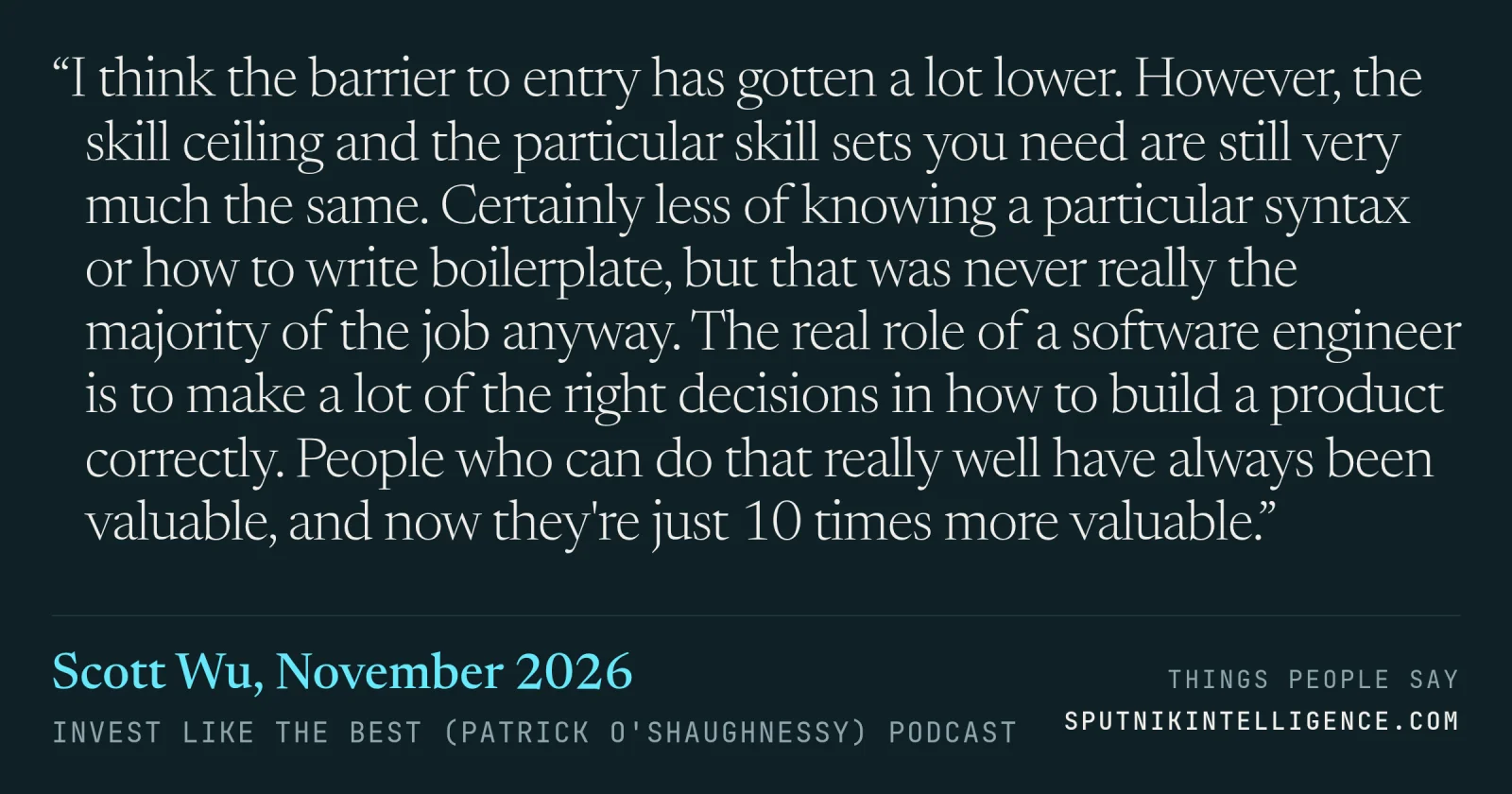
“I think the barrier to entry has gotten a lot lower. However, the skill ceiling and the particular skill sets you need are still very much the same. Certainly less of knowing a particular syntax or how to write boilerplate, but that was never really the majority of the job anyway. The real role of a software engineer is to make a lot of the right decisions in how to build a product correctly. People who can do that really well have always been valuable, and now they're just 10 times more valuable.”
Invest Like the Best (Patrick O'Shaughnessy) · Money & Markets · November 2026
Context
Patrick asked, half-provocatively, why Cognition has doubled engineering headcount if its own tools keep getting better. Wu argues the job was always about decisions rather than typing code.
Transcript
Like we're not. You should build a lot more.
I am. I am. Yeah, the percentage of stuff that I've built that includes an engineer has gone down and down and down. So I'm curious about the trajectory here. Yeah. Like why have you even doubled your engineering count? So
what I would say is I think the barrier to entry has for sure gotten a lot lower. However, I think the skill ceiling and a lot of the particular skill sets that you need are still very much the same as they always have been. Maybe a little bit less, of course. I mean, certainly less of the, okay, do you know this particular syntax or do you know how to write this particular boilerplate code? But I would argue that was never really the majority of the job anyway. Here's one way to put it. I think there's like a caricature view of what a software engineer does, which is that somebody writes out all of the specs entirely and that's a product manager that describes exactly every little detail of what the product should do. And then the software engineer's job is just to go and code monkey and take that exact spec and just translate the spec from English into Java or something like that. And they're just writing code that does exactly what they're told it's supposed to do, right? And maybe some of this exists. I think it's already very much the case that the majority of software engineers in the world don't function this way and haven't really. The real role of a software is a Software engineer in a lot of ways is to actually make a lot of the right decisions and details in terms of…
You talk about the shift of, I don't know what to call them, like categories of tokens where you kind of mentioned it earlier with the progression from chatbot to swarms of agents. But I'm thinking more in terms of like, I'm a person, I instruct a thing, and the tokens happen to make my thing…
So as you can imagine, it's shifted pretty heavily towards automated, automated sessions and tokens. I mean, I think at this point, internally is something like 90% of our usage of Devin. It's automated. Yeah, yeah, it's automated in some form.
Do you think of scheduled and automated? Scheduled, there's,
More from Invest Like the Best (Patrick O'Shaughnessy)