 Scott Wu
On Invest Like the Best (Patrick O'Shaughnessy)
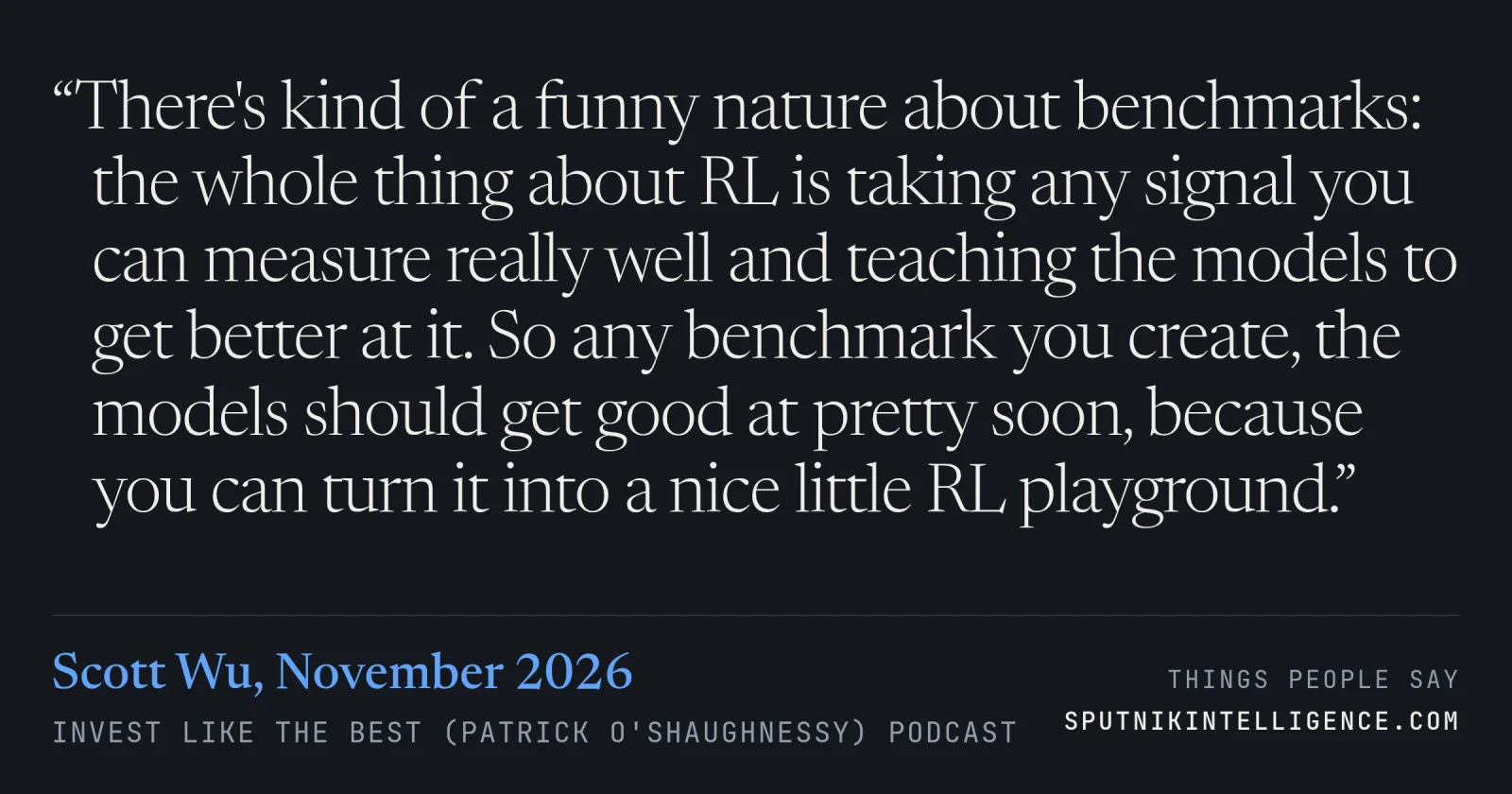
“There's kind of a funny nature about benchmarks: the whole thing about RL is taking any signal you can measure really well and teaching the models to get better at it. So any benchmark you create, the models should get good at pretty soon, because you can turn it into a nice little RL playground.”
Invest Like the Best (Patrick O'Shaughnessy) · Money & Markets · November 2026
Context
Patrick asked how Wu thinks about benchmarks that models saturate quickly. Wu says the open question is no longer raw logic but whether models can respect the messy constraints of real work, which is why Cognition built its own benchmark for things like staying in scope.
Transcript
…think some of the security risks specifically that people talk about with foreign models are a bit overblown, especially when you can post-train and tune the models to do whatever you want to do. It is very clear that you can train out and tune out whatever particular behaviors that you want. I'm
so interested in your thoughts on evals. And it seems like we've saturated quickly any benchmark we ever come up with. And it's hard to know what it even means for these things to get smarter from here. I'm curious how you think about that and what you're doing about it, if anything. You
know, we have our own software engineering benchmarks. Frontier code is our big one. And similarly, most benchmarks in coding, to give you a sense, they'll ask the agent, hey, I need you to go solve this task. Here's what you need to go do. And then at the end of that, they'll have some deterministic unit test that they run that says, okay, you fixed this bug because I ran the test that confirms it and now the bug's no longer there or whatever it is, right? And that's how all the traditional benchmarks work. We specifically made this benchmark to try to optimize not just for literal binary correctness, but for obviously all the kind of messy practical things that. Happen in the real world in terms of okay, well, you did do the fix, but you know, your change was way outside of the scope of what you were supposed to do or something, right? Or you built 10 other things alongside that, or what you did didn't conform to all of the actual guidelines of how we have set up this entire like dependency chart or things like that. We see there that there are, you know, very clearly still…
Is there anything that you think they're still not good at that you wish they were way better at, these models? That's like another way of asking this question of how they might get smarter or better.
It's really hard to describe, but you definitely still feel this experience that the EQ of the models is not quite where you would want it to be, you know, even when you're going and working on coding tasks together. It's kind of funny, obviously, to describe EQ in the context of working coding…
is it important to you to be this sort of like flag bearer for independent companies? You're kind of the last large company like this after Cursor was acquired. What about that is important? How do you think about the world where one of the massive companies comes and tries to acquire you in the…
More from Invest Like the Best (Patrick O'Shaughnessy)