 Paul Eastwick
 is a Professor of Psychology at UC Davis and the author of BONDED BY EVOLUTION: The New Science of Love and Connection.
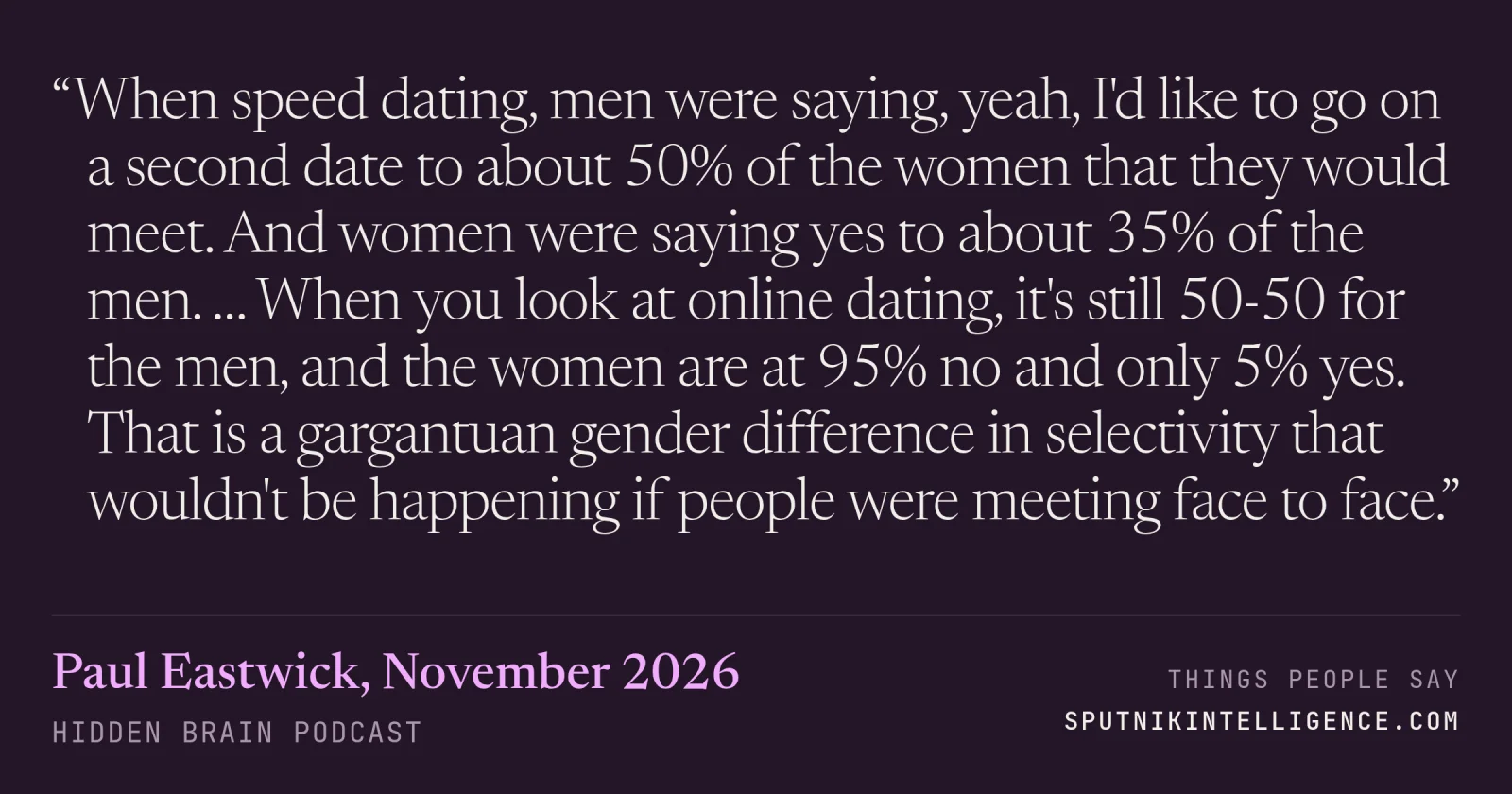
“When speed dating, men were saying, yeah, I'd like to go on a second date to about 50% of the women that they would meet. And women were saying yes to about 35% of the men. … When you look at online dating, it's still 50-50 for the men, and the women are at 95% no and only 5% yes. That is a gargantuan gender difference in selectivity that wouldn't be happening if people were meeting face to face.”
Hidden Brain · Ideas & Essays · November 2026
Context
Asked how dating apps amplify differences between heterosexual men and women, Eastwick compares in-person speed-dating numbers with app behavior, arguing the apps, not women's standards, create the impression that women are far pickier.
Transcript
…this for a very long time. So I think this idea is very, very tempting, especially in an online space where people are mainly evaluating looks, but it just doesn't describe real-life interactions between men and women, especially in contexts where they are getting to know each other over time.
You say that online dating apps unhelpfully amplify differences between heterosexual men and women. How so, Paul?
…to face. Do you find that women are pickier than men? You do. It's not a gigantic effect, but it's there. And to put specific numbers on it, when speed dating, men were saying, yeah, I'd like to go on a second date to about 50% of the women that they would meet. And women were saying yes to about 35% of the men that they would meet. So that's a difference, but it's not a gargantuan difference. When you look at online dating, it's still 50-50 for the men, and the women are at 95% no and only 5% yes. That is a gargantuan gender difference in selectivity that wouldn't be happening if people were meeting face to face. So I think like when men in particular feel frustrated and they feel like women's standards are too high, that is being driven by behavior on the apps. We wouldn't be feeling that way if we were out there socializing in person or, you know, meeting people in groups, meeting people organically. It wouldn't feel quite so demoralizing. And so this is one way that the gender differences online…
I'm wondering if the rise of online dating is connected with the rise of the manosphere, Paul. If men feel like they're being rejected 95% of the time, it becomes easier to tell a story that women are, you know, drawn only to the guy who has the most money or the guy who has. The corner office.
I think that is unfortunately true, that these things have unintentionally fed each other. And what men who are only using online ways of meeting partners, what they're feeling is that if I'm not in that upper, upper tier of men, I'm not going to get any attention whatsoever. And the insidious part…
We've been talking here mostly about heterosexual couples. What does the research have to say about same-sex relationships, Paul?
More from Hidden Brain