 Scott R. Anderson
Senior Editor at Lawfare and General Counsel of the Lawfare Institute.
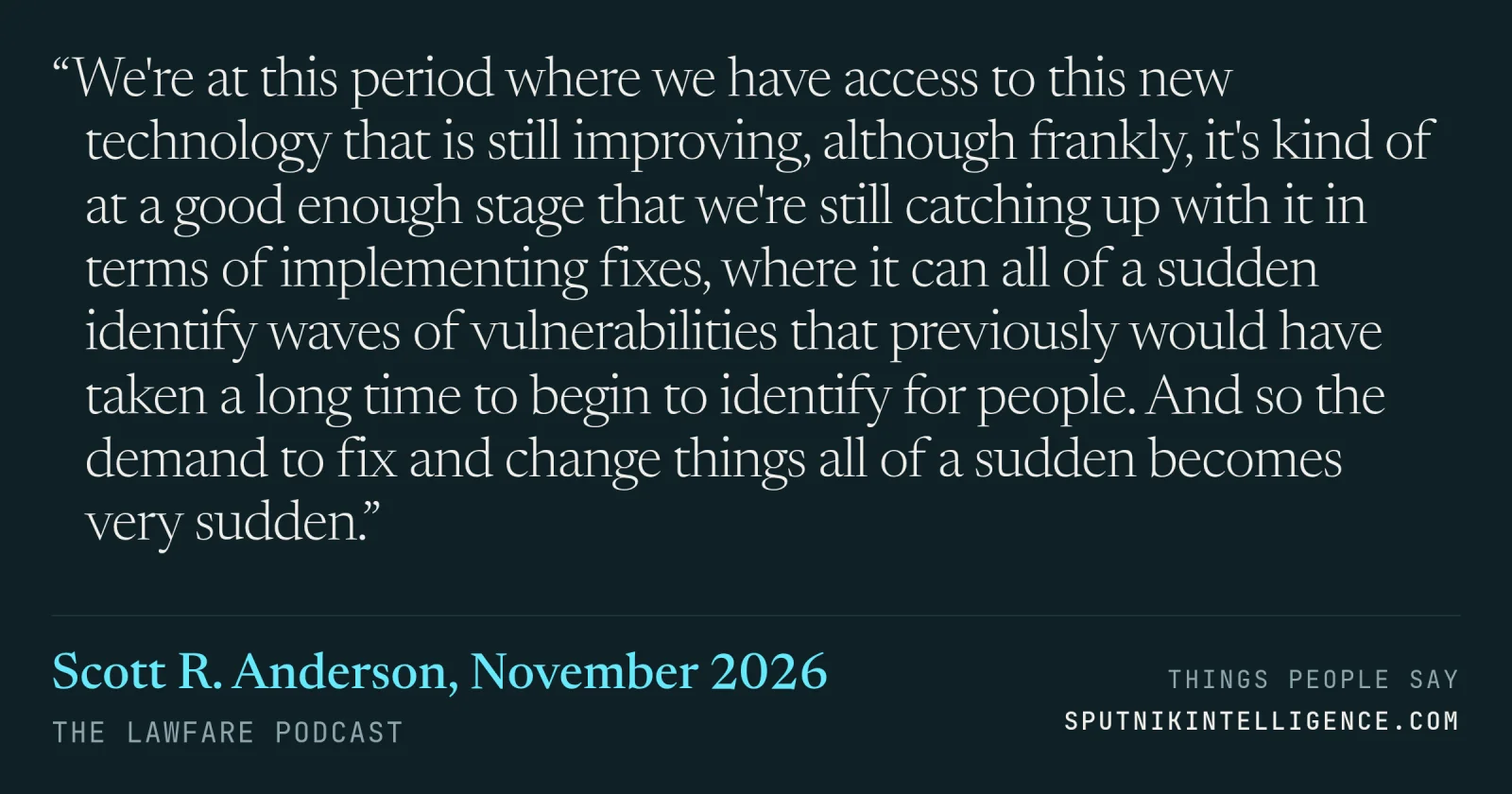
“We're at this period where we have access to this new technology that is still improving, although frankly, it's kind of at a good enough stage that we're still catching up with it in terms of implementing fixes, where it can all of a sudden identify waves of vulnerabilities that previously would have taken a long time to begin to identify for people. And so the demand to fix and change things all of a sudden becomes very sudden.”
The Lawfare Podcast · Policy · November 2026
Context
The panel was discussing the week's string of US tech outages. Anderson argues that aging infrastructure combined with AI-driven vulnerability discovery means more disruption is likely, even without an attacker behind it.
Transcript
…can point out weak spots we previously didn't know about. And if we're going to be responsible, we have to fix those weak spots and fixing them contemporaneously is going to create friction. So I am very much of the opinion that everybody needs to calm the fuck down about what we saw over the past
week, take a breath and not worry.
…they clearly were trying to put the kibosh on that perception. But it's also fair to say that there is like there is the systemic risk built in that has a concern. And in some ways, it has become more systemic, it seems to me, particularly in the cybersecurity realm, which inevitably intersects with lots of other elements of the system because of the advent of AI. Because all of a sudden, we're at this period where we have access to this new technology that is still improving, although frankly, it's kind of at a good enough stage that we're still catching up with it in terms of implementing fixes, where it can all of a sudden identify waves of vulnerabilities that previously would have taken a long time to begin to identify for people. And so the demand to fix and change things all of a sudden becomes very sudden. You have tools for doing it. And then on top of that, you have all these automated coding, automated solutions that to keep up with this year volume and pace of changes, you're going to turn to new AI-driven tools that anybody who's used AI to co-five code anything or code anything knows it's, you know, there's some trial and error inherent in that. So if you're moving too fast, you know, you…
And can I ask something related to that, which is also, it's not just that AI is helping us identify all these vulnerabilities faster, right? It's also that AI could help bad actors exploit the vulnerabilities, which is part of why it's so urgent or there's a sense of this urgency to patch them.…
Yeah, so look, let me refine my language. I think it is perfectly okay to worry. Worrying is what incentivizes you to fix things before they become acute problems. What I don't think we should be doing is panicking about malevolent actors yet. And the comments that you made, Scott and Molly, your…
So I want to get back to that upgrading question. Before we do, though, I want to get to another policy solution. We've seen another government approach for scenarios like this. And Anna, I want to ask you kind of how you feel about this, your reaction as kind of like a citizen, frankly, as a New…
More from The Lawfare Podcast