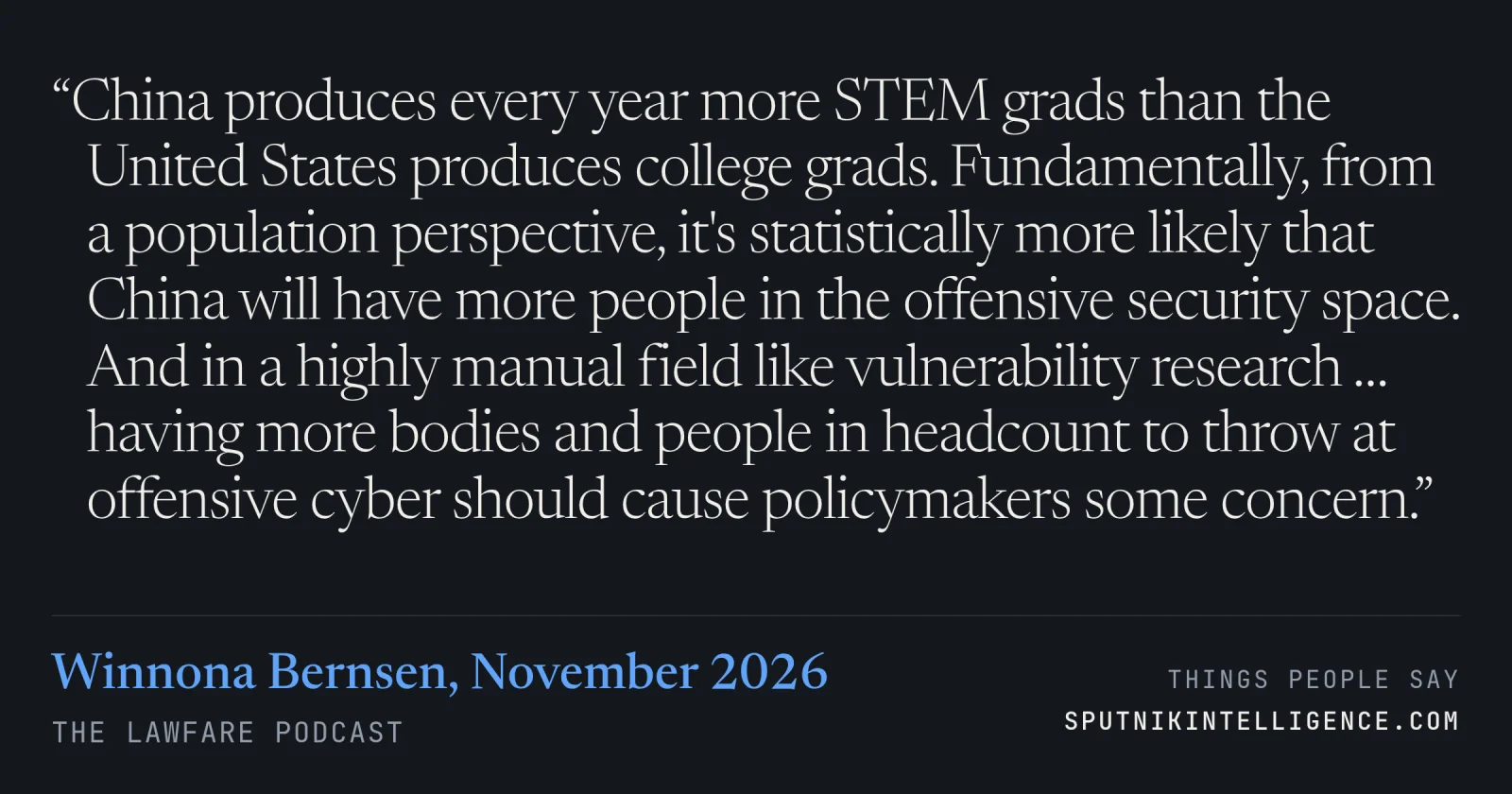
“China produces every year more STEM grads than the United States produces college grads. Fundamentally, from a population perspective, it's statistically more likely that China will have more people in the offensive security space. And in a highly manual field like vulnerability research … having more bodies and people in headcount to throw at offensive cyber should cause policymakers some concern.”
The Lawfare Podcast · Policy · November 2026
Context
Asked what China's pipeline of offensive hackers means for the US, Bernsen says the core issue is sheer scale in a field that still depends on manual work. She goes on to warn that AI could change that.
Transcript
…and then the offensive operations being broader and faster. Sometimes at the expense of deniability. The Chinese government doesn't necessarily care about getting caught. And so you see these two separate models that inherently showcase why we're valuing certain things in cyberspace.
In your mind, what are the biggest national security or cybersecurity or policy broadly issues that China's offensive cyber pipeline raises for the United States?
I think, and this is kind of a common theme throughout this discussion, that the issue is really scale. I really like this fact a lot. China produces every year more STEM grads than the United States produces college grads. Fundamentally, from a population perspective, it's statistically more likely that China will have more people in the offensive security space. And in a highly manual field like vulnerability research, where even though you're producing software, this software does not necessarily scale. Having more bodies and people in headcount to throw at offensive cyber should cause policymakers some concern. On top of that, I write in the report that China is already working to integrate artificial intelligence into its exploit, discovery, and offensive operations, which means that they might have at…
Let's end with some of your recommendations. You highlight that the U.S. procurement pipeline is more or less dominated, you mentioned this earlier, by large prime contractors and that it can, as in other areas, be difficult sometimes for a small business or an individual to compete. How might we…
Justin, are you asking me to fix the DOD contracting system? Pretty much in one
to two sentences would be good. Thank you.
More from The Lawfare Podcast