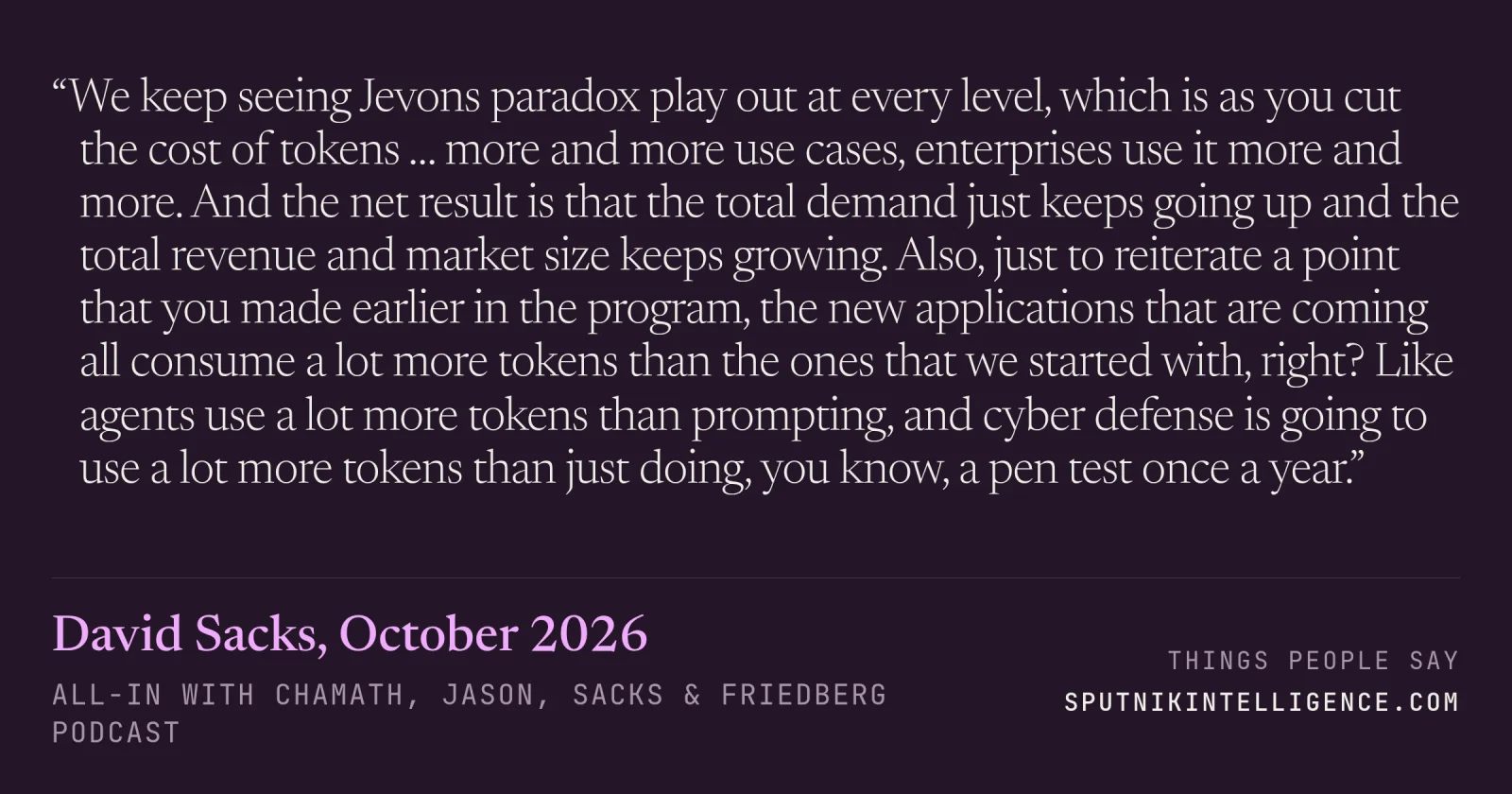
“We keep seeing Jevons paradox play out at every level, which is as you cut the cost of tokens … more and more use cases, enterprises use it more and more. And the net result is that the total demand just keeps going up and the total revenue and market size keeps growing. Also, just to reiterate a point that you made earlier in the program, the new applications that are coming all consume a lot more tokens than the ones that we started with, right? Like agents use a lot more tokens than prompting, and cyber defense is going to use a lot more tokens than just doing, you know, a pen test once a year.”
All-In with Chamath, Jason, Sacks & Friedberg · Money & Markets · October 2026
Context
The hosts were discussing how falling AI token prices are affecting revenue at the model companies. Sacks argues that cheaper tokens unlock more use cases, so demand and market size keep growing. He names agents and continuous cyber defense as new uses that burn far more tokens.
Transcript
…not just because they're giving up pricing power, right? It's not that they're losing margin. They're actually gaining margin. The reason they're able to do that is because all the algorithmic improvements they're making in order to make their models much more efficient. Yes. And here you go. Just
…you need it. If they can keep making their second and third run models this much cheaper, 10x cheaper each year, the Jevons paradox is going to get even more pronounced because enterprises will use it more. Token cost matters, right? We're sitting here with the token max and corporate. Now, look,
what we're seeing is that, I mean, we keep seeing Jevins' paradox play out at every level, which is as you cut the cost of tokens or more and more use cases, enterprises use it more and more. And the net result is that the total demand just keeps going up and the total revenue and market size keeps growing. Also, just to reiterate a point that you made earlier in the program, the new applications that are coming all consume a lot more tokens than the ones that we started with, right? Like agents use a lot more tokens than prompting, and cyber defense is going to use a lot more tokens than just doing, you know, a pen test once a year, right? You're going to need continuous monitoring of agents, attack surfaces, all that kind of thing. So all the new applications are going to be using exponentially more. 50 to 100 times the number
of tokens, yes. Exactly.
So the price will keep going down, but the market size keeps increasing. I think the biggest risk factor to Anthropic, I do think it is some version of the open source models, maybe not catching them, but sort of saturating intelligence at a low price point for some. Commonizing
it. Commonizing it for things like coding
More from All-In with Chamath, Jason, Sacks & Friedberg