 Helen Toner
AI, national security, China.
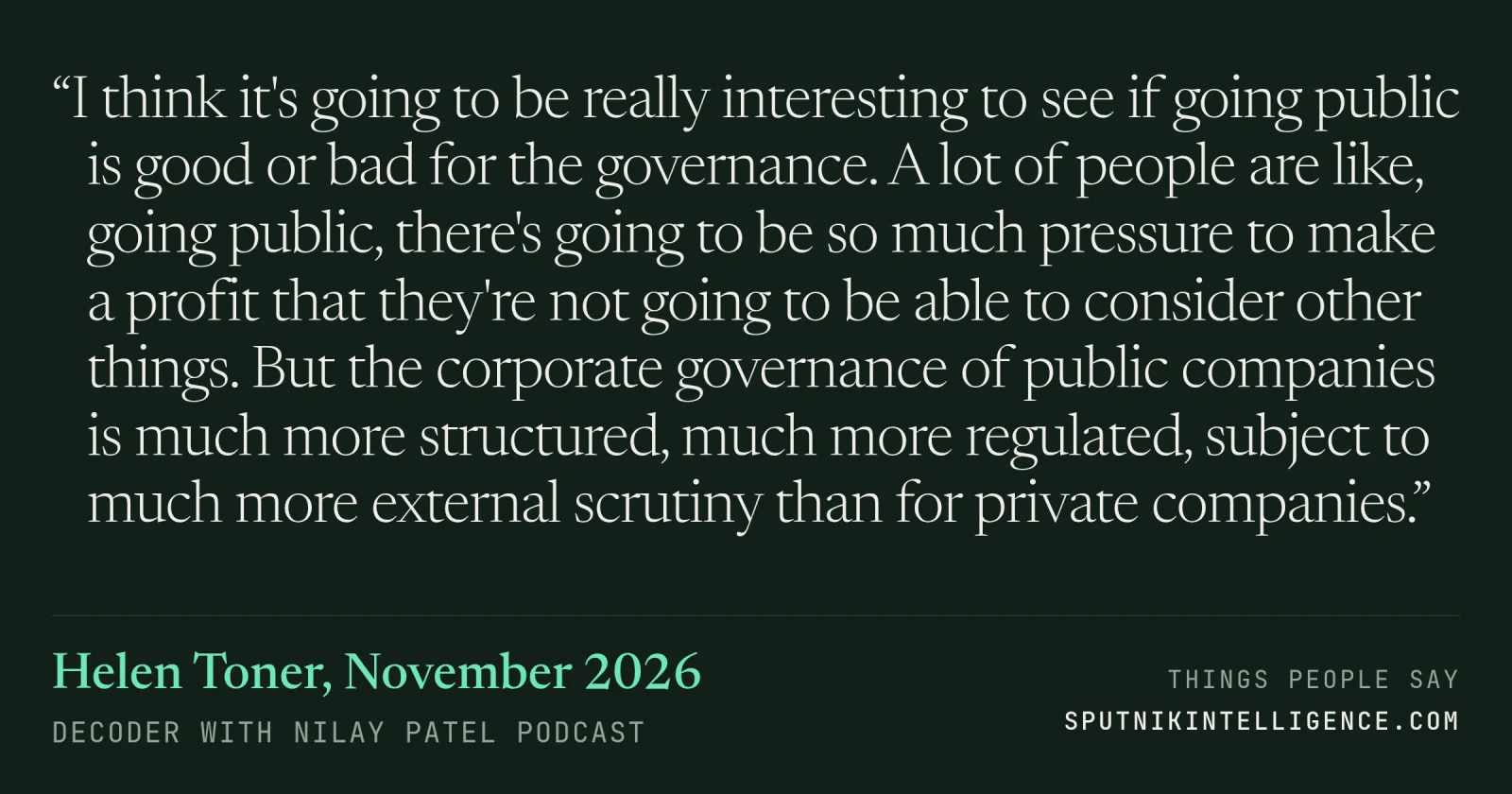
“I think it's going to be really interesting to see if going public is good or bad for the governance. A lot of people are like, going public, there's going to be so much pressure to make a profit that they're not going to be able to consider other things. But the corporate governance of public companies is much more structured, much more regulated, subject to much more external scrutiny than for private companies.”
Decoder with Nilay Patel · Tech Strategy & Big Tech · November 2026
Context
Asked how Anthropic's coming IPO might change the labs, Helen Toner argues public-company rules could make safety commitments more binding rather than less.
Transcript
yeah, yeah. No, and then it's suddenly my answers would all get like, you know, annoying and legal and blah, blah, blah, blah, blah. So
…really healthy, right? It might keep them from trying to kill everyone in the world because they have a bunch of investors looking for their next quarterly earnings, or it might push them further into an unhealthy kind of race. How do you see that playing out, given what you know of these people?
I think it's going to be really interesting to see if going public is good or bad for the governance. Because I think a lot of people are like, oh, no, going public, there's going to be so much pressure to make a profit that they're not going to be able to consider other things. But at the same time, I mean, like the corporate governance of public companies is much more structured, much more regulated, subject to much more external scrutiny than for private companies. And I think even things like, you know, getting to see Anthropic's S1 and like, okay, what are they doing and why are they doing it? And how do they think about the risks they're facing and how do they communicate about those with investors? Or like, you know, even things like the Trump administration put in place this kind of accord on, they call it super intelligence that several of the leading companies signed. And that was structured around, for example, having certain types of things being reported to an independent committee of the board. And that idea of an independent committee of the board is like kind of toothless if it's a private company that is deciding on its own. I thought about
you when I read that. I was like,
boy, some independent boards have gotten in a lot of trouble before. But if it's like a public company, then independent committee of the board has like a pretty strong legal meaning. So I don't know. It's something that I'm watching with great interest.
The other race dynamic here is China. You mentioned China before, right? There's inside of our country, a bunch of labs are going to go public. They're going to become big, the richest companies in the history of the world, and they're going to fight for every dollar that capitalism can generate.…
More from Decoder with Nilay Patel