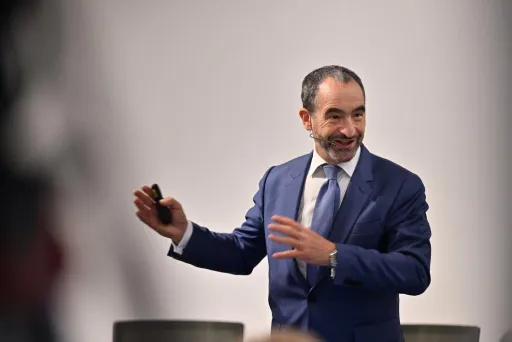
 Michael Liebreich
Host of Cleaning Up.
“The way we'll solve this problem is not going to be by banning boilers and fossil fuel cars or by focusing on the emissions that we want to get rid of, but actually by growing the solutions. And we've just got to grow them to the point where they're crowding out the fossils.”
Cleaning Up: Leadership in an Age of Climate Change · Climate & Energy · November 2026
Context
The host sets out his own model of how the energy transition happens and contrasts it with others such as net zero, cap and trade and degrowth. It started the discussion of whether climate needs one shared story or many.
Transcript
very good. And one of the, well, you were going to say, what are we missing? Do you want to go there or do you want me to continue and try and frame how we might think about this question of acceleration? Well,
I think we'll get there in the conversation. I have a few points.
…but you call it the process. But the TED talk process is that really what I've done with the talk is propose a model of acceleration, a model of change, which is this idea. And I've actually spoken about it on one of the episodes of Cleaning Up, so we can put a link to the, it's called the Pragmatic Climate Reset Part 1. I did this four-line model. And the four-line model essentially says that the way we'll solve this problem is not going to be by banning boilers and fossil fuel cars or by focusing on the emissions that we want to get rid of, but actually by growing the solutions. And we've just got to grow them to the point where they're crowding out the fossils. And that is a model of how we're going to get the transition done. But there are lots of other, there are lots of other models that have been proposed over time. I mean, I obviously think mine is the best. But it just strikes me that when you have, whether it's narratives or law or all of the work that you've done, sort of comparing and contrasting and trying to educate yourself and others, that…
I think some models can be useful and they're useful for some people and there's not one model for everybody, I would say. So this whole... The sort of walk and chew gum at the same time. You know, there is, this is a deeply worrying topic. You can't sort of study climate without realizing that…
But you've talked about the push and the pull, so the push away from what we don't want and the pull towards. And it's very... And I've got
empathy for both of those. So I get the people who say we've got to stop the fossil fuel stuff. And I also really understand, and I actually agree with you, Michael, when you say, you know, we'd be better, instead of banning things, or perhaps you could say alongside banning things, or trying to…
More from Cleaning Up: Leadership in an Age of Climate Change