 Haseeb Qureshi
Managing Partner at Dragonfly who talks crypto markets, tokenized stocks, market structure legislation such as the CLARITY Act, and onchain trading.
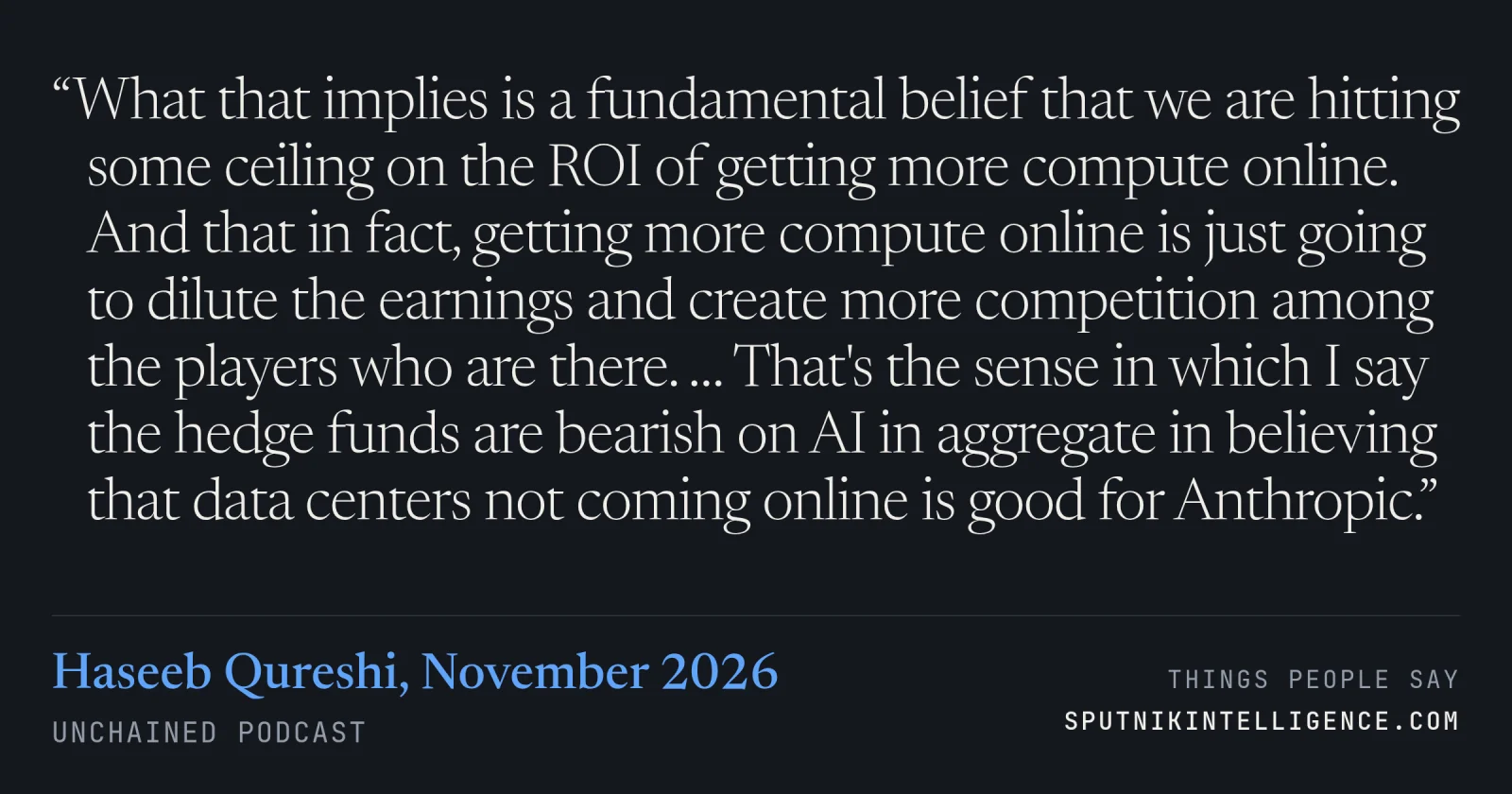
“What that implies is a fundamental belief that we are hitting some ceiling on the ROI of getting more compute online. And that in fact, getting more compute online is just going to dilute the earnings and create more competition among the players who are there. … That's the sense in which I say the hedge funds are bearish on AI in aggregate in believing that data centers not coming online is good for Anthropic.”
Unchained · Crypto & Web3 · November 2026
Context
Responding to the argument that slower buildout helps incumbents, Qureshi notes chip stocks fell while hyperscalers rose. He argues that cheering for less compute is really a bet that AI returns are hitting a ceiling.
Transcript
NVIDIA and like most of the iSOCs are down, right? Yeah. Demand for funding.
Demand for chips down.
Yes. But to me, what that implies is a fundamental belief that we are hitting some ceiling on the ROI of getting more compute online. And that in fact, getting more compute online is just going to dilute the earnings and create more competition among the players who are there, as opposed to what all the labs are doing right now is taking that compute and investing it into building better models that will ultimately result in more economic value getting created. It seems like largely the hedge funds don't believe that if they believe that less compute coming online is good for these companies. Like I think on net, it should mean that it's a limiter to growth. Even it can mean that they can earn more in the short to medium term. That's the sense in which I say the hedge funds are bearish on AI in aggregate in believing that data centers not coming online is good for Anthropic.
Yeah, I mean, I think it's more like concentration of power than anything else, right? Like you can still believe that like compute coming online is good, but it's basically like this computer has already been pre-sold. And so to Robert's point, like if it gets built or not is almost like…
My kind of contrarian take to this is that the non-US compute build out is now going to is, I mean, you already see like Crusoe and Core Weave going on TV and podcasts like saying this. And I would say on the private side, you see this a lot too. It's like the non-US build out speed up is like 100x…
Right. It's not as enterprise friendly to have your GPUs outside the US. But the demand from NeoClouds and from consumer apps and whatever, I think they're going to be a lot less sensitive to where the compute's going to live.
More from Unchained