 Tarun Chitra
Founder and CEO of Gauntlet, a risk modeling and optimization platform for DeFi protocols, and managing partner at Robot Ventures.
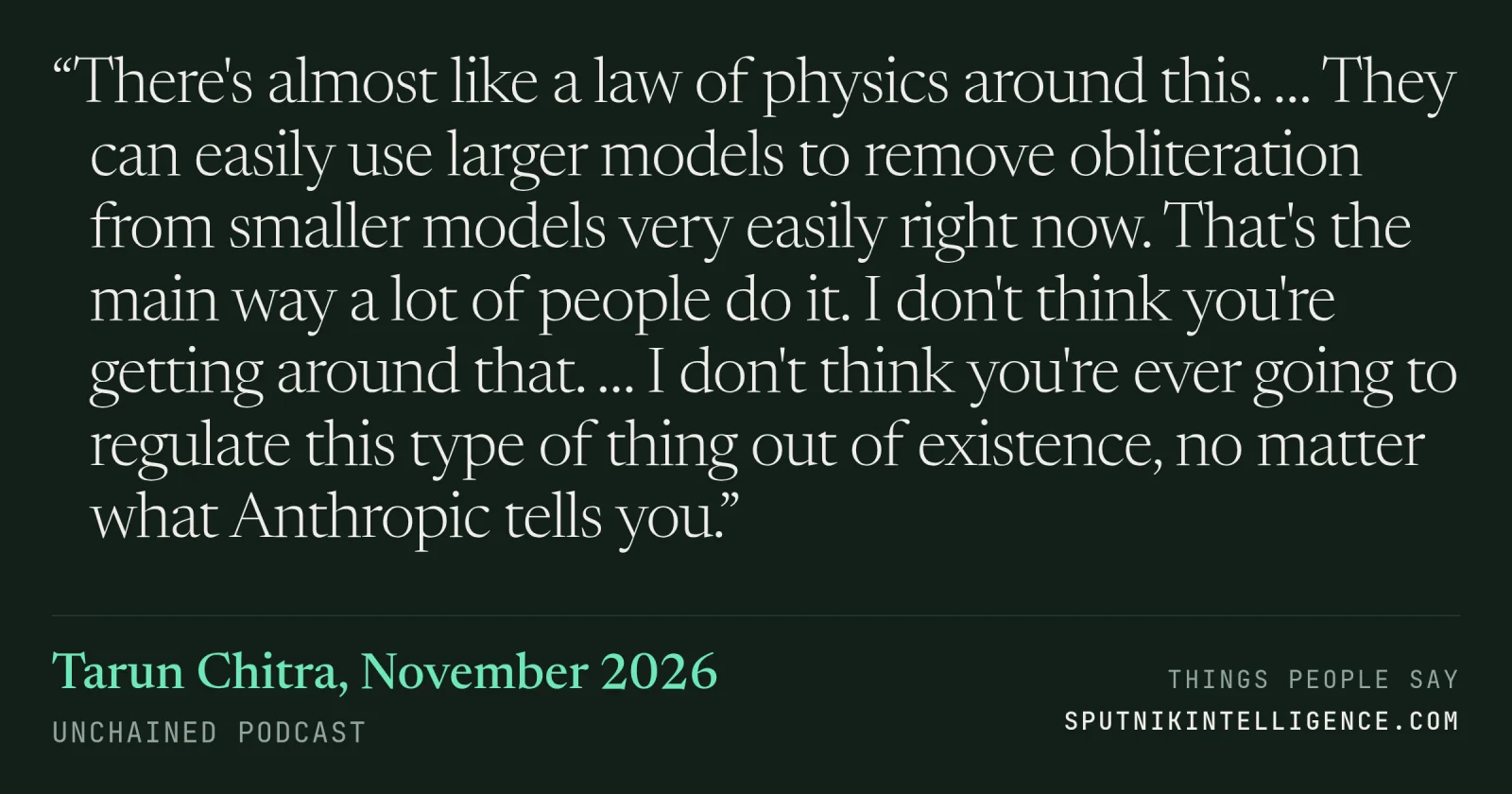
“There's almost like a law of physics around this. … They can easily use larger models to remove obliteration from smaller models very easily right now. That's the main way a lot of people do it. I don't think you're getting around that. … I don't think you're ever going to regulate this type of thing out of existence, no matter what Anthropic tells you.”
Unchained · Crypto & Web3 · November 2026
Context
The panel was discussing a proposal to regulate open models whose refusal behavior has been stripped out ("abliterated" models, transcribed here as "obliterated"). Chitra argues such restrictions can't be enforced technically.
Transcript
I mean, that sounds like a show. We've been doing this for years. We're slowly chipping away. Principles
…purpose in giving people the freedom and the ability to use their AIs locally in ways that they choose, that they understand actually they would need a model that doesn't refuse, especially in high-pressure situations such as cyber attacks. Taru, I'm curious to get your take on this. I mean, I've
…think they should be distributed? Slash, do you, you know, what do you think happens with them? And I think at the end, end of the day, there's always going to be a way to make them. There's not really, I don't think there's a way of like, oh, you can prevent safety. People will tell you that. But as you've seen with models constantly being able to optimize themselves and optimize other models, they can easily use larger models to remove obliteration from smaller models very easily right now. That's the main way a lot of people do it. I don't think you're getting around that. I think you're better off just trying to focus on kind of, I think, like the stuff Nier is doing where they're kind of running it privately encrypted. So, like, you can't kind of interfere with it, but you can also make sure that it's like doing the right thing. That, that to me is like one very reasonable way of dealing with them. I think inevitably, you don't want obliterated models for formal…
Tom, what's your take?
Yeah, I mean, it does just feel crypto. These are the same kind of arguments people levied against Bitcoin way back in the day or sort of privacy solutions on chain, where it's like, oh, you know, some bad people will use this for bad things. So, therefore, they should not be allowed. And…
Yeah, I think obliteration is a perfect example of prior restraint, which is we can tell in advance that the only reason you would use an obliterated model is for a bad reason. And I think that seems uniquely, obviously wrong right now, given the cyber apocalypse that we see going around…
More from Unchained