 Sebastian Mallaby
Writes about finance and technology at the Council on Foreign Relations, where he is the Paul A. Volcker senior fellow for international economics.
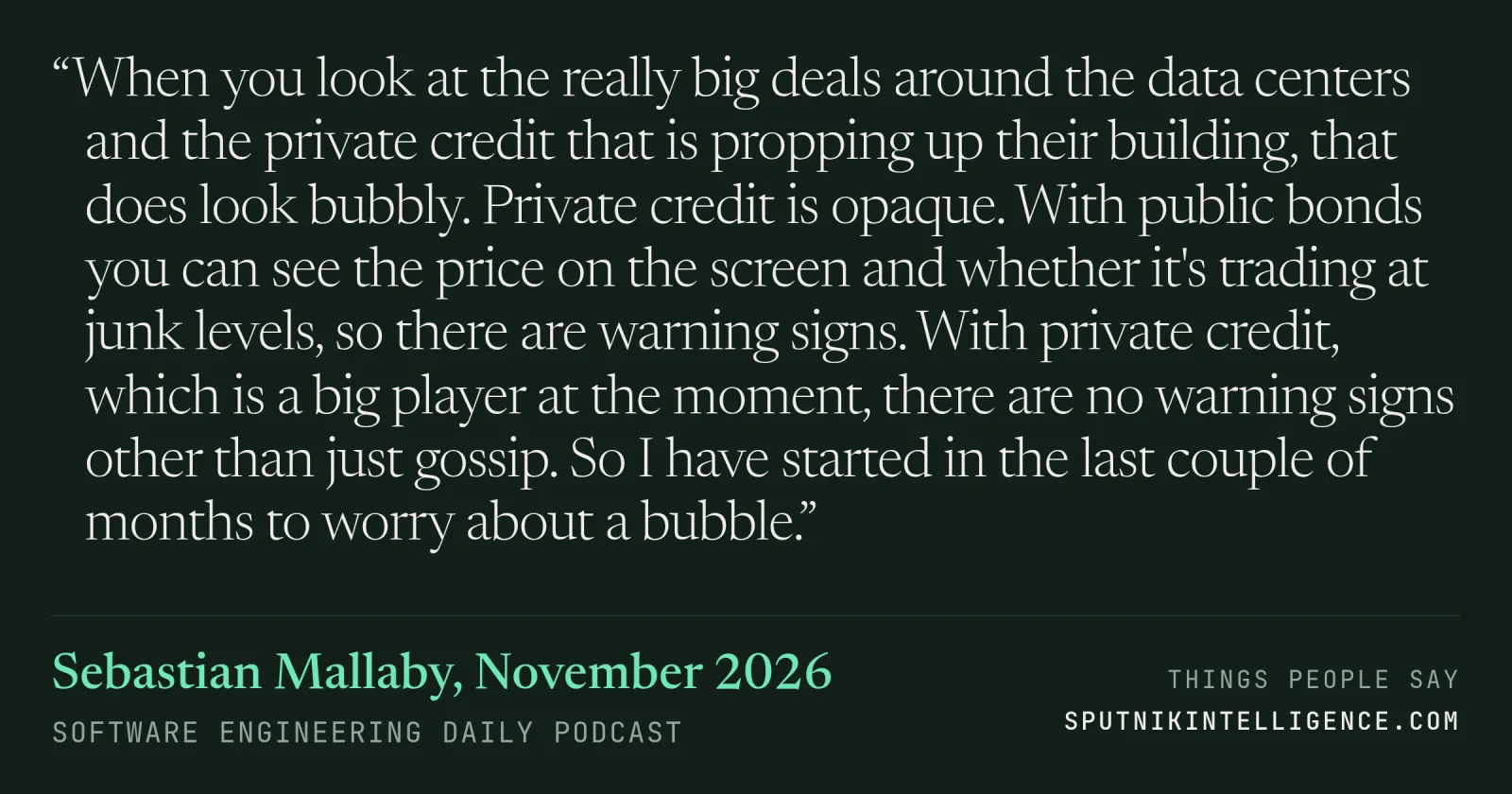
“When you look at the really big deals around the data centers and the private credit that is propping up their building, that does look bubbly. Private credit is opaque. With public bonds you can see the price on the screen and whether it's trading at junk levels, so there are warning signs. With private credit, which is a big player at the moment, there are no warning signs other than just gossip. So I have started in the last couple of months to worry about a bubble.”
Software Engineering Daily · Hands-On Engineering Podcasts · November 2026
Context
Discussing whether AI is in a bubble, Mallaby explains why he has become more worried about the financing of AI infrastructure. His concern is that private credit hides distress until it is too late.
Transcript
…hedge fund, which to say it blew up is a bit unfair because they're still in business, but they did have to sell their public stock portfolio to Citadel because they were down sufficiently that they were getting capital calls because they'd borrowed. And here, again, the leverage is the key point.
Exactly. Yeah. Once you're levered, then margin, you don't need that much of a dip to get this self-reinforcing margin call cycle going on.
Right, right. They were levered four to one. And so just going down 25% on the equities meant they'd gone down to zero because you have to forex it. So they couldn't hold those positions. But in some sense, who cares about a fund, right? That's fine. Citadel buys it, end a problem. That's not systemic. It's unfortunate for the investors in situational awareness, but it's not a systemic problem. But when you look at some of these really big deals around the data centers and the private credit that is propping up the building of the data centers, that does look bubbly. And unfortunately, also private credit is opaque, right? They don't have to say exactly what their loans are. They may disclose something to their limited partners who are backing the fund. And that might leak out a bit. But basically, it's not like the public bond. Issuance, you can see the price on the screen, you know, that's traded a bit, so you can see what it's worth. You can see if there's distress and if it's trading at junk bond levels. So, at least there are warning signs when you finance it with bonds. But with private credit, which is a big player at the moment, there are no warning signs other than just gossip. So, I do start, I have started in the last couple of months…
So, I realize we're coming close to the end of our time here, and we've wandered over a wide range from the individual story of Demis to the current sort of layout and even the financial situation. Are there any things we haven't talked about that you think would be important to cover before we…
You know, I'm very interested in this debate about open and closed models, right? I'm always most interested in the ones where I'm at least certain that I'm correct, because I do think this is a finely balanced argument. But maybe I could tell you my perspective, and you could tell me yours, and…
Yeah, it's interesting. Well, and it's interesting also when we talk about models, because often what we talk, the equivalent that we talk about there is open weights, where the weights are published. Weights are not legible in the way that code is, in the sense that open weights means I can take…
More from Software Engineering Daily