 Sebastian Mallaby
Writes about finance and technology at the Council on Foreign Relations, where he is the Paul A. Volcker senior fellow for international economics.
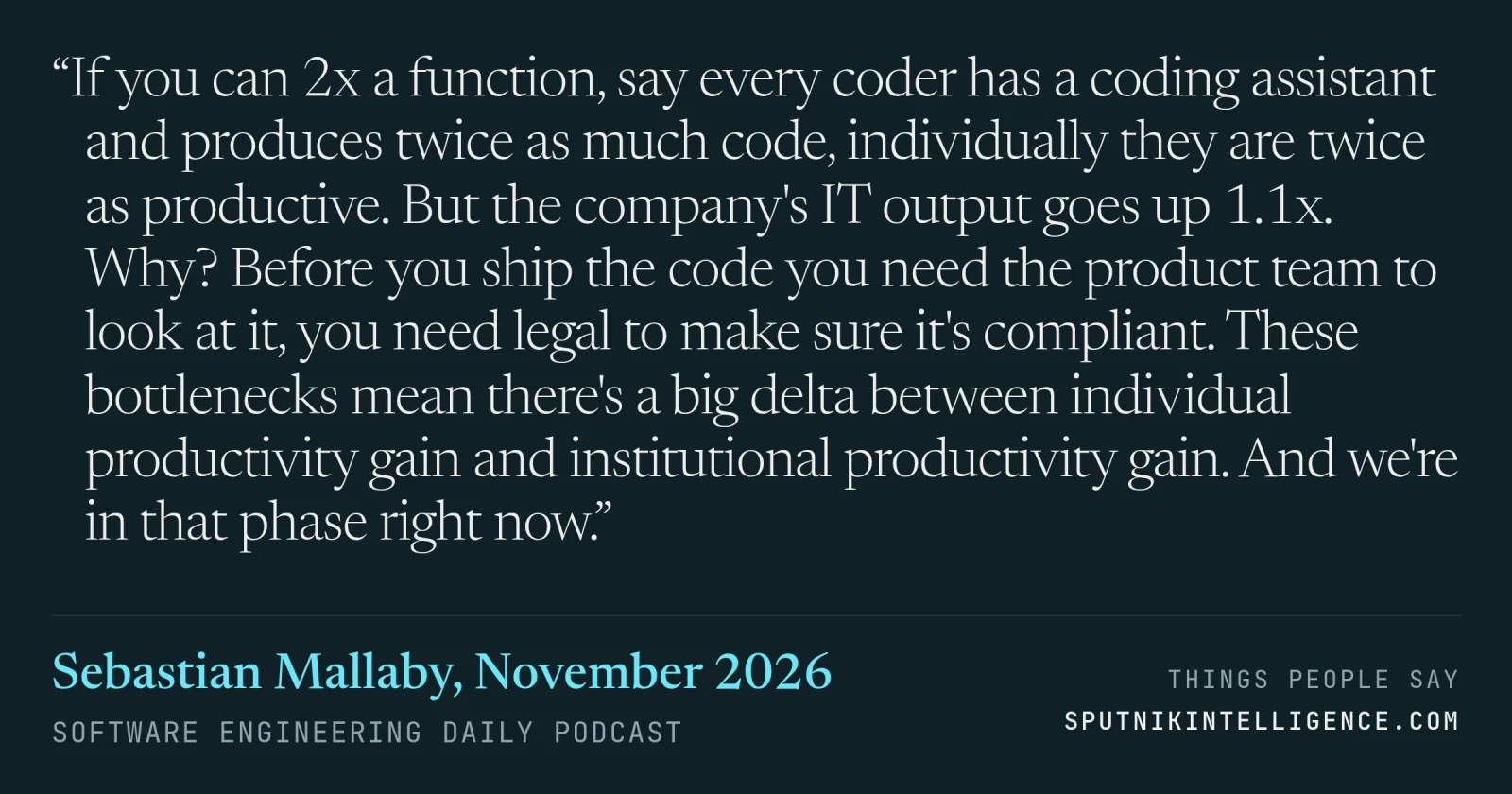
“If you can 2x a function, say every coder has a coding assistant and produces twice as much code, individually they are twice as productive. But the company's IT output goes up 1.1x. Why? Before you ship the code you need the product team to look at it, you need legal to make sure it's compliant. These bottlenecks mean there's a big delta between individual productivity gain and institutional productivity gain. And we're in that phase right now.”
Software Engineering Daily · Hands-On Engineering Podcasts · November 2026
Context
Asked what institutions are needed to cope with AI-driven change, Mallaby draws on the history of electricity and on executives he talks to who find AI productivity gains hard to realise outside coding and call centers.
Transcript
Yeah, so first of all, your comment makes me think the ideal investment portfolio in this world is like some GPU investments together with a portfolio of premium restaurants or something like that, right? Or maybe gyms, or
other in-person experiences, right? Yeah, exactly. Things that happen together. Like you talk about obsessions, I'm obsessed with in-person experience and immersive theater and improv and all these different things that just get you together in a place with people.
Yeah, right, exactly. So, totally, that's right. You want to invest in the pure silicon and the pure experience. But you're saying, how do institutions adapt? So, I think this is again super exciting because it's so early and we're going to see how this plays out. But what we know is that typically in the first phases of invention through economic history, people do small things with the new tech. So, electricity comes along and you can reconfigure certain tasks that are more efficient, but the sort of design of the factory where maybe there had been a kind of coal-fired steam engine or something in the middle powering your loom, and then the workers were kind of organized around this shape. You know, you kind of stick with that shape, you just have electricity running the loom instead of the steam power, for example. And it takes quite a long time between the advent of electricity and the first automobile production line where you have a straight line production line where you rearrange how the workers are laid out. Because actually, oh, you know, we don't need to put the power center in the middle because it's kind of a localized steam thing. It's coming along wires on electricity, and you can make it go to lots of different…
absolutely. Yeah, the theory of constraints and bottlenecks has absolutely seen a resurgence with this stuff. Something you were talking about, you know, in making the electricity comparison reminded me of Carlota Perez's book about technological revolutions and financial capital. And in that book…
Yeah, I agree with your framing very much. And back in, let's say, January of this year, 2026, I had no trouble saying flat out there is no general AI bubble. I really was comfortable in stating that very confidently because the demand for GPUs was just going straight up and data centers were being…
Exactly. Yeah. Once you're levered, then margin, you don't need that much of a dip to get this self-reinforcing margin call cycle going on.
More from Software Engineering Daily