 Jan Rosenow
Oxford Professor.
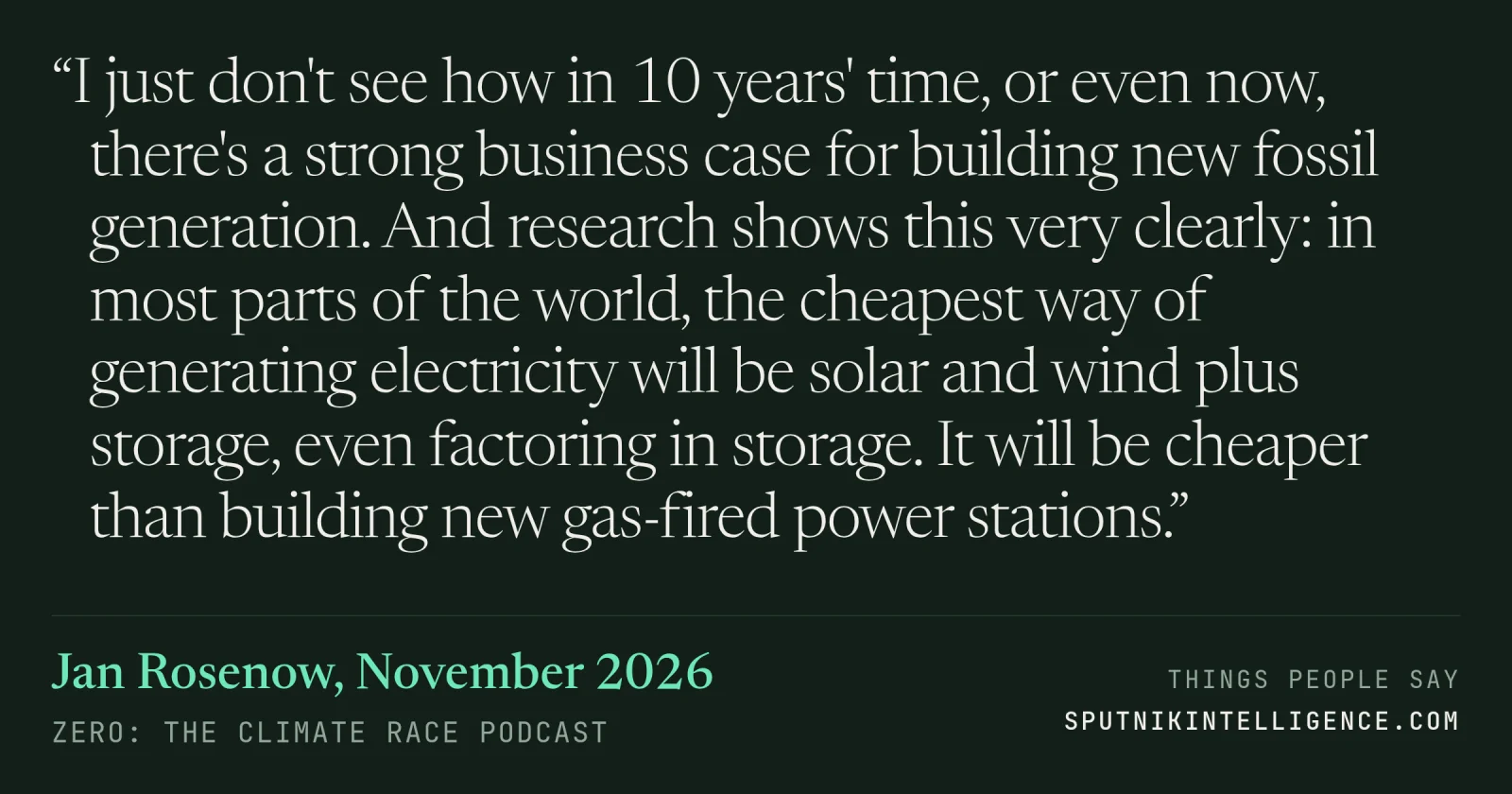
“I just don't see how in 10 years' time, or even now, there's a strong business case for building new fossil generation. And research shows this very clearly: in most parts of the world, the cheapest way of generating electricity will be solar and wind plus storage, even factoring in storage. It will be cheaper than building new gas-fired power stations.”
Zero: The Climate Race · Climate & Energy · November 2026
Context
The host pointed out that the US data center and AI boom is expected to raise gas burn in the short term, and asked whether that holds in the long run. Rosenow says the economics have already shifted against new gas plants.
Transcript
…There's still some fossil in there, but it's tiny. I think 90% plus of all capacity being built is renewable. So I would be surprised if the additional electricity demand that we're layering on top would be provided with fossil fuels. I think most of it will be served with renewable energy.
…like the United States, where we are seeing a boom because of artificial intelligence and all the data centers that need to be powered, there is clear indication that gas burn is going to increase in the short term. But you think, even in the US, in the long term, this is not going to be the case.
Yes, and that's specifically because the fundamental economics have changed in a way where I just don't see how in 10 years' time, or even now, there's a strong business case for building new fossil generation. And research shows this very clearly: that the expectation is that in most parts of the world, the cheapest way of generating electricity will be a combination of renewables, mainly solar and wind plus storage, even factoring in storage at the same time. It will be cheaper than building new gas-fired power stations.
So, let's take this goal that many countries are going to talk about at COP31, which is to increase the final energy of global consumption to 35% for electricity by 2035, from about 20-ish percentage. We'll come to the sort of final energy question later, but there is clearly an increase in…
I mean, one of the problems with such targets is always that you could achieve them in a way that actually isn't particularly helpful. So, let's, you mentioned data centers before, right? You could just build loads of data centers, which drives up the electrification rate. Is that a good thing?…
I suppose you could say the same thing about the Paris Agreement, where there are clear targets about keeping global warming below two degrees Celsius and preferably below 1.5 degrees Celsius. It focuses the mind to actually act on it, even though there is a very real risk that we may even blow…
More from Zero: The Climate Race