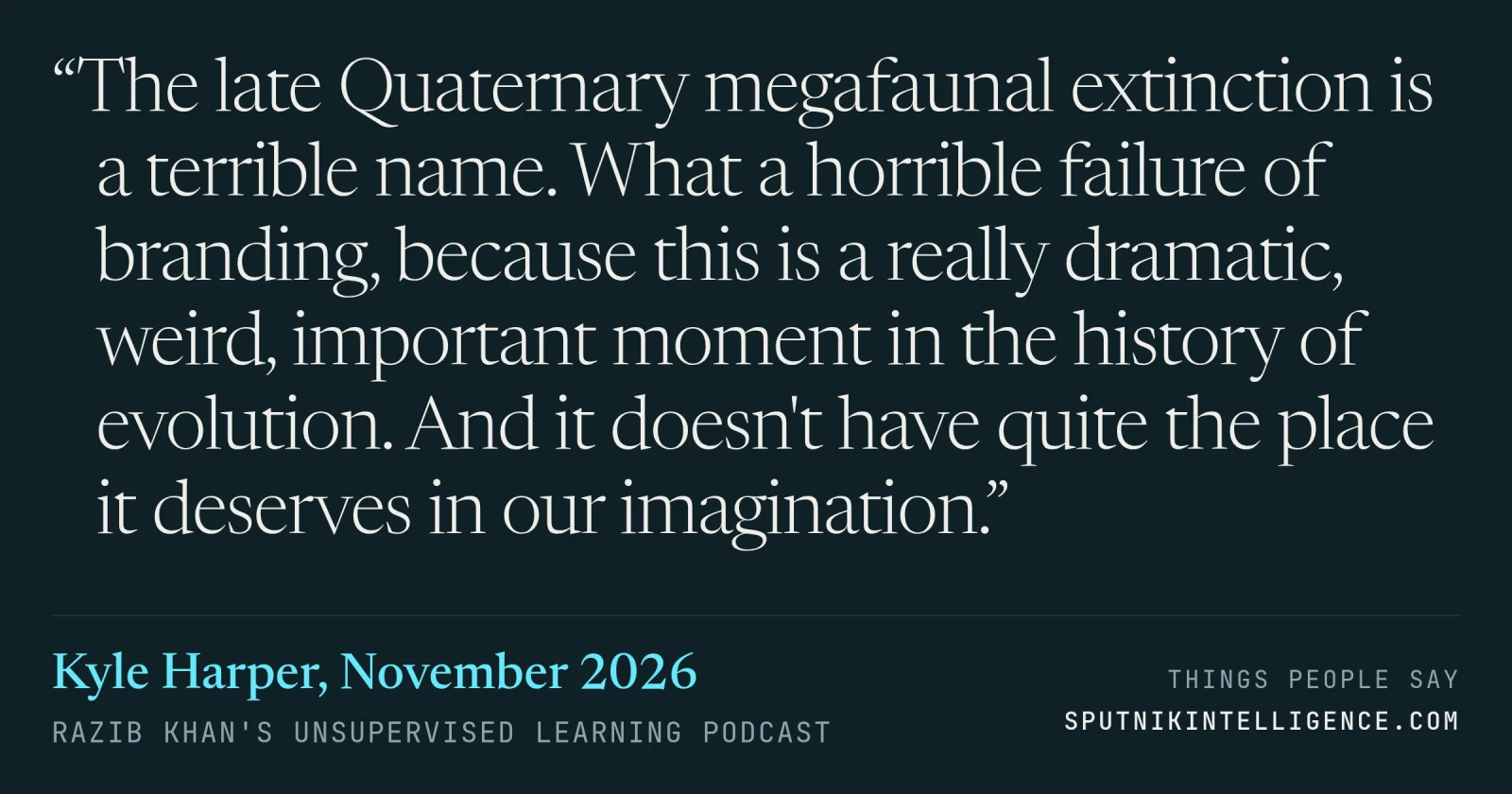
“The late Quaternary megafaunal extinction is a terrible name. What a horrible failure of branding, because this is a really dramatic, weird, important moment in the history of evolution. And it doesn't have quite the place it deserves in our imagination.”
Razib Khan's Unsupervised Learning · Ideas & Essays · November 2026
Context
Harper was describing how, at the end of the Pleistocene, big land animals disappeared on every continent after humans spread and began hunting. He says the scale of the loss is far larger than the famous mammoths and saber-toothed cats.
Transcript
…I mean, if the planet were tipped into a totally fundamentally different sort of physical state that was like Venus, yeah, it'd be pretty hard to kill to kill the prokaryotes, but it could happen. I mean, you know, in principle, the Earth could have wobbled into one of these other planetary states.
…have been arguments traditionally about what caused those extinctions, climate change or us. You take a particular perspective on that, I think, in the book from what I read in it. And can we talk a little bit about that? Because I think it's really interesting just to go over the details here.
Yeah, I mean, let's start by zooming out and then kind of zooming in. So the Pleistocene is the geological epoch of the last 2.6 million years down to the beginning of the Holocene, a little under 12,000 years ago. And it's a period of repeated ice ages interrupted by interglacials like our current Holocene when it warms up, but then it cools back down. And the Pleistocene, it's easy for us to forget, but as you know, is sort of the home for human evolution. Most of our evolutionary history takes place against the backdrop of a Pleistocene world. And that's true both in the larger sense of the genus Homo, but also of the species Homo sapiens. And if Homo sapiens have existed for something like 300,000 years, even so, 95% of our history is Pleistocene history. And during that history, we are hunter-gatherers. We rely on taking energy from wild plant and animal sources in the environment. And maybe the most striking evolutionary change in the Pleistocene, if you were like just looking at the fossil record objectively and leave us aside…
Yeah. So a lot of people do not know. Actually, I mean, a lot of people don't think about the ice age all the time. Okay. I think I do think about the ice age. A fair amount, so I'm a little different than a lot of people, but there was an Emian, there was an earlier interglacial, like 120,000…
Yeah. And I mean, I like the mention of the Osage Orange, which is a tree that some listeners may be familiar with. If you've ever noticed a weird tree that has this very strange fruit, it's like the size of a softball. It's got these like weird brain-like looking little grooves all over it. It's…
Yeah. And this is one of some, you know, these sorts of realities about the ecosystems that emerged, you know, well, during the Pleistocene is one of the reasons that there have been some scholars and activists who want there to be kind of a rewilding of, you know, parts of mostly, you know…
More from Razib Khan's Unsupervised Learning