“I have often joked that planning a summit with the Chinese is like wedding planning, but really, it's like wedding planning with the worst possible in-laws you can imagine. Like they don't like the food, they want to haggle over everything. So it requires a tremendous amount of preparation.”
The Lawfare Podcast: Patreon Edition · September 2026
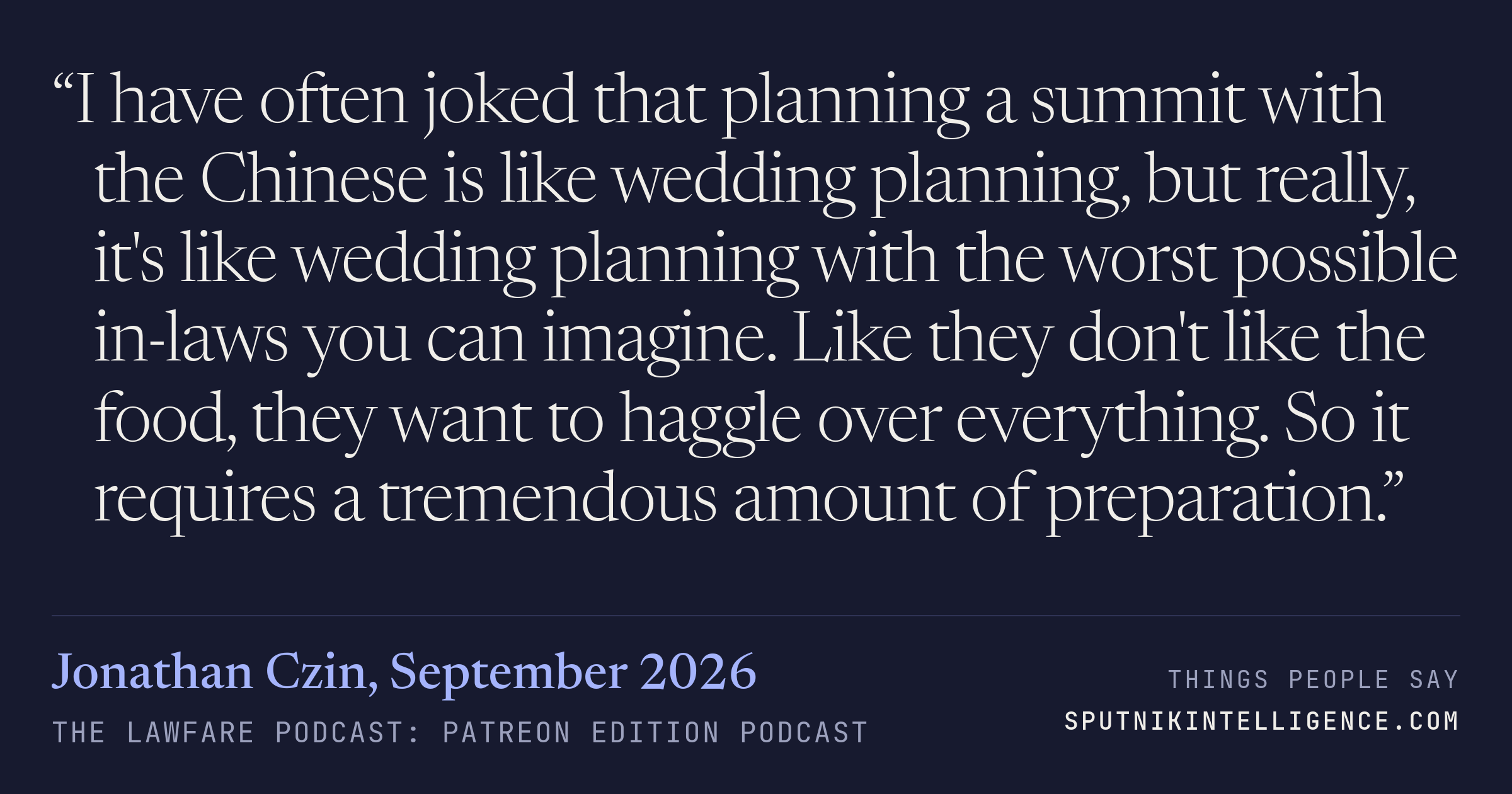
Czin, a former National Security Council staffer, is explaining why he expected little from Xi's state visit. He says there were almost no in-person preparatory meetings beforehand, so there wasn't the runway that summits with Beijing need.
Transcript
I can assure you, I have many squirrel-like moments too.
But I finally got back to what I really wanted to work on, which was China, just in time for us to get to work a little bit together. But that's great. Appreciate that. So let's start with your expectations going into this summit. So I watched a bit of what you'd written and spoken about. And, you know, you said you had pretty low expectations, I think, that for an extension of what you call the gentleman's agreement. Could you walk us through that?
Yeah, I mean, it was driven by kind of two main factors, right? I think, especially as a former NSC staff, just at a very mundane level, it was very hard to detect any signs of kind of meaningful discussions since the last summit, right? There were a couple of engagements, but Ho Life Feng and Secretary Besson, who had the lead on these issues, hadn't had any in-person meetings until just the week before the summit. You had the Executive Vice Foreign Minister, Ma Zhao Shu, come in the middle of August for a pretty abbreviated trip. So really, like these trips, I think your listeners should be aware, they just require a painstaking amount of effort, right? And work, and especially with the Chinese, right? I have often joked that, you know, planning a summit with the Chinese is like wedding planning, but really, it's like wedding planning with the worst possible in-laws you can imagine, right? Like they don't like the food, they want to haggle over everything. So it requires a tremendous amount of preparation. And that just didn't go into this, right? So I think just at a mundane level, there just wasn't the runway to adequately prepare for a lot of this. And then I think structurally, I don't think that there was a real focus. From the administration on this set of issues. I mean, the decision-making, as you all know, has become so centralized and so personalized on foreign policy in this administration. The old National Security Council, as you've written up, as we knew it, has kind of been blown up. And I think more so on China issues than any other suite of issues. Trump is his own China desk officer, right? Like you don't see people like Wickoff or Kushner or these other characters anywhere involved in it, right? And just from a bandwidth perspective, I think to the extent President Trump is focused on foreign policy issues, it's really Iran as the first and probably second priority, Ukraine and Russia, you know, kind of a distant third. And then I think China's number four, right? And so I think that was part of why I just had very low expectations, just because you didn't see the focus from the U.S. side on getting its act together ahead of the summit.
Yeah. So, John, I mean, I want to get a little bit more on this council that was involved in national security of which you speak in the previous administration and help just tee this up just a little bit more on how you would contrast with how this administration, you know, prepared for this summit.
Yeah, I mean, when I was on the National Security Council, I mean, the preparation that would go into this would start months ahead of time, right? And you're negotiating with the Chinese over every aspect of this: the content, the sequencing, how this is going to go down. And especially since, you know, in the Biden administration, we didn't do any state visits. There was no visit to Beijing or to the United States by President Xi, except until the end of the administration. We were often meeting in third country, right? So it was a question of who is technically hosting whom, because then you get to control the agenda. And I just wouldn't underestimate the level of detail to which we would negotiate things, right? How long are those opening pleasantries going to be? Are they going to be 30 seconds? Are they going to be a minute? That sort of thing. And all of that fell to us. And then, in terms of the substance, there was more of a bottom-up process about, you know, what kind of decisions needed to be made ahead of this meeting, right? Not just about the summit itself, but the broader geopolitical dynamic and everything else that's going on, which I think, especially in this instance, is such an important part of the story here, too. It's not just about the summit, it's about the things that we're not talking about because the summit has sucked up so much of the oxygen in the room right now.
Yeah. So if we were still so fortunate to have you writing the PDB on the summit, how Beijing might perceive the outcome, objectively, how we all did, the scorecard of a summit like this. What would you write in terms of what was agreed with the deliverables, the optics, and anything else? How would you measure who came out ahead?
More from The Lawfare Podcast: Patreon Edition