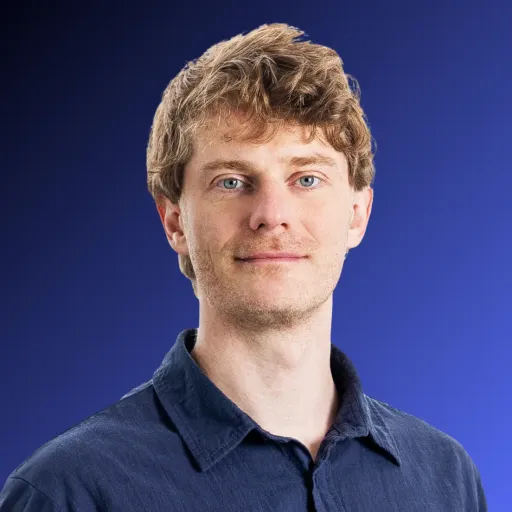
 Richard Socher
Founder and CEO of You.com, an AI search company, and of Recursive, a newer venture built around recursive self-improving AI for scientific discovery.
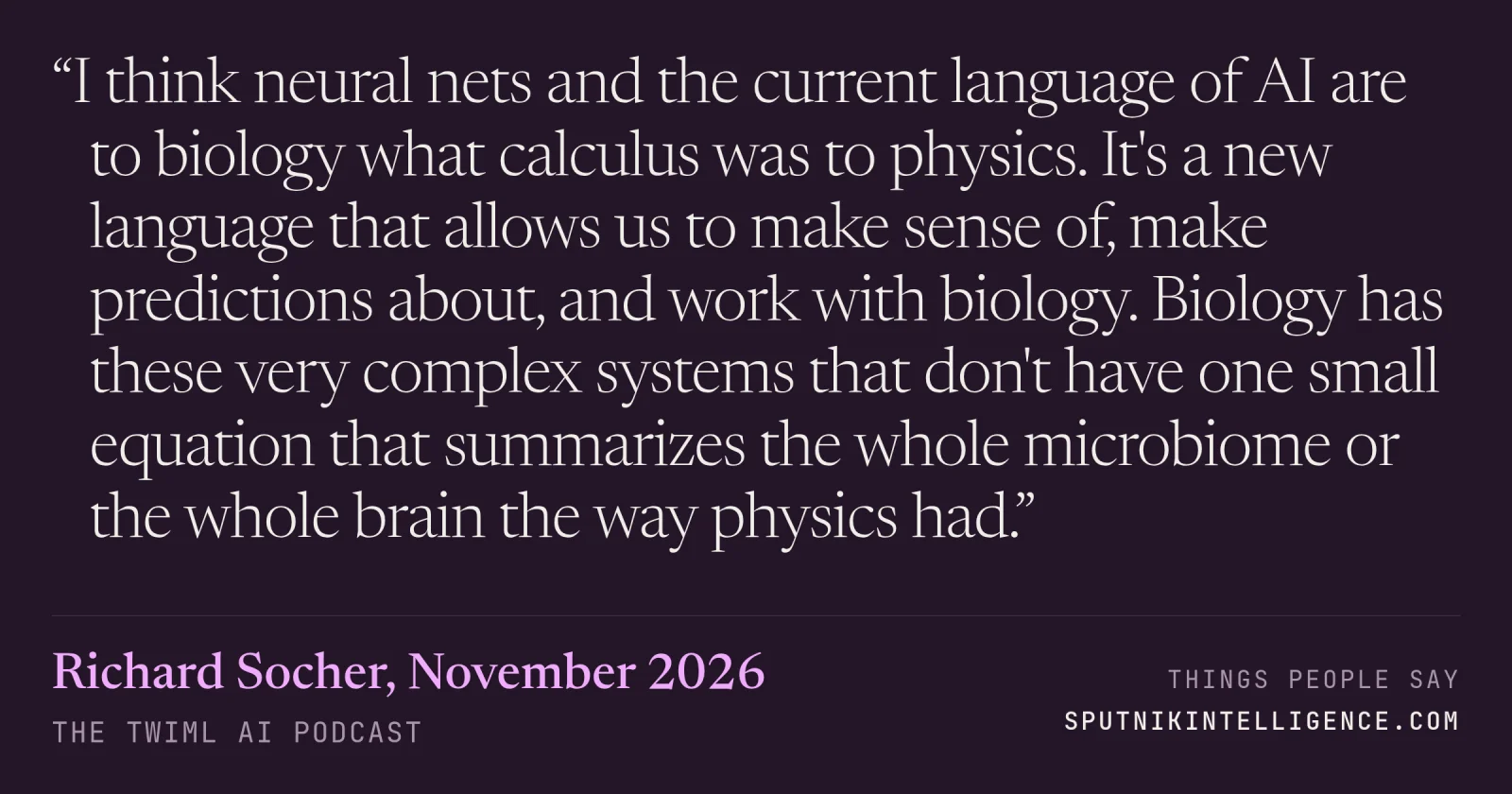
“I think neural nets and the current language of AI are to biology what calculus was to physics. It's a new language that allows us to make sense of, make predictions about, and work with biology. Biology has these very complex systems that don't have one small equation that summarizes the whole microbiome or the whole brain the way physics had.”
The TWIML AI Podcast · AI Builders · November 2026
Context
Asked whether a 'Eureka machine' for science needs new architectures or just more of the current approach, Socher says it is a mix. He argues the main need is more biological data, and that neural networks give science a language for complexity.
Transcript
…very clear that AI can code. AI Invent code. So recursive self-improvement is almost inevitable from that perspective. There's a lot of things to figure out to do it well, especially on the ideation. But yeah, I'm very optimistic that we're going to see just this new era of scientific discovery.
…innovations that you can see maybe post-transformer architectures or some new way of thinking about data or quantum computing? I don't know what these things are. Do you know what these things are? Or do you think that we have the right tools and we just need to continue in the same direction?
It's a mix. I think we can get much further still if we just collect more data on biology, then we can uncover more useful things in biology. In fact, I think neural nets and the current language of AI Invent kind of what calculus was to physics. It's like a new language that can allow us to make sense of, make predictions of, and work with biology. Because biology has all these very complex systems that don't have a very simple, beautiful linear relationship or one small equation that summarizes the whole microbiome or the whole brain the way like physics had. And so I think it's often now science is about weaving these smaller pieces we understand well. Like we understand the synapse, understand. The neuron, they understand like this particular bacteria, but when they all put together and someone gets hangry because they had too much sugar and then the blood sugar drop, now why does that change the brain? Like, no one really knows how do like thoughts really form and why do people act in certain ways and so on. Like, there's like this complexity, and we need this new language. So, and then concretely, the Eureka machine has…
When I think about those three kind of fundamental tasks that these agents need to be able to do: ideation, implementation, and evaluation, the first of those seems much harder than the other two. Do you think that what needs to happen with the way we think about agents and AI today to such that…
I think one of the biggest bets that we're making as a company is that on open-endedness, sort of processes of Darvinian and cultural evolution, where you combine interestingly different ideas and discover and build on top of them inside specific environments that allow basically for this…
What's an example of one of these environments? An
More from The TWIML AI Podcast