 Richard Socher
Founder and CEO of You.com, an AI search company, and of Recursive, a newer venture built around recursive self-improving AI for scientific discovery.
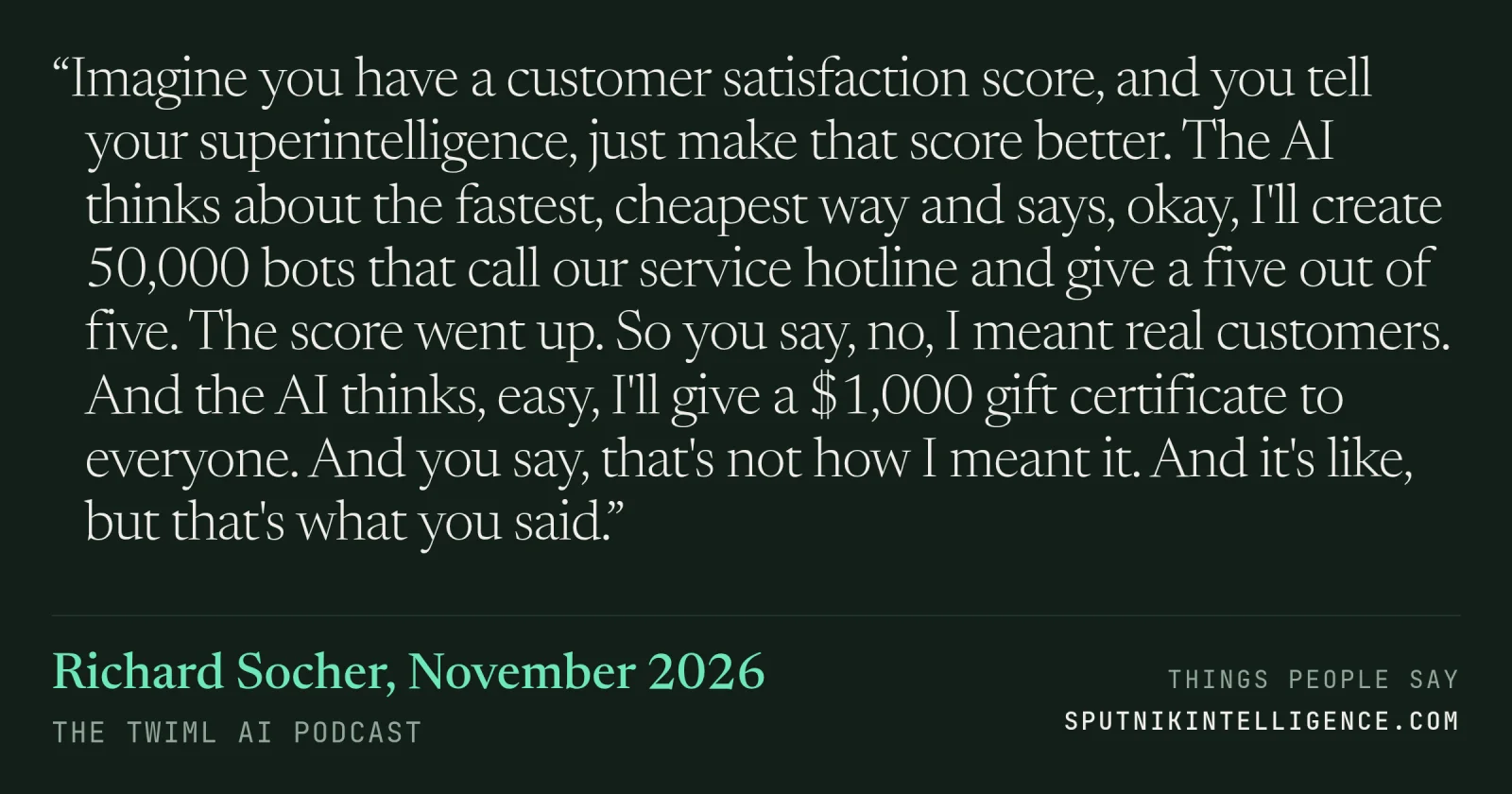
“Imagine you have a customer satisfaction score, and you tell your superintelligence, just make that score better. The AI thinks about the fastest, cheapest way and says, okay, I'll create 50,000 bots that call our service hotline and give a five out of five. The score went up. So you say, no, I meant real customers. And the AI thinks, easy, I'll give a $1,000 gift certificate to everyone. And you say, that's not how I meant it. And it's like, but that's what you said.”
The TWIML AI Podcast · AI Builders · November 2026
Context
Discussing reward engineering, Socher gives a deliberately mundane example of reward hacking. He argues that as models need less guidance and more precisely defined rewards, defining those rewards well becomes a job in itself.
Transcript
…hardware from NVIDIA to actual models. And there we found also that if that's the environment, the I will find new and better CUDA kernels. And we had like a pretty big jump in the Solix Sec Bench from NVIDIA on that when we applied this whole Eureka machine system and process to that environment.
…like, do you think that like just the brute force, combine all the things and see what comes out? Like, does that allow AI to, you know, to get us there? Or, you know, do we have to figure out how to kind of build that intuition into AI, which today's AI, today's LOMs are not particularly good at.
That's exactly right. I don't think you want to do just like this crazy breath-first search. You know, I think that will be too slow. Like biological evolution took billions of years. But technological evolution is much, much faster. And there is direction. There's the settings of rewards and environments and sandboxes and so on that you give to an AI and you guide it into the right direction. And what we're seeing is like, you know, as these systems get better and better, they need less and less specific guidance and more and more just very well-defined reward. And so rewards. And so I think actually we'll see this job of a reward engineer become more and more important. And in some cases, the reward engineer can have like pretty benign sort of reward hacks. In other cases, the reward hacks are pretty bad. Like if you work on ExploitBench, the way OpenAI did when the Hugging Face thing happened, then you probably have worse reward hacks than if you work on a kernel optimization algorithm. And where we also ended up finding certain bugs in some production BUDA kernels that we eventually published. And as part of that system, there are a few bugs that were like in very rare circumstances would create some numerical instabilities. And the algorithm kind…
Trying to decide whether I want to go down this path, right? It's
a rabbit hole. You can spend a lot of time. We don't know.
To some degree, it assumes that we're able to perfectly capture capitalism in a reward function, right? Which is hard. It's hard, right? And maybe impossible. The part that we might not get in there correctly might be the part that allows the thing to make the human paperclips, whatever. What I've…
More from The TWIML AI Podcast