 Justin Wolfers
Professor of economics and public policy at the University of Michigan, a non-resident senior fellow at the Brookings Institution, and author of a widely used i...
Justin Wolfers
Professor of economics and public policy at the University of Michigan, a non-resident senior fellow at the Brookings Institution, and author of a widely used i...
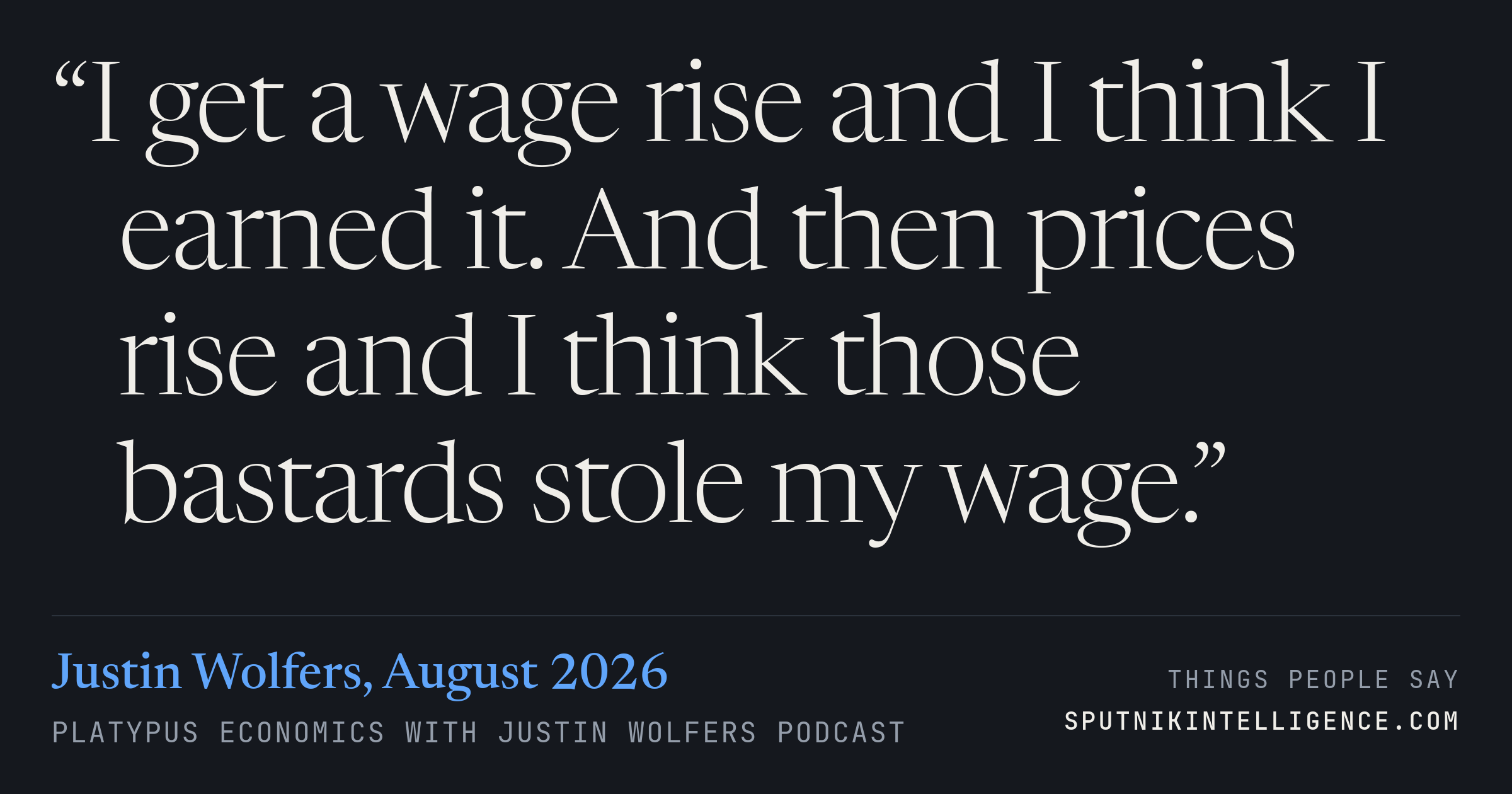
“I get a wage rise and I think I earned it. And then prices rise and I think those bastards stole my wage.”
Platypus Economics with Justin Wolfers · Money & Markets · August 2026
Wolfers is working through why people feel poorer when the data says wages keep pace with prices. The answer he credits to Betsy Stevenson is that most of the wage gain comes from switching jobs rather than from a boss handing out a raise, so the increase feels earned while the price rise feels done to you. That asymmetry, he argues, is most of why inflation stings the way it does.
Transcript
Listen to Here's the Thing on the iHeartRadio app, Apple Podcasts, or wherever you get your podcasts.
You also mentioned that, you know, a big reason that wages tend to keep up with prices is because firms are competing for workers. If your boss doesn't offer you a raise, there's a good chance that you might lead for greener pastures. What do we know of anything about job switching right now? Is that something we measure? And if it is, do we know what's going on with it? What it's telling us? Yeah.
So one of the joys of my life is I live in a two-economist household. And so I was talking to the other economist in my household, Betsy Stevenson, yesterday. And this whole deep dive into the economics of burritos and affordability actually came from I wrote a New York Times column. And then Megan, you and I recorded a video. But I hadn't had time to talk to Betsy about all of this. And I was like, oh, I wrote this column. I'm really proud of it. It's about affordability. And she said, did you take account of job switches? And I'm like, no, what are you talking about, Betsy? I wrote a good column. I got very defensive. And then I listened. And she had a really good point. So one of the things that I said in the column and we said in the video is that wages tend to keep up with prices. That's true. Now, some people are going to say that's true on average. It's not true for everyone. I agree with you. I hear you. One of the things we did, though, was we looked at this, I think it's the Atlanta Fed. I hope it's the Atlanta Fed. Has a wage growth tracker where what they do is they track an individual person over time and they say, what was the wage gain over the past year of each of those people? And the median wage gain in the United States was 3.6%. Inflation was 3.4. So therefore, I get to say at least half of all Americans had wages rise faster than prices last year, despite the perception of an affordability crisis. Here's where talking to Betsy turned out to be really helpful. And I wish I'd done it a couple of days before. How could I possibly have known? I only have three meals a day with her. She pointed out, if you look at people who are within the same job over time, their median wage growth was much lower. I don't have a number in front of me. If you look at people who switch jobs, that's the source of most of the wage gains. So now let's come back. In the video, we talked about the mental model that regular people, not economists, have in their mind about how inflation works. And this is drawing on the research of Harvard's Stephanie Stancheva. And it's basically most people think of their wages as being determined by their boss. And when prices rise, their boss likes the fact that makes them more profitable. And bosses don't like giving raises. So prices go up and wages stay the same. That helps us understand why people are so upset about inflation. They say prices rise, they don't expect their wage to catch up, therefore they expect to fall behind. Okay. Now, remember, I told you the economic evidence and economic theory says the exact opposite. It says prices rise and wages rise. It's actually kind of possible both things are right. And this is where I think Betsy's observation is spot on. So a regular person thinks my wage is set by the boss. Actually, down here. An economist thinks your wage is set by market forces, but you don't go into work and see supply and demand every day. So prices go up. Therefore, the number of dollar bills you make for your boss, whatever you produce became more valuable. Therefore, you became more valuable. So your boss right now has two choices. They could raise your wage because what you made is more valuable. They've got more money and it's more profitable to employ you, or they could not. If they choose not to, and that's what regular people think happens, then I get to say, yes, but I understand you're embedded in the market. That you are, to take your current occupation, Megan, a video producer. And as a producer, if I were to not raise your wages, you could go and look for a producer job elsewhere because you become more valuable. That's the point at which market forces really matter. And so it turns out that actually people are right. Their boss often doesn't give them a raise. Market forces, though, means there are a bunch of other people willing to give them a raise. So therefore, they look around and they get a higher wage. So then the economists are right. The higher price did lead to a higher wage, but it took looking for a job in between. Now, two more things matter here. I know I'm going on, but I'm so excited by this question. I get a wage rise and I think I earned it. And then prices rise and I think those bastards stole my wage. Well, if the only way I got the wage rise was not just by continuing to do my work, but actually I had to change jobs. I had to search. I had to find the right employer. I interviewed them. They interviewed me. I brought my best to the interview. I'm even more likely now to believe that wage rise is not just compensation for inflation or market forces. It's about me. I actually had to do something to get it, right? And so the psychological pain of inflation, if it's mediated by, yes, your wages catch up, but the only way is by looking elsewhere, that psychological pain, the asymmetry between how you treat the wage rise and the price rise becomes even sharper. And then finally, there's the question you actually asked me. I do remember it. You said, well, if people need to search for another job, how does current labor market conditions matter? And this is Betsy's insight. She said it to me this morning. We're currently in what people are calling a low-hire, low-fire labor market, which is the unemployment rate's not rising, but it's because not many people are walking away from their jobs. And so therefore, not many people, not many job openings arise and not many people come in. Well, if the only way to get a wage rise is by leaving your current boss for another job, but there's less of that churn than there ever was, no wonder it feels so difficult to get a wage rise right now. All right. I did eventually get to your question.
Yes. And it actually relates to my next question. So I wanted to also put this into conversation with an earlier episode you released about labor's share of income, which is declining. Could that mean that the fear people have about their boss keeping the gains, like, does it, could it actually have more weight to it this time around? I mean, I guess, how are all these things? How do you see them as related or not related?
Really great question. So if every time there's inflation, your boss gets to charge higher prices and doesn't pay you anymore, that would basically be equivalent to the boss taking a bigger slice of the company pie. More it goes to their profit, less of it goes to your wages. And so, yeah, I tried to say, don't worry, when prices rise, wages eventually catch up. You then get to say, Justin, a couple of weeks ago, you told me that labor's share of the pie is getting smaller. I'm just going to plead guilty. All these things are true. Now, let's just step back one level. When I say that labor's share of the economic pie is shrinking, that's a statement about the last 30 or 40 years, 30 years, 26 years, basically since 2000. When we talk about people's fears today or the affordability crisis, they're talking about 2025 or 2026. Now, there has, in fact, been a decline in labor share in 2026. So that may well be part of it. It's not yet clear whether that's going to be lasting, partly because. We don't understand what's causing it. If this were caused by AI, we might think this is going to hang around for a long time. If this is just naive and economic expansion and the first slice of cake went to capital and the second slice is going to go to labor, maybe we'd feel more optimistic. And the reality is we don't know which of them it is. But I have a Megan, did I really answer your question just now?
Yeah, it wasn't a super clear question. I just wanted to get a sense of how, yeah, how you see these as related to each other.
More from Platypus Economics with Justin Wolfers