 Chamath Palihapitiya
CEO @SocialCapital, Bestie @theallinpod
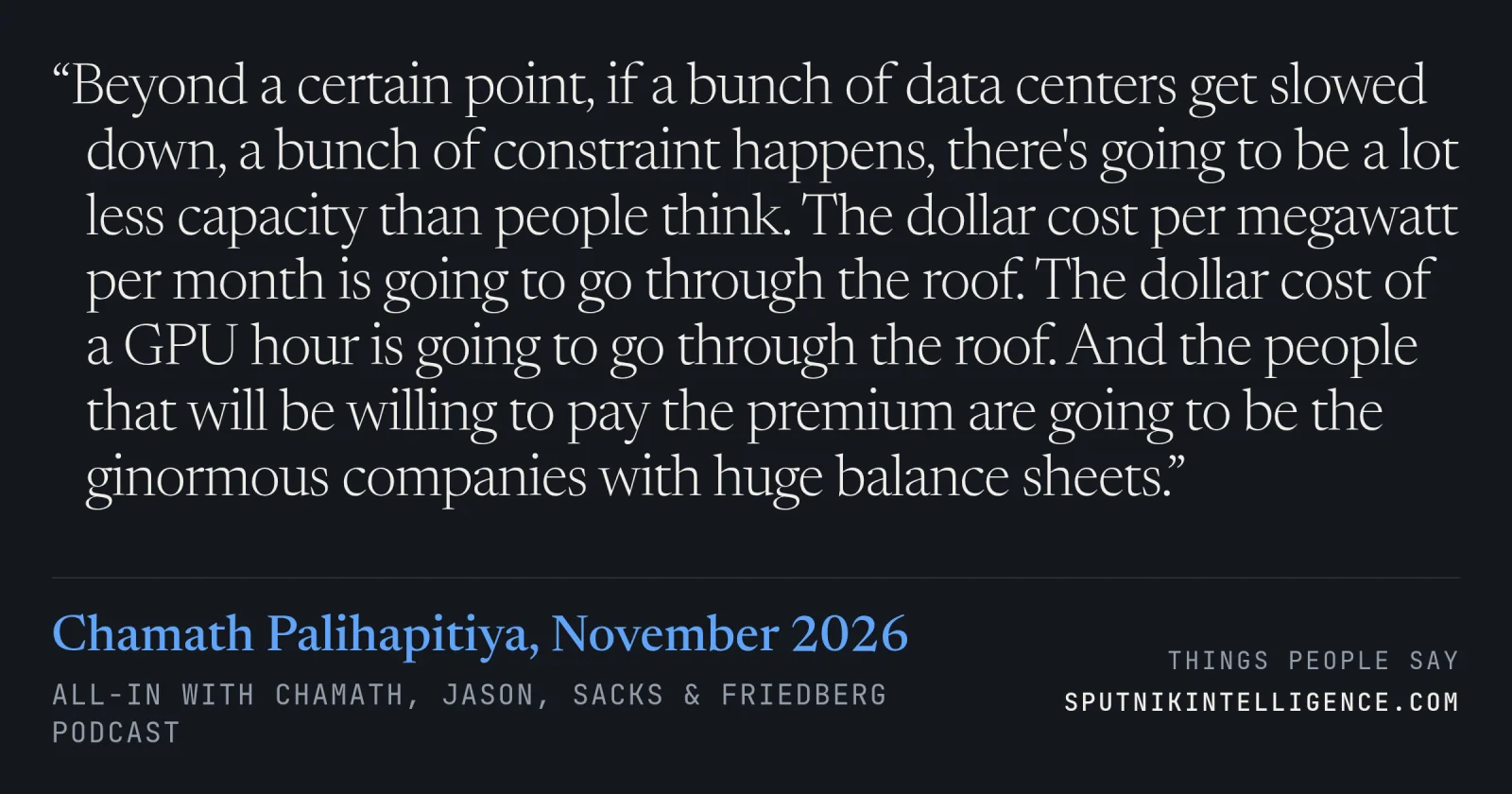
“Beyond a certain point, if a bunch of data centers get slowed down, a bunch of constraint happens, there's going to be a lot less capacity than people think. The dollar cost per megawatt per month is going to go through the roof. The dollar cost of a GPU hour is going to go through the roof. And the people that will be willing to pay the premium are going to be the ginormous companies with huge balance sheets.”
All-In with Chamath, Jason, Sacks & Friedberg · Money & Markets · November 2026
Context
The panel was debating how compute deals get repriced if data center supply tightens. Chamath says scarce capacity pushes prices up and hands the advantage to the biggest buyers.
Transcript
Not if you miscast what I'm saying. You can
…or lack of one and by the loyalty of Anthropic and their success, making them a great long-term partner, especially for the space data center business. So I could see him instead of throwing it up to spot saying, hey, let's meet somewhere in the middle. That's what I think. It's a longer time.
I'm not saying throw it up to spot. What I'm saying is when Spot moves sufficiently, even a long-term offtake moves so much that existing contracts are negative EV. And so you just got to move existing contracts to positive EV territory. And if you can get out in 90 days and reprice something into positive EV territory, you should. So my point is more that beyond a certain point, if a bunch of data centers get slowed down, a bunch of constraint happens, there's going to be a lot less capacity than people think. The dollar cost per megawatt per month is going to go through the roof. The dollar cost of a GPU hour is going to go through the roof. And the people that will be willing to pay the premium are going to be the ginormous companies with huge balance sheets. And so you could just sell it to Google or Meta if you wanted to. You don't have to sell it to OpenAI.
Okay, Sachs, the really interesting part of all this, just to dip into the science corner, is this infrastructure does two things, right? Inference, people using the product every day, and then building the next model. If you want to run away with the next model, cornering compute at any price is a…
I'll say something very quickly. When you're talking about infrastructure of this magnitude, these gigawatt power data centers, they cost around $50 billion. Okay. Nobody can make that investment in conditions of uncertainty. The last thing you ever want to do is break ground on a project like…
All right. Everybody has been demanding, Friedberg, that we do a science corner on this exponential time hypotheses. I guess a layman's way of explaining it would be computers can't solve important problems quickly, but there seems to be some science and some recent innovations that say maybe this…
More from All-In with Chamath, Jason, Sacks & Friedberg