 Justin Wolfers
Professor of economics and public policy at the University of Michigan, a non-resident senior fellow at the Brookings Institution, and author of a widely used i...
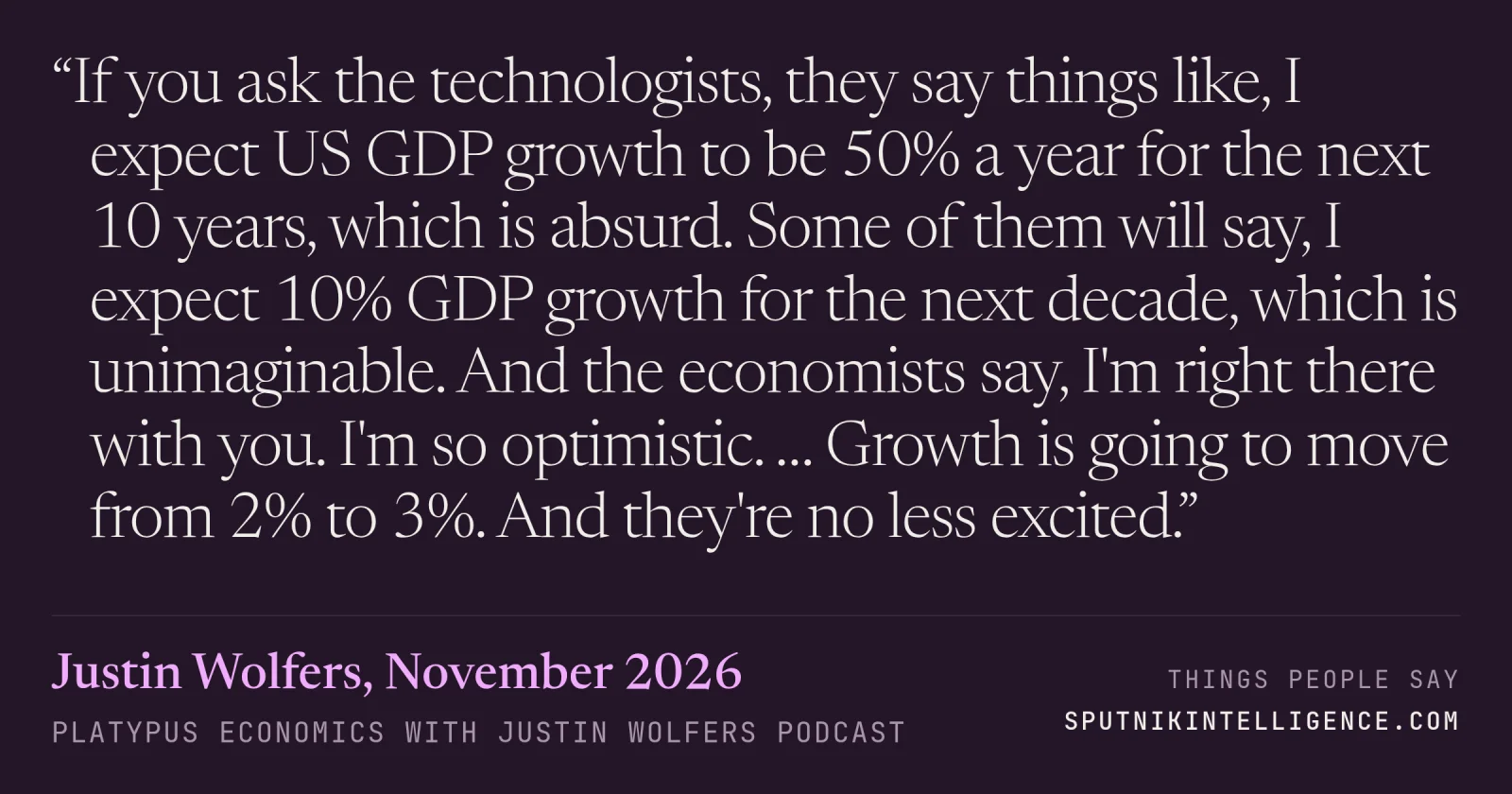
“If you ask the technologists, they say things like, I expect US GDP growth to be 50% a year for the next 10 years, which is absurd. Some of them will say, I expect 10% GDP growth for the next decade, which is unimaginable. And the economists say, I'm right there with you. I'm so optimistic. … Growth is going to move from 2% to 3%. And they're no less excited.”
Platypus Economics with Justin Wolfers · Money & Markets · November 2026
Context
Asked whether AI is already showing up in productivity data, economist Justin Wolfers describes what his partner sees at AI conferences: everyone agrees AI will transform the economy, but technologists and economists mean very different numbers by it.
Transcript
And I'm Justin Wolfers. I'm an economics professor. And this is the professor is in. Thing of this is office hours. Augusta is bringing me your questions. Come on in. We went through some heavy stuff this week. I bet you've got a few questions.
…think a lot of people think maybe this is going to be a huge productivity boost. If that happens, that would obviously be a huge factor in our debt to GDP ratio. Is there any evidence in the data right now that AI is creating that productivity boost? Like, how would we see that if it's showing up?
…labs, naturally, it's their life's work. They're very AI positive. And the billionaires for whom they think they might get a second billion, they're very AI positive. So at the end of the conference, someone will ask a question like, do you think AI will revolutionize the economy? And they all put up their hand and say, yes, you're beauty. And what's interesting, though, is what does that mean? If you ask the technologists, they say things like, I expect US GDP growth to be 50% a year for the next 10 years, which is absurd. Some of them will say, I expect 10% GDP growth for the next decade, which is unimaginable. And the economists say, I'm right there with you. I'm so optimistic. This is going to transform the economy. Growth is going to move from 2% to 3%. And they're no less excited because growing from 2% to 3% means. Instead of doubling the standard of living every 35 years, we double it every 34 years, 35 years. No, wait, sorry. Let me get that right. Rule of 72. Let me tell you the math I'm trying to do in my head just so everyone can play along at home. How long…
It's good. I mean, it's answering a really important question, which is what does the AI revolution mean for growth or not what does it mean, but what might it mean?
Let me take one more step. I just want to spend a moment of humility. When the economists are in the room with the technologists and they go, you know, the technologist says we're going to grow at 10% forever. Not only will hunger be gone, but all want will be gone. The economists laugh and they're…
When I was a little kid, I thought that we would be in the future when video calling existed. And everything past then has seemed like the future to
More from Platypus Economics with Justin Wolfers