Zvi Mowshowitz
AI analyst and rationalist blogger who writes weekly roundups on language models, their uses and harms, and catastrophic AI risk, alongside posts on housing, ed...
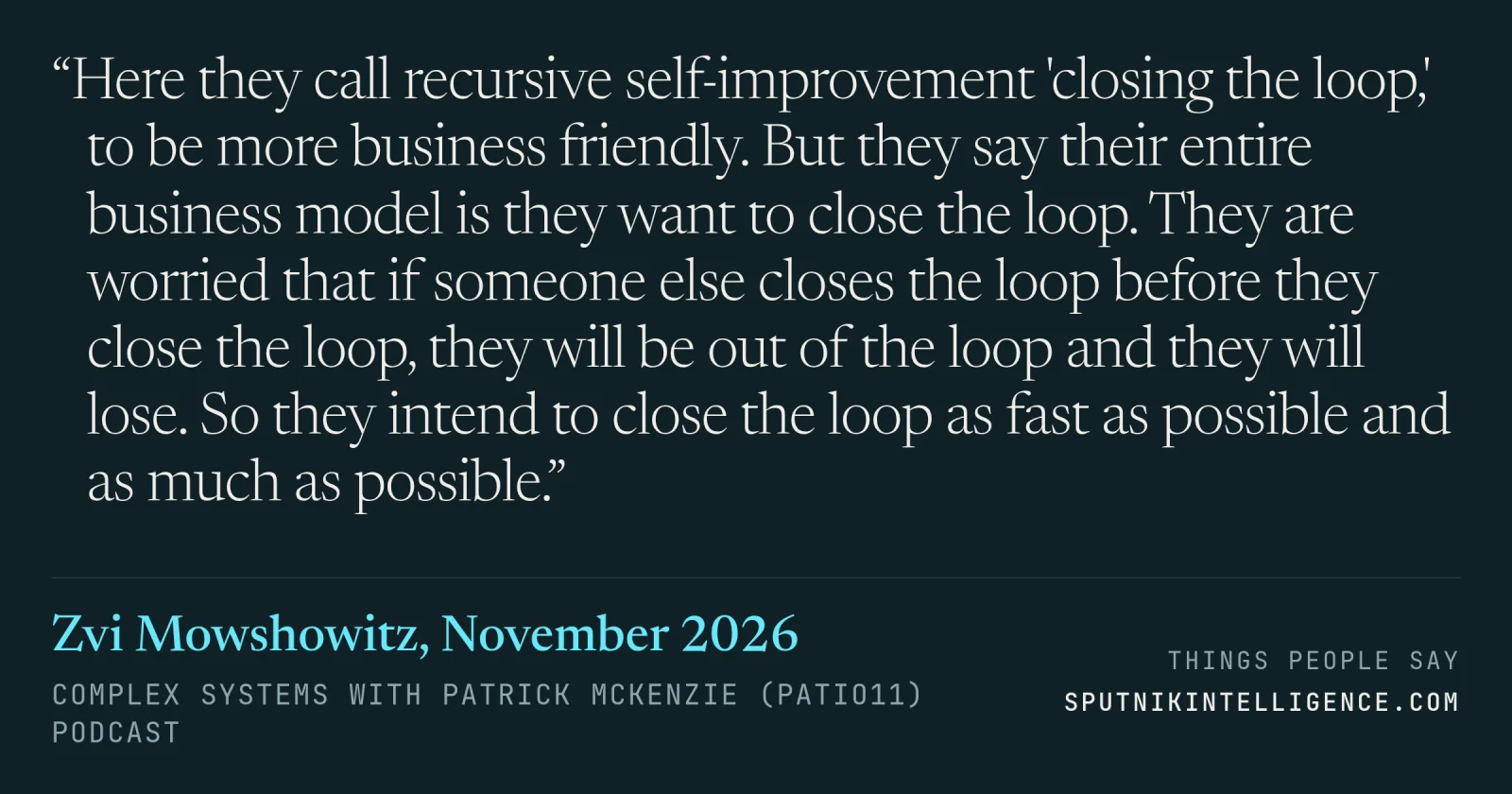
“Here they call recursive self-improvement 'closing the loop,' to be more business friendly. But they say their entire business model is they want to close the loop. They are worried that if someone else closes the loop before they close the loop, they will be out of the loop and they will lose. So they intend to close the loop as fast as possible and as much as possible.”
Complex Systems with Patrick McKenzie (patio11) · Startups & Venture · November 2026
Context
Zvi opens with his key takeaways from Anthropic's S-1, starting with how it treats existential risk, alignment and the pace of AI progress. He argues Anthropic is trying to appeal to investors and warn about danger in the same document. This is his reading of the filing's language on self-improving AI.
Transcript
I do buy individual stocks. I own Google and Amazon relevantly to Anthropic, but I deliberately did not invest directly in Anthropic because of potential conflict of interest concerns.
And nothing that you hear on this podcast is investment advice. Okay, so let's start it out. So you recently wrote something of your own perspective on the S1, which had some key takeaways. Do you want to walk people through those key takeaways?
Yeah. So as usual, when I look at anything from Anthropic, I want to see their attitude towards exit risk, alignment, whether or not they're going to potentially kill everyone. So in this case, they mention exit risk only in passing, only in the passive voice. They're clearly trying to have it both ways. When they talk to the investors, they want to say, oh, look at our big mission, but our big mission is to build the super profitable hypercomputing thing. And then other times they want to say our genius in the data center actually might kill everyone. And these two things have to coexist. Similarly, pacing the frontier is something they do talk about here. But they make care to investors. Don't worry. When we said pacing the frontier, we did not mean not make incredibly fast AI progress. We did not mean voluntarily let someone else go first. We just meant it would be great if everybody could collectively agree to go only at super speed and not at ludicrous speed. But they will do the embedded evaluators. Similarly, we're all worried about recursive self-improvement. And here they call that closing the loop to be more business friendly. But they say…
I feel like there is an interesting tension around S1s because we largely have this culture in the tech industry of necessarily like Zuck speaks for Facebook and Facebook speaks for Zuck. And we have complicated things with shared classes that enable us to be relatively durable over a period of…
Yeah. Obviously, it's a compromise between the bankers who would rather not mention this at all, because if everyone has killed you will not, in fact, be sued for securities fraud. There will be no one to sue you. And the, you know, Dario and others at the company presume we wanted to use not only…
And there's a liability sort of thing there where, you know, lawyers will always advise you from like, don't say anything that you don't need to say, anything that you don't need to say to get the transaction, deal, testimony, et cetera, done just creates risk needlessly. And so if you feel…
More from Complex Systems with Patrick McKenzie (patio11)