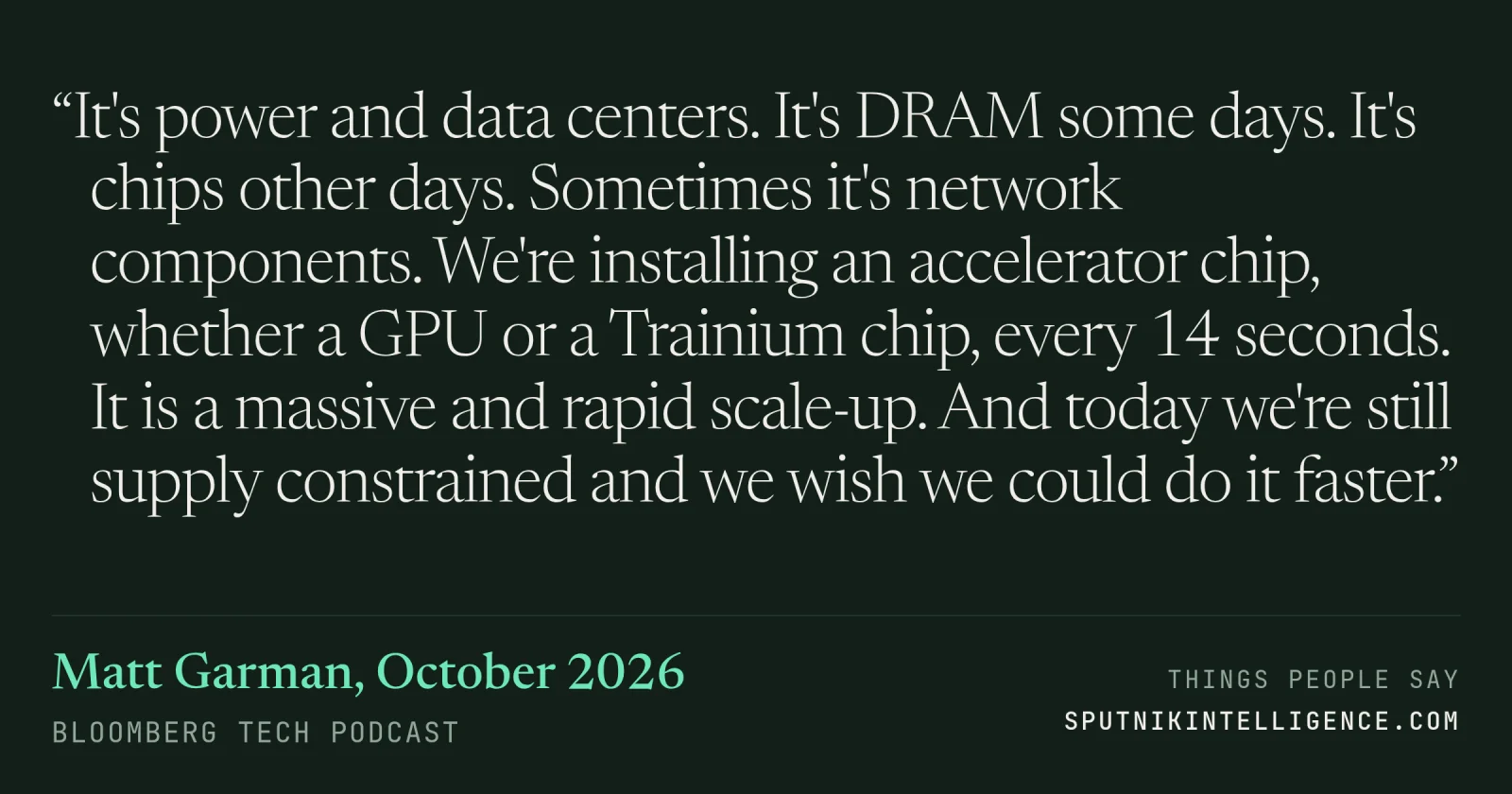
“It's power and data centers. It's DRAM some days. It's chips other days. Sometimes it's network components. We're installing an accelerator chip, whether a GPU or a Trainium chip, every 14 seconds. It is a massive and rapid scale-up. And today we're still supply constrained and we wish we could do it faster.”
Bloomberg Tech · October 2026
Context
Ed Ludlow asked the AWS CEO what the biggest constraint on adding AI capacity is: chips, buildings or power. Garman said it changes day to day and described how far down the supply chain Amazon plans parts years ahead.
Transcript
You are adding capacity as quickly as you can and trying to give confidence to the customers that it will be there when they need it. What is the biggest constraint today, Matt, as you and I speak now? Chips, getting the data center built, power?
Yeah.
Look, the whole industry is ramping up really aggressively, and we are building really, really fast. And so it's day-to-day as to what the biggest bottleneck is. I think we're running really fast across all of those that you mentioned. It's power and data centers to make sure that we have enough space to run for our customers. It's DRAM some days. It's chips other days. Sometimes it's network components other days. And part of what we do for our customers is actually really understand all the way down three levels into that supply chain to really understand deeply what are the components our customers are going to need, how do we get commitments from our suppliers multiple years out, and then ensure that we have all of the processes together so that we can land these in a really efficient way. I think we shared recently, we're installing an accelerator chip, whether a GPU or a tranium chip, every 14 seconds. It is a massive and rapid scale-up. And today we're still supply constrained and we're scaling really rapidly for customers and we wish we could do it faster.
The next big evolution of the business is to sell Tranium outside of AWS next year. I think a lot of people misunderstand how that works in practice, what we mean when we say that, Matt. But it must be a really hard choice because the demand internally is also there for the use of Tranium.
Yeah.
Yeah.
More from Bloomberg Tech