MG

Matt Garman

Things Matt Says on Podcasts

Where to Find Them

Matt Garman has been a guest on Bloomberg Tech (7 times) , Closing Bell (2 times) , No Priors , AWS Podcast , Uncanny Valley | WIRED , Platformer , The Interview , a16z Podcast , Decoder with Nilay Patel , TBPN and Big Technology .

Recently: “Intel Tumbles on PC Outlook, AWS CEO on AI Spending and Growth” on Bloomberg Tech (October 2026); “Building the Cloud for an Agentic World | AWS CEO Matt Garman” on a16z Podcast (October 2026); “China's AI Push Meets Amazon's Cloud Surge” on Bloomberg Tech (August 2026); “Why Amazon is hiring 11,000 junior employees” on Platformer (June 2026); “BIG INTV: AWS CEO Matt Garman Doesn’t Think AI Should Replace Junior Devs” on Uncanny Valley | WIRED (December 2025); “Closing Bell Overtime: Apple AI, Media M&A Tensions and What China Sees Next 12/8/25” on Closing Bell (December 2025).

What They Said

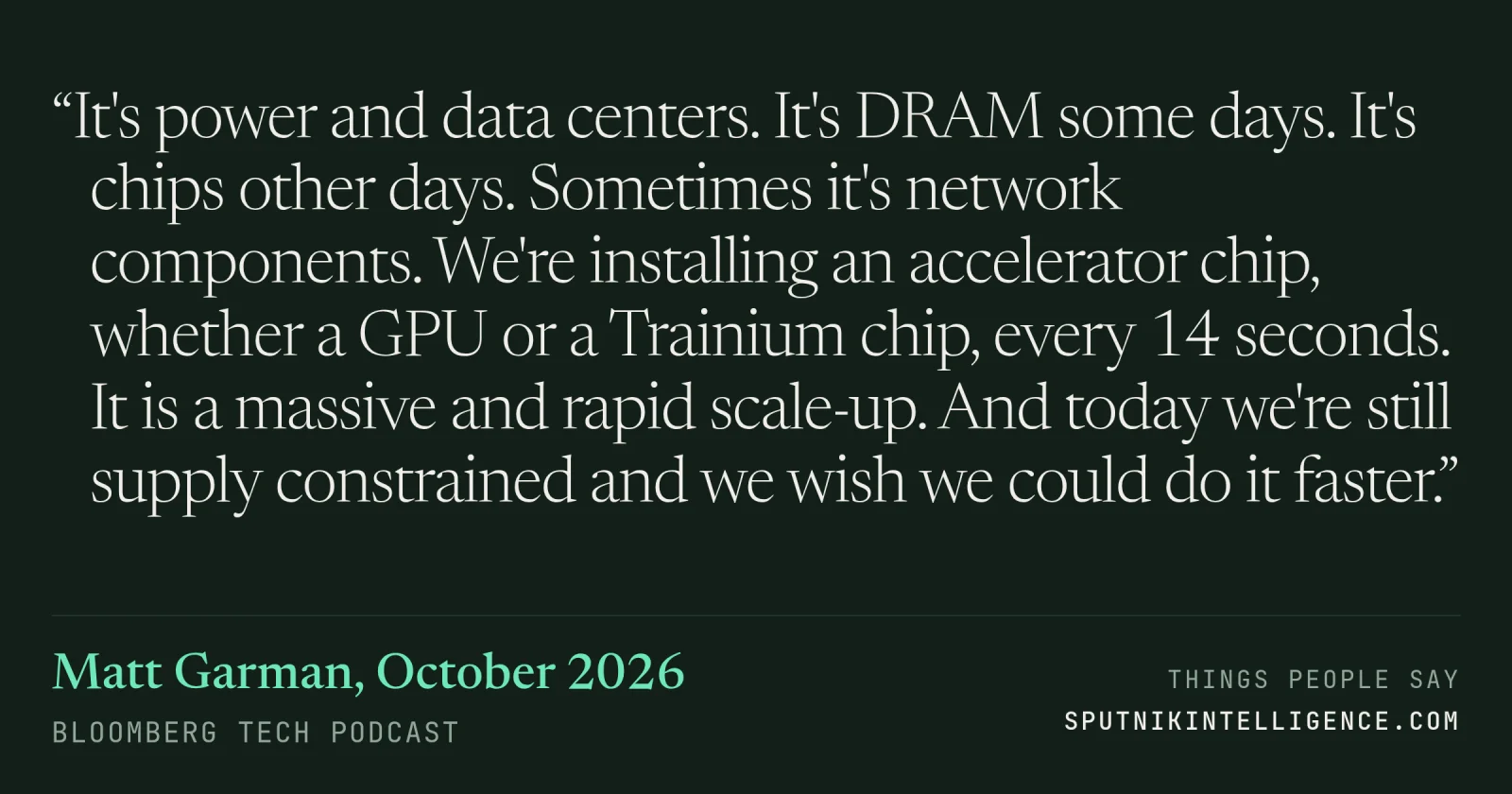
“It's power and data centers. It's DRAM some days. It's chips other days. Sometimes it's network components. We're installing an accelerator chip, whether a GPU or a Trainium chip, every 14 seconds. It is a massive and rapid scale-up. And today we're still supply constrained and we wish we could do it faster.” — Matt Garman, Bloomberg Tech

Ed Ludlow asked the AWS CEO what the biggest constraint on adding AI capacity is: chips, buildings or power. Garman said it changes day to day and described how far down the supply chain Amazon plans parts years ahead.

Bloomberg Tech · 2026-10-30 Permalink → Listen →
Bloomberg Tech Around 34:58 into the episode
Ed Ludlow

You are adding capacity as quickly as you can and trying to give confidence to the customers that it will be there when they need it. What is the biggest constraint today, Matt, as you and I speak now? Chips, getting the data center built, power?

Speaker 2

Yeah.

Matt Garman

Look, the whole industry is ramping up really aggressively, and we are building really, really fast. And so it's day-to-day as to what the biggest bottleneck is. I think we're running really fast across all of those that you mentioned. It's power and data centers to make sure that we have enough space to run for our customers. It's DRAM some days. It's chips other days. Sometimes it's network components other days. And part of what we do for our customers is actually really understand all the way down three levels into that supply chain to really understand deeply what are the components our customers are going to need, how do we get commitments from our suppliers multiple years out, and then ensure that we have all of the processes together so that we can land these in a really efficient way. I think we shared recently, we're installing an accelerator chip, whether a GPU or a tranium chip, every 14 seconds. It is a massive and rapid scale-up. And today we're still supply constrained and we're scaling really rapidly for customers and we wish we could do it faster.

Ed Ludlow

The next big evolution of the business is to sell Tranium outside of AWS next year. I think a lot of people misunderstand how that works in practice, what we mean when we say that, Matt. But it must be a really hard choice because the demand internally is also there for the use of Tranium.

Poonam Goyal

Yeah.

Speaker 2

Yeah.

Speaker names come from our own diarization. The position is estimated from where the line sits in the episode.
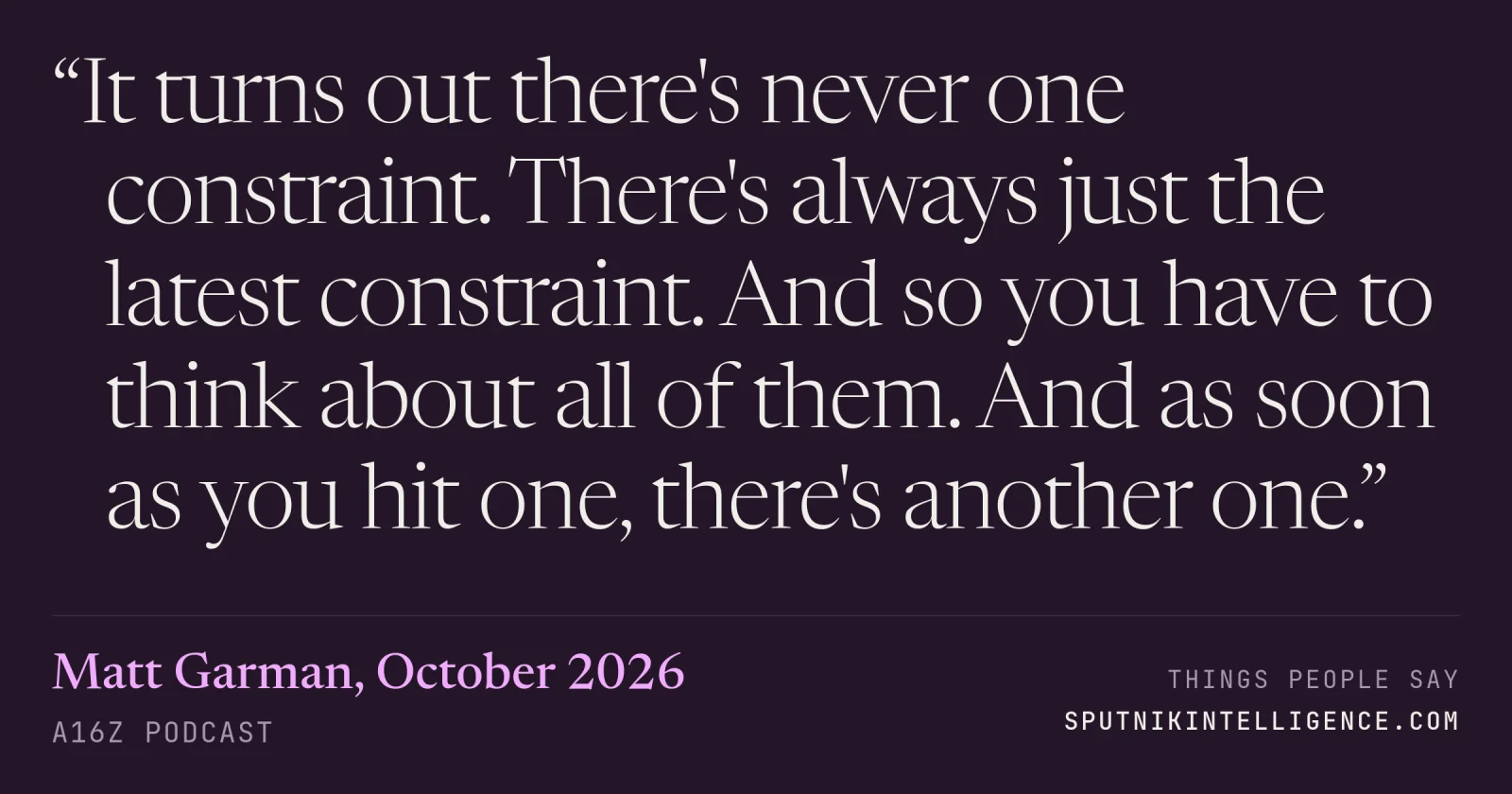
“It turns out there's never one constraint. There's always just the latest constraint. And so you have to think about all of them. And as soon as you hit one, there's another one.” — Matt Garman, a16z Podcast

Garman is asked where supply constraints on AI infrastructure will be most severe in 2027 and 2028. He says he doesn't expect a single one: once power stops being the bottleneck it might be memory, chip fabrication capacity, networking components or connectors. He credits the idea to a book he read as an undergraduate, The Goal.

a16z Podcast · 2026-10-08 Permalink → Listen →
a16z Podcast Around 30:53 into the episode
Matt Garman

I don't know that. I am sure that we're one of the bigger purchasers of components out there for sure. And who knows about everyone, but that kind of depends on how you think about them and how you measure. So

Raghu Raghuram

that I was leading to is where do you see the constraints being most severe, let's call it 27, 28? And where do you see the constraints easing up?

Matt Garman

Yeah. It's funny. So I'll answer this in a roundabout way, but I remember that in undergrad, we actually, this is a long time ago, and I never thought this would be like a useful book that I read, but we read the goal. And the goal, right? And so it turns out there's never one constraint. There's always just the latest constraint. And so you have to think about all of them. And as soon as you hit one, there's another one, right? And so, you know, what do you just like, what is the constraint that's going to happen in 2028? Like, I actually don't think there will be one. I think it's like every month for us, it's do you have enough power? And then as soon as power is no longer the constraint, you know, it might be memory. It might be TSMC capacity. It might be, you know, HBM. It might be networking components. It could be, you know, there's a blip somewhere in the supply chain and like, you know, connectors or whatever it is, right? At some point, you have to…

Raghu Raghuram

drive crisis, and then there was memory crisis.

Matt Garman

Exactly. And so, you know, it's like, I think we think through all of those things. And so we also think about where's their diversification in manufacturing, like all of those kind of pieces we try to work through. And we're never going to be perfect on it, but there's always a different supply…

Raghu Raghuram

Yeah. So obviously there's a lot of wide-ranging debate about data centers. Right. And it's clear that folks like us where we stand, but do you think as an industry, we have not done a good job of explaining why data centers are good for America generally in the world. But how do you, what's the…

Speaker names come from our own diarization. The position is estimated from where the line sits in the episode.

Collections They Appear In