Tae Kim

Things Tae Says on Podcasts

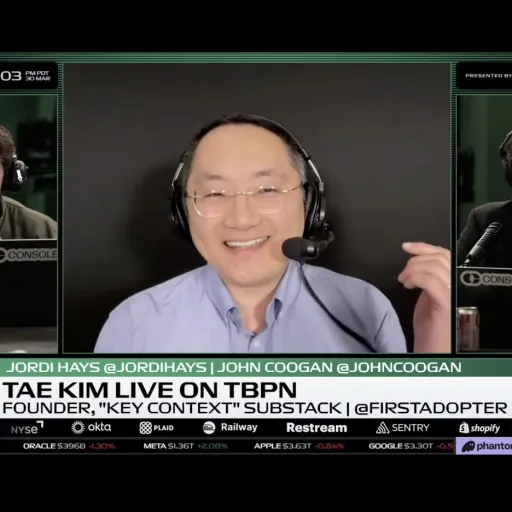
Best-in-class insights and analysis from THE NVIDIA WAY book author Tae Kim. "Key Context" Substack, covering AI, semiconductors and tech. Priors: Barron's, Bloomberg Opinion.

Where to Find Them

Tae Kim writes Key Context by Tae Kim and hosts Barron's Live . They have also been a guest on TBPN (8 times) , Squawk Pod , Motley Fool Hidden Gems Investing , The Investor's Podcast (We Study Billionaires) - The Investor’s Podcast Network and What's Your Problem? .

Recently: “TSMC Hacked, Vibes Down Outlook Down, NVIDIA v2 | Tae Kim, Ben Smith, Gunjan Banerji, Abhishek Malani” on TBPN (November 2026); “NVIDIA Won’t Be the Same Without Jensen Huang — Tae Kim” on TBPN (November 2026); “Treasury Secretary Bessent: ‘F’ the Iranian Leadership 11/13/26” on Squawk Pod (November 2026); “Anthropic: 8 Most Interesting Things in Its S-1 IPO Filing” on Key Context by Tae Kim (October 2026); “An Interview with OpenAI’s Richard Ho on Why Jalapeño Is a Groundbreaking AI Chip” on Key Context by Tae Kim (October 2026); “An Interview with d-Matrix CEO Sid Sheth on Why 3D-Stacked Memory Compute Is a Game Changer” on Key Context by Tae Kim (October 2026).

What They Said

“If you see what happened in the last week, all the sentiment, like everyone's freaking out, Anthropic IPO is not going to happen. And then someone, very brilliantly at the bottom of the market, leaked the October ARR saying it was going to be over 80 billion to Wall Street Journal. And then sentiment completely flipped around. And now we're all six, seven times oversubscribed.” — Tae Kim, TBPN

The hosts asked whether next week is a bad time for Anthropic's IPO given the market turmoil. Tae Kim says a well-timed leak of its October revenue run rate reversed the mood.

TBPN · 2026-11-13 Permalink → Listen →
TBPN Around 50:58 into the episode
Tae Kim

…they dropped. Exactly. And then Opus 5.5 came out as such a great model that their growth, the way their growth curve looks from the September quarter to October looks great. And Wall Street is not that smart. Like they're kind of like goldfish. They just, you know, what happened this month? Yeah.

John Coogan

Yeah.

Tae Kim

So if you see what happened in the last week, all the sentiment, like everyone's freaking out, anthropic IPO is not going to happen. And then someone, very brilliantly at the bottom of the market, leaked the October ARR saying it was going to be over 80 billion to Wall Street Journal. And then sentiment completely flipped around. And now we're all six, seven times oversubscribed. They set the thing low, and now it's going to go great. And the IPO is going to go bonkers next week. So that's going to help sentiment. Yeah.

John Coogan

Yeah, that makes a lot of sense. And this

Tae Kim

RSI thing, by the way, is very bullish for AI semiconductors because the more advances you get, the more chips you need to buy to accomplish the RSI. Yes,

John Coogan

but it feels like it's bullish for semiconductors broadly, the semiconductor oligopoly. It's good for TPU, Tranium, Intel, AMD, the startups.

Speaker names come from our own diarization. The position is estimated from where the line sits in the episode.
“I think what you're going to see in the next six months is that the gap between Anthropic and OpenAI versus Chinese models is going to widen dramatically. Because the only reason, I mean, this is obvious if you've been following everything, the only reason these Chinese models are good is because they're just distilling the American models. … Both these labs have been cutting off the distillation accounts from China.” — Tae Kim, TBPN

Asked whether cutting China's access to Blackwell chips would widen the gap with open models, Tae Kim argues chips aren't the main constraint on Chinese labs. He says the bigger factor is US labs shutting down accounts used to distill their models.

TBPN · 2026-11-13 Permalink → Listen →
TBPN Around 48:50 into the episode
Jordi Hays

They're just like, we want compute. But the government is taking a different policy, and so you can't look at it as a single stance.

John Coogan

…frontier compute available, the DeepSeek, Moonshot, MiniMax, Ant Group decreases over the next year or two. Now, you could have Huawei and SMIC and SME take off. That's certainly a possibility, but at least in the short term, it feels like China is going to be more GPU-poor in the next year or two.

Tae Kim

So I think the bigger problem for China's models is not that. It's that right now we're going through this RSI thing where Anthropic and OpenAI are hitting apart the RD cycle where AI is just going to take off. And what both these labs have done over the last, I think this has been undercovered, is that they've been cutting off the distillation accounts from China. And I think what you're going to see in the next six months is that the models from Anthropic and OpenAI are the gap between Anthropic and OpenAI and versus Chinese models are going to widen dramatically. Because the only reason, I mean, this is obvious if you've been following everything, the only reason these Chinese models are good is because they're just distilling the American models. And

Jordi Hays

they're buying the same data.

John Coogan

Yeah, there's a little bit of a problem.

Tae Kim

Yeah, yeah. It's mainly installation. And Anthropic's been very good at this, kind of, you know, putting out a document that shows what's going on. And both these labs have been clamping down on it. And as RSI takes effect, I think the leadership of the American AI labs are going to really show up.…

Speaker names come from our own diarization. The position is estimated from where the line sits in the episode.
“I did over 100 interviews. It was focused on how NVIDIA was built, how effective it was at business culture. But I did ask: are there any negative behaviors I should worry about? And no one said infidelity. All the negative behavior, dozens of stories of him, all the bad behavior was him berating executives and employees in meetings. … That's his standard operating procedure for 30 years.” — Tae Kim, TBPN

Tae Kim, who wrote a book on Nvidia, is discussing the allegations that forced Jensen Huang out. He says that across his interviews the only bad behaviour anyone described was harsh berating in meetings, which insiders saw as Huang's normal style.

TBPN · 2026-11-13 Permalink → Listen →
TBPN Around 34:29 into the episode
Tae Kim

…top of the New York Times, would you want to do this? And obviously, it did not meet those tests. And yeah, you can't have an affair with the customer. That's a conflict of interest. And you can't have an affair with your subordinates because you have power over these people. That's just game over.

John Coogan

Yeah. Yeah. No, and it makes sense if you're working at a company and you're the one not having the affair. You're like, this is not a level playing field for a company. There's so many reasons why that. I mean, when I was

Tae Kim

writing my book, I did over 100 interviews. It was focused on how NVIDIA was built, how effective it was at business culture. But I did ask: are there any negative behaviors I should worry about? And no one said infidelity. All the negative behavior, dozens of stories of him, all the bad behavior was him berating executives and employees in meetings. You're completely incompetent. We're going to go out of business because you're so incompetent. And that, you know, that's his, frankly, that's just his management style. I saw the Wall Street Journal report on Colette. That's just what he does in every meeting. It's not different. That's his standard operating procedure for 30 years. So I kind of laugh that people are going off. It's also

John Coogan

a standard operating procedure in a lot of companies, not just. Oh, really? Okay. I mean, yeah, going back to the financial crisis, you hear about bankers and hedge fund guys screaming at each other across. John always likes

Jordi Hays

to say the good part of getting yelled at on a conference call is you can turn the volume down.

John Coogan

So the one thing I want to say is I did circle

Speaker names come from our own diarization. The position is estimated from where the line sits in the episode.

Collections They Appear In