 Erik Bernhardsson
On Unsupervised Learning with Jacob Effron
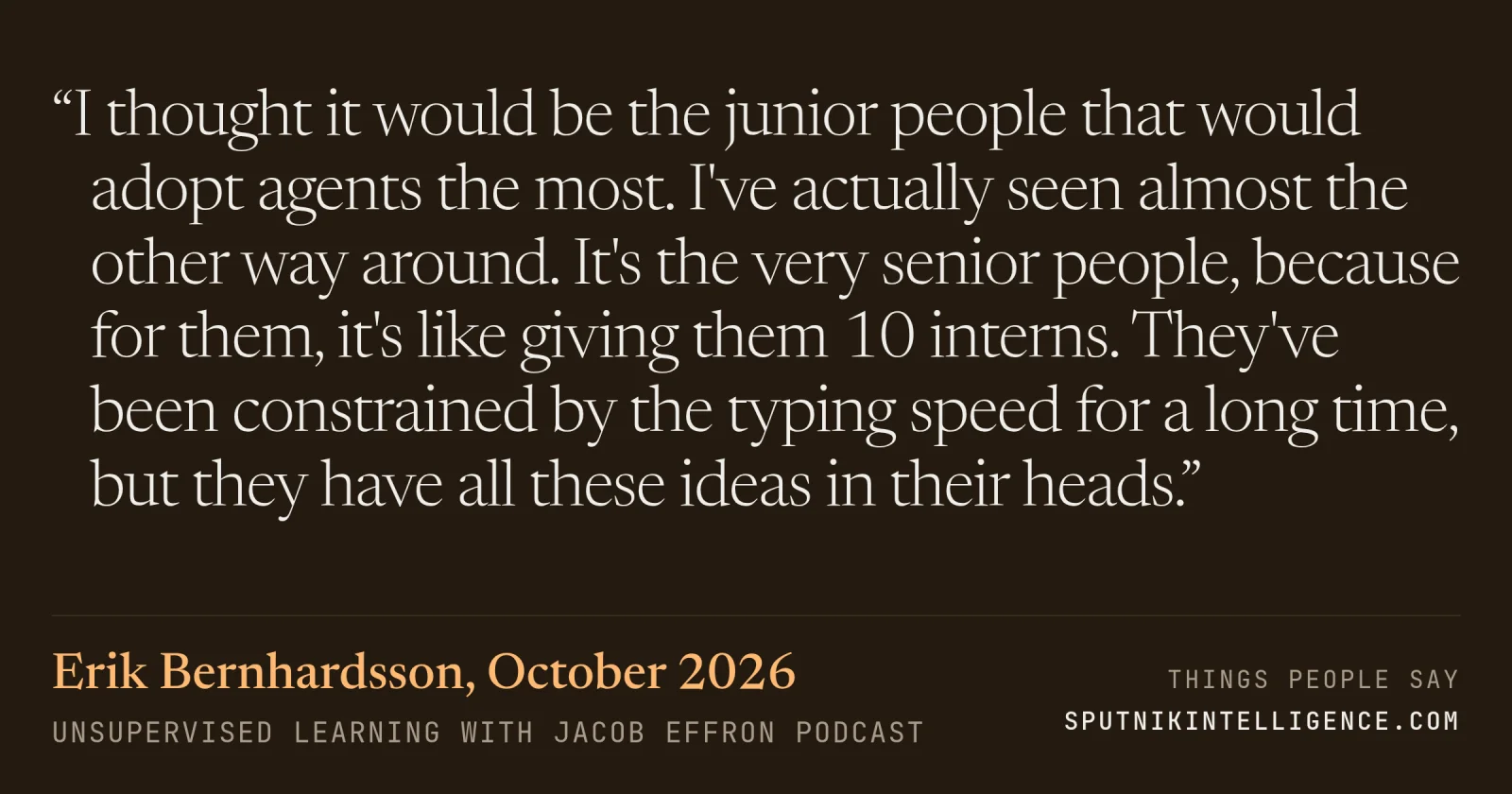
“I thought it would be the junior people that would adopt agents the most. I've actually seen almost the other way around. It's the very senior people, because for them, it's like giving them 10 interns. They've been constrained by the typing speed for a long time, but they have all these ideas in their heads.”
Unsupervised Learning with Jacob Effron · AI Builders · October 2026
Context
Bernhardsson estimates about 95% of the code merged at Modal is now written by agents to some extent. He still thinks good engineers are needed to supervise them, and says some senior engineers have gone "complete agent maxing."
Transcript
…like, how do you, how do you allocate resources? I mean, resource allocation is like basically like, you know, the number one thing that I think a CEO has has to has to really be ruthless about at a company. And like so much value is being created, like allocating the work to the right resources.
…keeping the system running. How much has you guys were building the company pre-Chat GPT and then post-Chat GPT moment? How much has that changed, maybe on the product side, what you guys were doing, but then also when you were thinking about building and the velocity that you can ship software at?
Yeah, I mean, we've always benefited from being quite well positioned at a time where like AI kind of blew up. And that's been incredible to see. And we're powering so many different AI applications today that I had no idea would exist four years ago, five years ago when we started models. So that's been kind of incredible. And like you said, software in itself has also like how we build software has changed a lot. People write, I mean, like, I think probably like at this point, like 95% of the lines of code that gets merged at modal is probably written by agents to some extent. Infrastructure still, I feel like, relies a lot on like agents are like kind of good at it. I've actually been on a tier like the last few days, like building or the last few months, actually, like writing like an insane amount of code using agents. And like, it's kind of incredible, like, what they can build, but like, you kind of still need humans to like supervise them quite a lot. And like, you know, infrastructure has a lot of tail risks around the reliability and taking and making sure that things scale and like…
How have you found the velocity of shipping software has changed what you guys need to do with code review or CI CD or deployment? Have those pieces of your development lifecycle changed at all?
I think a little bit. I think we're coming up against some of those constraints. We've had to spend a lot more time on CI CD. I always like, you know, even long before agents, I always like, you know, I was a CTO for many years. Like, I was always obsessed with CI CD as very, very important to…
But it's interesting to think about kind of the, you know, how different the world is with these really powerful coding agents. And obviously, I think, you know, part of what I believe your co-founders talked about is kind of the shift even in who the consumer of modal is over time, right? From a…
More from Unsupervised Learning with Jacob Effron