 Erik Bernhardsson
On Unsupervised Learning with Jacob Effron
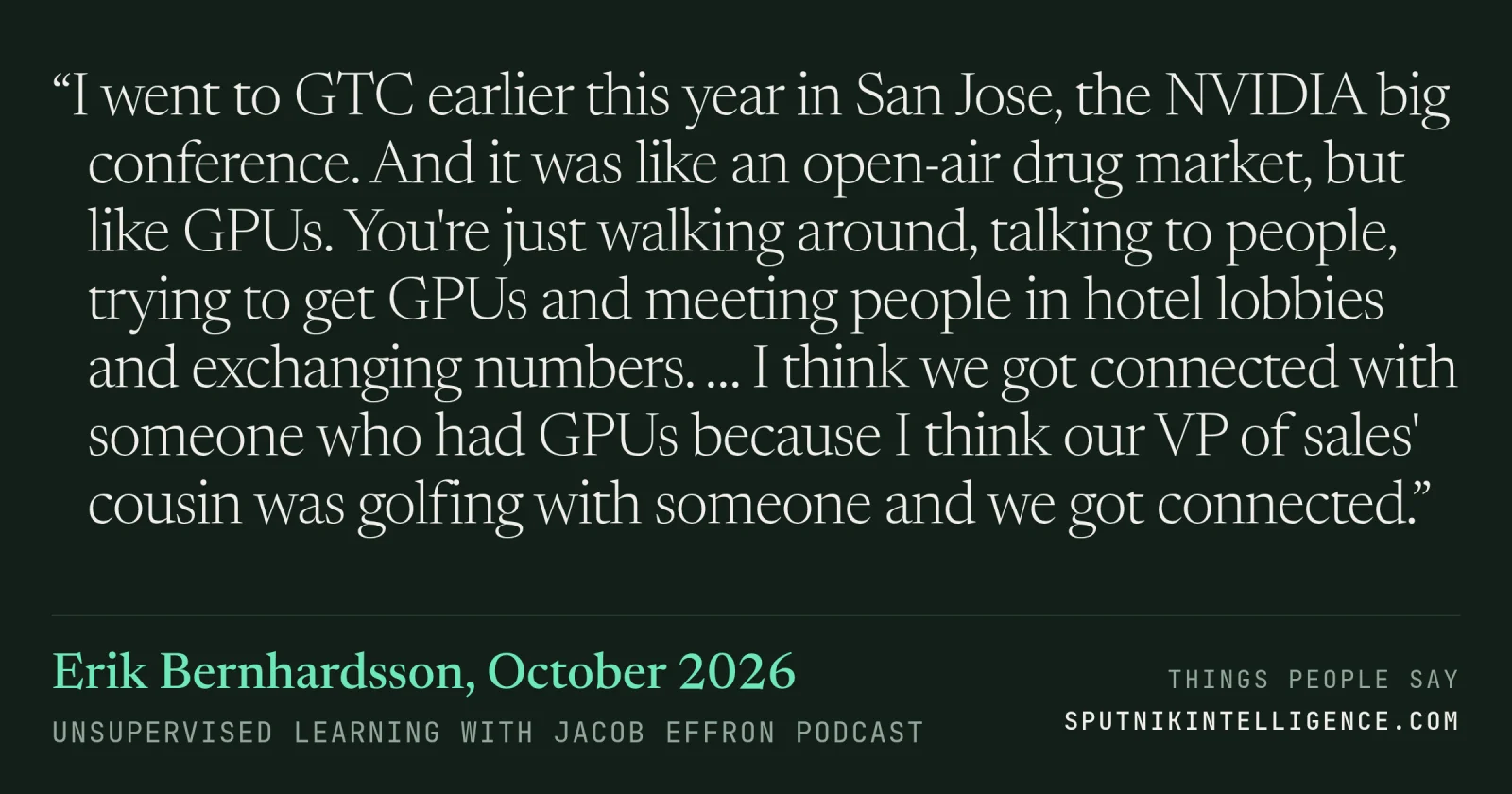
“I went to GTC earlier this year in San Jose, the NVIDIA big conference. And it was like an open-air drug market, but like GPUs. You're just walking around, talking to people, trying to get GPUs and meeting people in hotel lobbies and exchanging numbers. … I think we got connected with someone who had GPUs because I think our VP of sales' cousin was golfing with someone and we got connected.”
Unsupervised Learning with Jacob Effron · AI Builders · October 2026
Context
Asked how organized the GPU compute market really is, Modal's CEO described it as "a lot of late night WhatsApp groups." He argues compute comes in too many shapes to trade on an exchange, so it will stay unwieldy for a long time.
Transcript
…more efficiently. And the value prop of Modal has always been like, don't think about capacity. Like we handle all of that like annoying stuff, the sort of the day-to-day knife fighting of getting capacity and working. We work with 25 different clouds at this point and adding more all the time. How
much of like an organized marketplace is compute these days versus like the wild west, like random people that somehow have capacity and late night text messages?
It's a lot of late night WhatsApp groups and like it's pretty unorganized. Like, I mean, I went to GTC last year, or sorry, earlier this year in San Jose, the NVIDIA big conference they're doing. And it was like an open-air drug market, but like GPUs, like you're just like walking around, like talking to people, trying to get GPUs and, you know, meeting people in hotel lobbies and, you know, exchanging numbers. And, you know, I mean, at some point, we, I think we got connected with someone who had GPUs because I think our VP of sales cousin was golfing with someone and we got connected. Like there's many such cases. Like it's very far from an efficient market. I mean, some people are working on this and I think over time it'll get a little bit more efficient, but it's very heterogeneous. Like compute comes in many sort of different shapes or forms. So I also feel like structurally, like it will not, like it will be a little bit like sort of unwieldy for a long time. Like it's just not something you can like sort of buy and sell on an exchange because it's not like a fungible contract.
Yeah, maybe the key differences being like, I guess, the kind of actual powered shell or size of the cluster and like the chips themselves. To your point, there's a lot of people that have been trying to build like, hey, you know, compute is this fungible single asset that you could build a…
I think a lot of it's actually boils down to reliability. I mean, first of all, it's like, you know, differences in like disk and networking and of course CPU and memory and things like all these things vary and region or like location, like they're all over the world. Like we have GPUs in the US…
Have you found the data providers, the companies
More from Unsupervised Learning with Jacob Effron