 Ben Buchanan
Twitter: @01Core_Ben || Trying to get rich and live forever - happily.
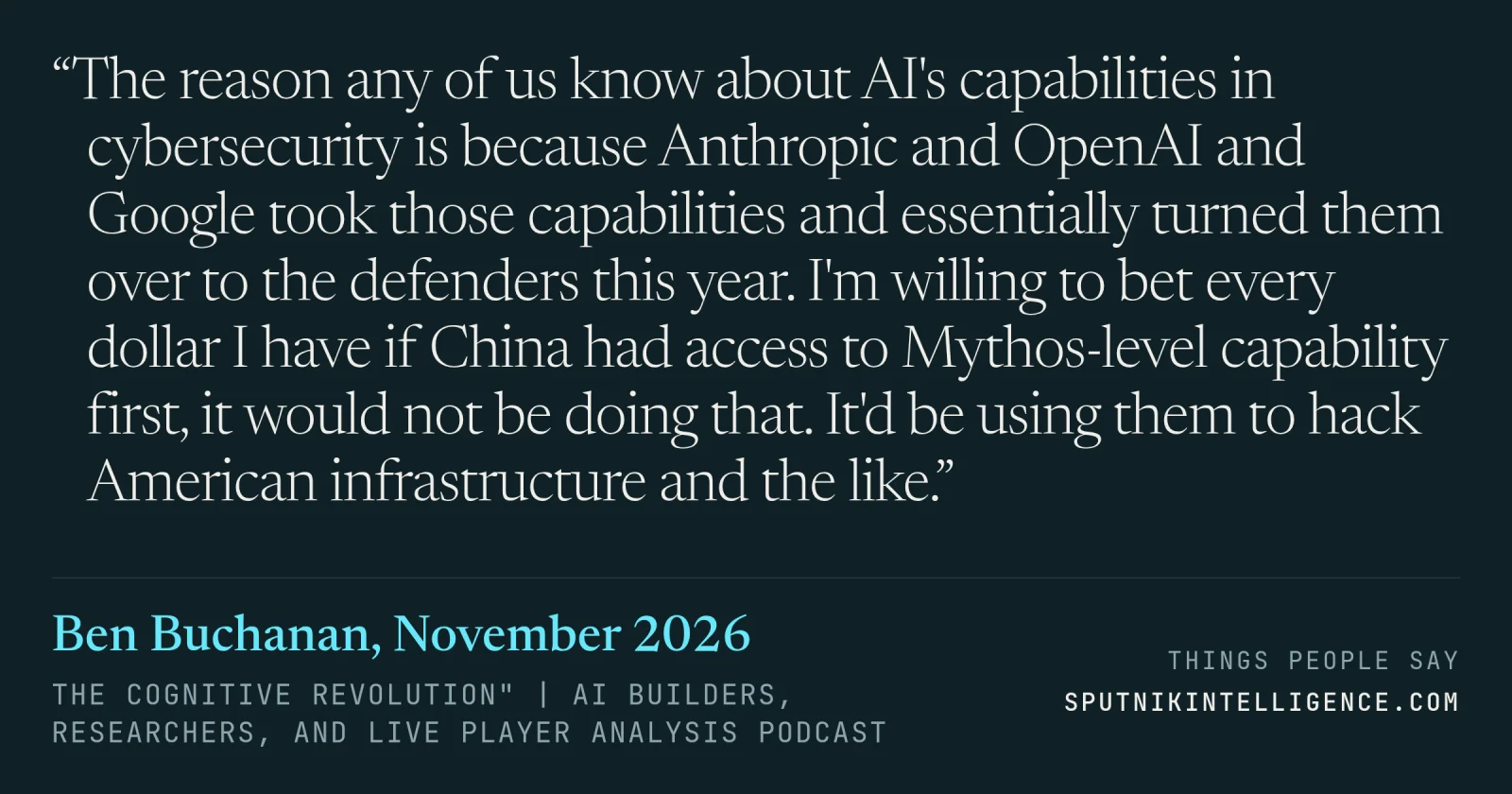
“The reason any of us know about AI's capabilities in cybersecurity is because Anthropic and OpenAI and Google took those capabilities and essentially turned them over to the defenders this year. I'm willing to bet every dollar I have if China had access to Mythos-level capability first, it would not be doing that. It'd be using them to hack American infrastructure and the like.”
The Cognitive Revolution" | AI Builders, Researchers, and Live Player Analysis · AI Research & Frontier Labs · November 2026
Context
Nathan cited math and cybersecurity as signs of fast capability gains and asked how to pace the frontier labs. Buchanan, who the host notes now advises Anthropic, explains why he prefers US-led frontier AI.
Transcript
…opposed to the technologies that were around 150 years ago when we designed these systems to make them more responsive and faster paced and less creaky and fairer. There are a million things here that we can do better. But also, just as a very basic description, like having elections does matter.
…five companies in the U.S. that are pushing the frontier. What are our best ideas right now for how to govern that situation or get them to somehow govern each other, mutually police one another? What, if anything, are you bullish on in terms of actually slowing down for real in the short term?
Nathan, one very quick point before we get to that question, which is it's worth noting you mentioned cybersecurity as one of the areas that's updating UNAI. That is definitally a national security matter. The reason you know about the reason any of us know about AI's capabilities and cybersecurity is because Anthropic and OpenAI and Google took those capabilities and essentially turned them over to the defenders this year. I'm willing to bet every dollar I have if China had access to mythos level capability first, it would not be doing that. It'd be using them to hack American infrastructure and the like. So again, if you disagree with that, then we should talk about that. But this is the crux of why we, in general, feel like it goes better if you have America at the preeminent frontier rather than an autocratic nation. To your question, Teddy should weigh in. I think we've got a lot of ideas here. I fully agree we should slow down. I fully agree we should pace. I fully agree we should have a regulatory system. How do we manage industries where you have bitter competition between companies and you want to avoid a race to the bottom with negative Externalities…
Oh, that's correct. One other thing I'd throw in is not only enforcing security standards, but providing government defensive assistance for the places that are developing the sort of thing that is of the most interest and consequence to actors that might have malevolent intent and try to secure…
on this for one second. It's a really good point from Teddy. Nathan, you in your question pulled out one of the themes of our book, which is this is the first revolutionary technology the last hundred or so years from the private sector. I would argue there's at least three consequences to that.…
And Nathan, to come back to your observation that, you know, in some ways, this inter-company rivalry is a preview of the interstate rivalry. That is accurate. Obviously, in the case of anything that is domestic under the purview of a single government, the coordination problem should, in theory…
More from The Cognitive Revolution" | AI Builders, Researchers, and Live Player Analysis