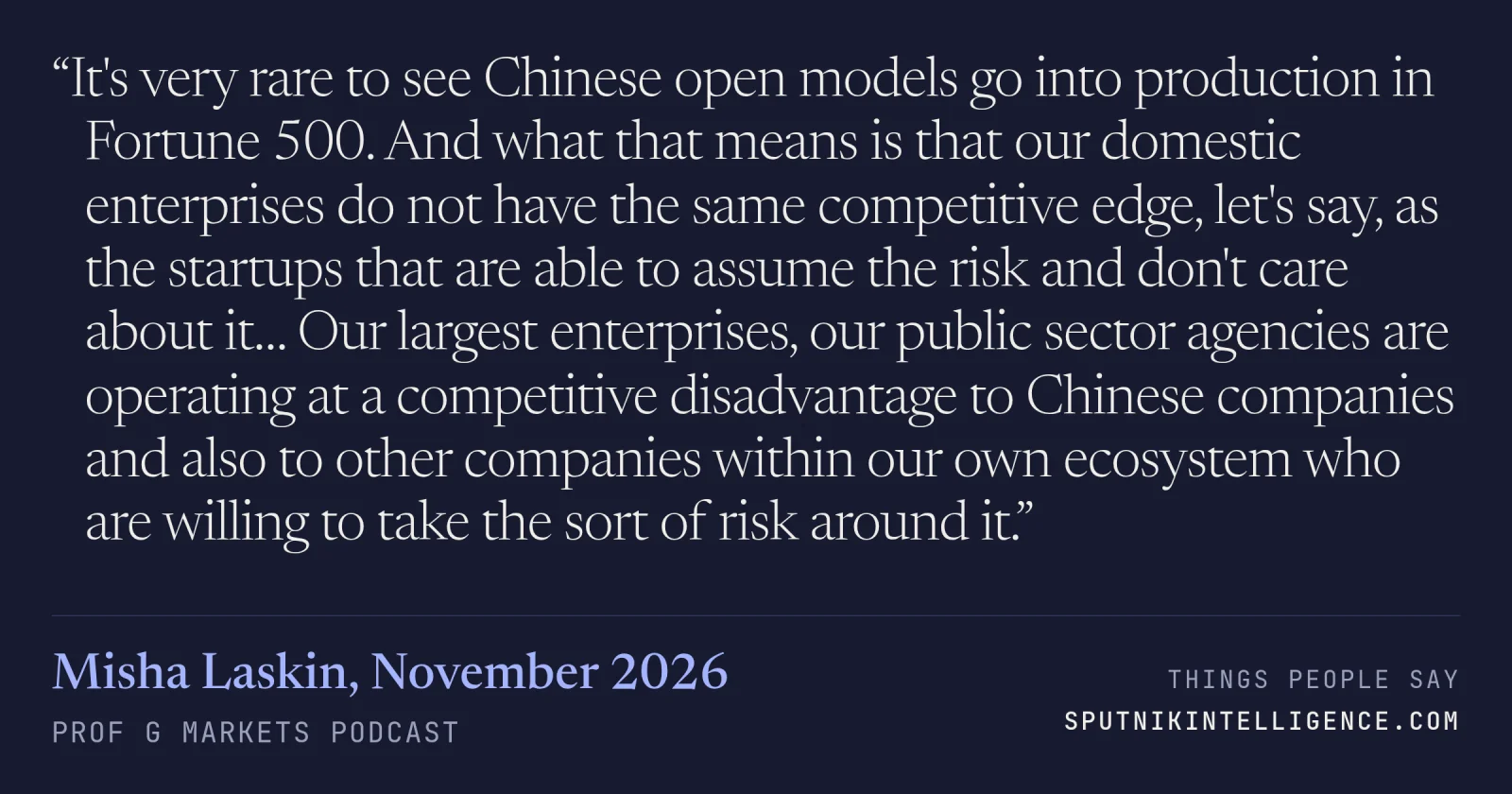
“It's very rare to see Chinese open models go into production in Fortune 500. And what that means is that our domestic enterprises do not have the same competitive edge, let's say, as the startups that are able to assume the risk and don't care about it… Our largest enterprises, our public sector agencies are operating at a competitive disadvantage to Chinese companies and also to other companies within our own ecosystem who are willing to take the sort of risk around it.”
Prof G Markets · Money & Markets · November 2026
Context
Ed Elson had said he was surprised Microsoft was reportedly testing DeepSeek. Laskin replies that large US enterprises and agencies mostly avoid Chinese models, which leaves them behind startups willing to take the risk.
Transcript
…the leader in open model building and that there's an ecosystem that's distributed across the world. And the reason for that is that both domestically and abroad. So domestically, our Fortune 500 enterprises do not want to use. Chinese models for various reasons around risk, perception, regulatory.
But some of them even have, which I've been surprised by. I'm pretty sure Microsoft was testing out DeepSeek for a moment, which I was really surprised by. I might be getting that wrong, hopefully not.
…as the startups that are able to, you know, assume the risk and don't care about it, right? So we need to provide good solutions for, you know, you can kind of think about enterprises who, like instead of renting their intelligence, they want to own it or they want to do something, they want to do a bit of both. You have to provide them a good solution. And so where we are at the market is that our largest enterprises, our public sector agencies are operating at a competitive disadvantage to Chinese companies and also to other companies within our own ecosystem who are willing to take the sort of risk around it. So it's extremely important to have something that's competitive to Chinese models to support our own companies and agencies. And then abroad, it's really important that our allies build on American technology. And this is kind of where the geopolitical part comes in: is that the world abroad will adopt whatever the best stack is, right? Whatever the best technology stack, they'll adopt it.…
When you say the Chinese gave us a gift, I'm like, would they ever really give American Startup gift? And I think what you're pointing to is that there are sort of two theories behind why they would do this. One of the theories is it's not a gift at all, and they're trying to erode the economics of…
That's correct.
Right. So I'm going to assume that's what is happening here. I guess the next question is: why wouldn't the US just ban Chinese models? I've been sort of waiting for that to happen. Like, you know, why not just ban DeepSeek? Why are we letting them flood our market with their open models? I guess…
More from Prof G Markets