 Steve Eisman
Investor known for betting against the subprime mortgage market before the 2008 financial crisis, a story told in Michael Lewis's book The Big Short.
Steve Eisman
Investor known for betting against the subprime mortgage market before the 2008 financial crisis, a story told in Michael Lewis's book The Big Short.
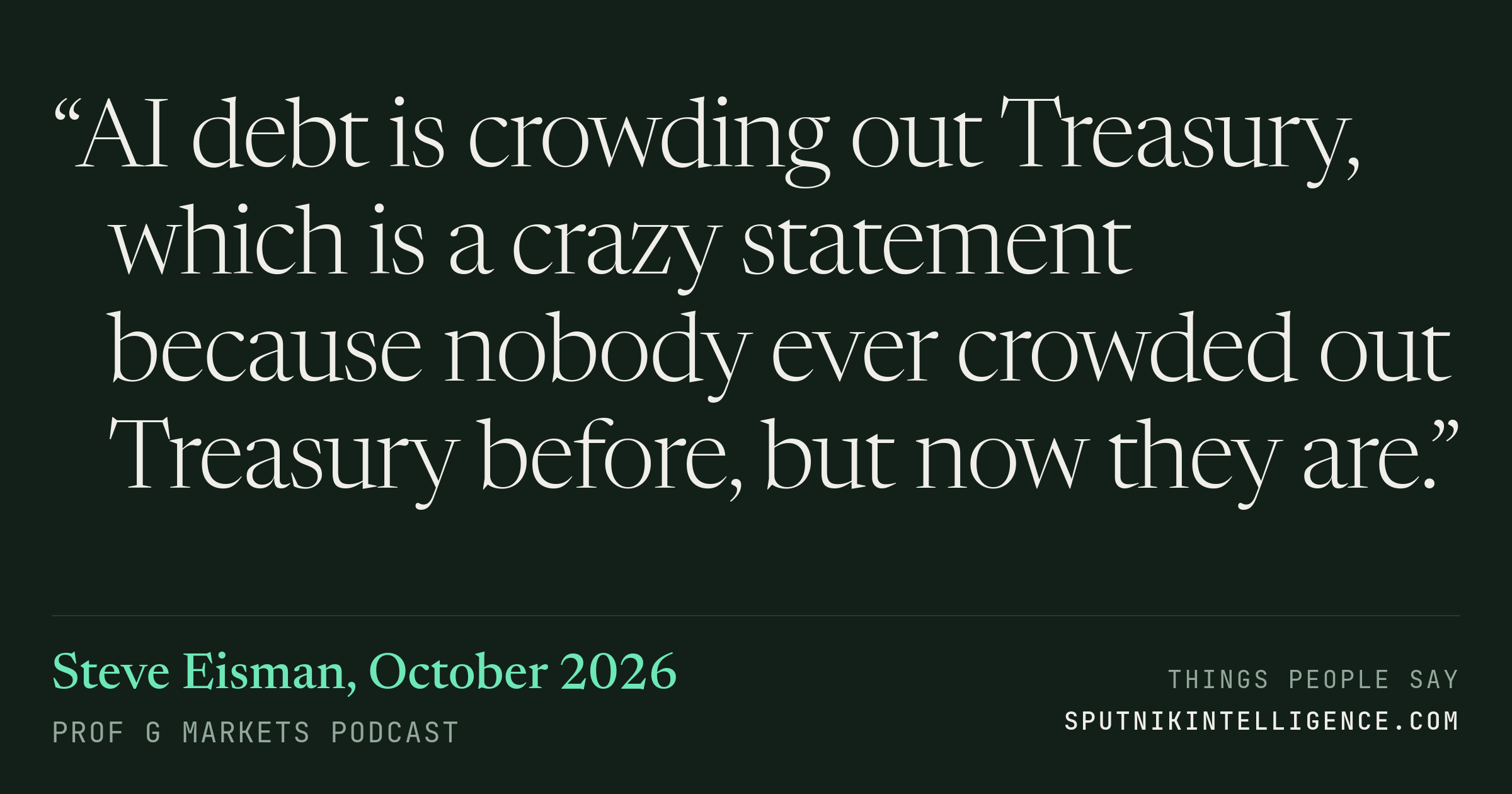
“AI debt is crowding out Treasury, which is a crazy statement because nobody ever crowded out Treasury before, but now they are.”
Prof G Markets · Money & Markets · October 2026
Asked about the recent rate hike, Eisman says he is more worried about the 10-year yield. His argument is that data centers are funded with long-term debt, so roughly $500 billion of AI borrowing this year competes with the government's own borrowing. He says the 10-year would be much lower without AI.
Transcript
You know, for a time, the inflation numbers were actually getting a little bit better, but oil prices are higher. So I think the Fed was basically taking out some insurance. They may take out some more insurance. I'm much more concerned by what's happening with the 10-year. And I think part of the reason why the 10-year is so high, other than that, the oil prices are up and people are nervous, is that AI is a $500 billion issuance this year, and it's having a crowding out effect of the treasury markets. If there was no AI, none, the 10-year would be much lower.
Could you spell out why that would be the case for us?
If you're Microsoft or Meta, Google, well, not Meta, but Google, and you're building a data center, that's a long-term project. You're not raising overnight debt. You're raising long-term debt. You're raising 10-year debt, something like that. So the Treasury has a $6 trillion deficit this year. Now I add on top of that $500 billion in AI debt. And there's a bit of a competition, which didn't exist before. So I think one of the reasons why the 10-year is as high as it is is because, like I said, there's a crowding out effect where AI debt is crowding out Treasury, which is a crazy statement because nobody ever crowded out Treasury before, but now they are. And that's why Scott Besson tried to pull a rabbit out of the hat by trying to buy $6 billion. Dollars worth of long-term treasuries in something called Operation Twist, where he would issue short-term debt to buy long-term treasuries. And it's failed miserably. So the Treasury Department has lost a lot of credibility because when he started, I think the tenure was like at 4.75 and now it's at 5.21.
Yeah, what do you make of his comments about that buyback program? Because his view was that yields were wrong, that the markets were incorrectly saying something about the sustainability of the U.S. economy that wasn't true. And he was trying to correct it back to the truth. Do you agree with him? What do you make of his comments?
I think it's a weird argument. I mean, the treasury markets are pretty efficient. They're more than pretty efficient. They're really efficient. So to say that they're wrong, what are they wrong about? I mean, there's a war going on. The oil prices are higher. You know, diesel fuel is at an all-time high. I mean, what exactly is he? I don't know what he's talking about because what is he saying? That inflation is about to come down. Well, if inflation is about to come down, then treasury yields will come back down when that happens. I mean, I don't get the argument. I really don't.
Just in terms of this AI bubble story, which has been around for a very long time at this point.
More from Prof G Markets