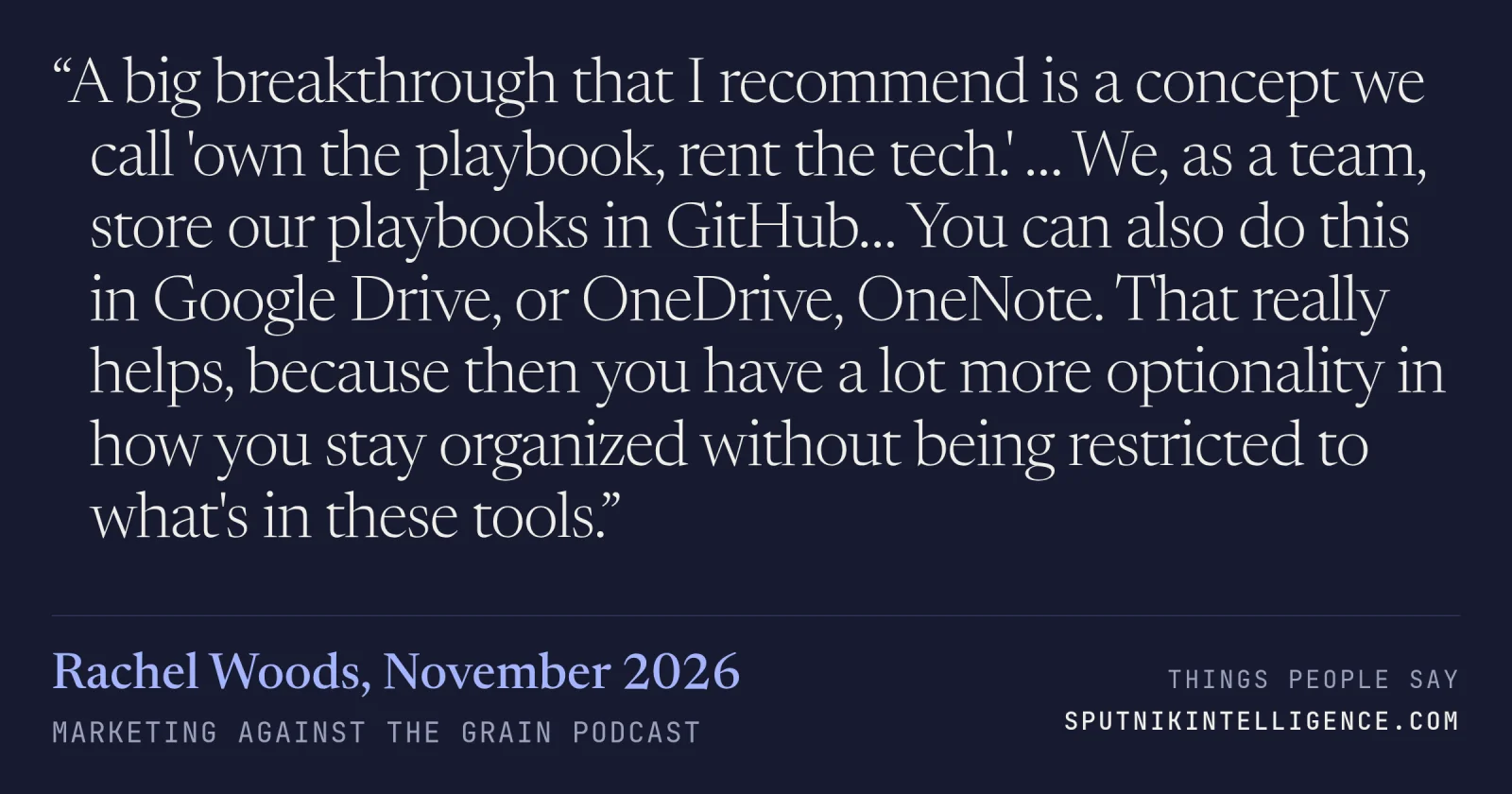
“A big breakthrough that I recommend is a concept we call 'own the playbook, rent the tech.' … We, as a team, store our playbooks in GitHub… You can also do this in Google Drive, or OneDrive, OneNote. That really helps, because then you have a lot more optionality in how you stay organized without being restricted to what's in these tools.”
Marketing Against The Grain · Media & Creator Economy · November 2026
Context
Kipp Bodnar asked how she keeps track of dozens of stacked AI workflows. Her team keeps the step-by-step instructions as plain files in a place they control, so no single AI vendor owns how they work.
Transcript
…they're a huge company, and then, like, we're a, I mean, we're eight people total, only four of us full-time, right? So, this is that is a huge breadth, and we use this as well. So, this is a big picture visualization of what I'm talking about when I say like stacking a bunch of playbooks together.
…for me is like, how do you just keep track of all this stuff? Like, I feel like I'm doing a lot of this stuff, but sometimes like the observability and understanding where things are, I still have a lot of trouble with. So, I'm excited that we're going to kind of dive into how you actually do that.
Yeah. Um, so one of the key things is, and there's a million ways to really organize yourself, but I'll say a big breakthrough that I recommend thinking about is first, just even a concept we call own the playbook, rent the tech. If you can see here, I'm showing a diagram, but this isn't a diagram that's like rendering in Claude or rendering and chat GPT. This is actually pulling from all of our playbooks, which aren't stored in any of those tools. We, as a team, personally store our playbooks in GitHub. If anybody's not familiar with GitHub, it's a place that software engineers have used for a really long time for sharing code. That's where we store and share all of our files with all of our playbooks and all of the other information that we have across the team. But you can also do this in Google Drive. You can have all of your playbooks in Google Drive or in OneDrive, OneNote, like any of these different platforms. And so, that really helps because then you have a lot more optionality of how you stay organized without it being restricted to just what's in these tools.
Love that.
So, yeah, it's own the playbook, rent the tech. Like, if there's like one thing you take out of this, it's that it will help you so much and just be able to really organize yourself and be in control of these systems as you build them.
Yeah, because systems got to change. You need that control, you need that observability to actually continue to evolve them, right?
More from Marketing Against The Grain