 Adam Grant
Organizational psychologist at Wharton, #1 NYT bestselling author of THINK AGAIN, host of the Re:Thinking podcast.
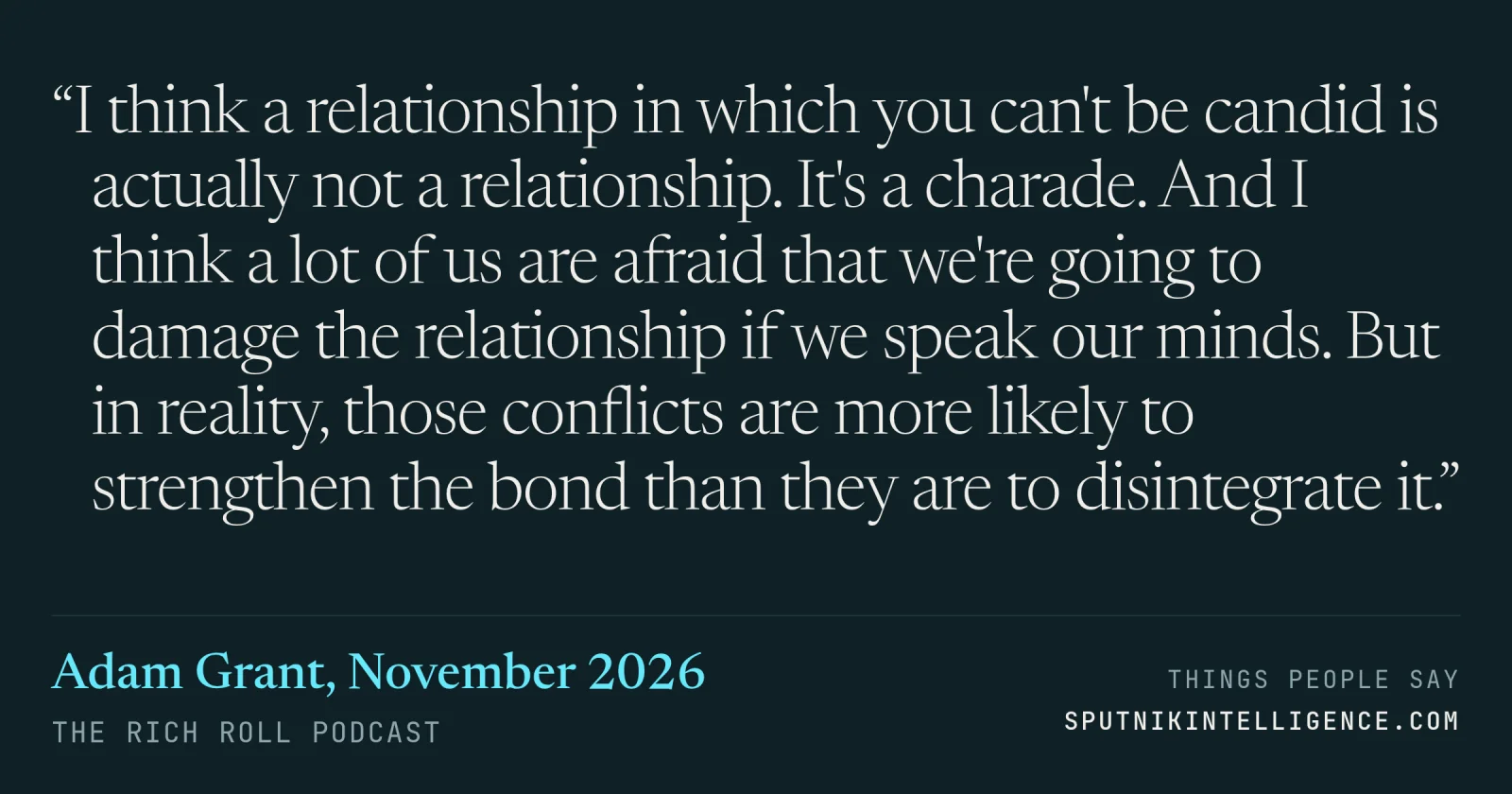
“I think a relationship in which you can't be candid is actually not a relationship. It's a charade. And I think a lot of us are afraid that we're going to damage the relationship if we speak our minds. But in reality, those conflicts are more likely to strengthen the bond than they are to disintegrate it.”
The Rich Roll Podcast · Health & Longevity · November 2026
Context
Rich Roll had said he fears that saying what he really thinks will get him abandoned. Grant answered with research where people told a friend or coworker a hard truth and later felt closer to them.
Transcript
I don't want to deal with that issue. Let's agree or disagree.
…a very fear-inducing thing, you know, and underneath that fear is like, well, if I say what I really think, then, you know, I'll be abandoned or, you know, this is going to be very unpleasant and it's not going to go well. And we're making our own judgments about a future that has yet to transpire.
…member. You're supposed to tell them a hard truth. Some people are randomly assigned to do this, others aren't. And the question is, what happens in a week or two afterward? A week or two later, on average, you feel closer to the person that you've confronted and they feel closer to you too because you have shown that you care enough about your relationship that you want to be honest with them. I think a relationship in which you can't be candid is actually not a relationship. It's a charade. And I think a lot of us are afraid that we're going to damage the relationship if we speak our minds. But in reality, those conflicts are more likely to strengthen the bond than they are to disintegrate it. And the reason for that is when you have to work through a problem together, you are making a commitment to hear each other. You are making a real investment in trying to improve the relationship. We sometimes forget to convey that, or we make the mistake of saying, never go to bed angry. And then you only fight when you're angry and tired, which is not a good recipe for healthy conflict. But if…
You have this illustrated graphic cartoon in the book of like two people having an argument, and in between is like a squiggle that represents the problem, but they're going at each other. And then by distinction, you have them aligned and then they're both like looking at the squiggle as the…
That's a great parallel. I think one of the things that people do constantly, I learned this actually about a quarter century ago. I went through conflict mediation training and I thought if I could learn to help other people resolve their conflicts, I would be less avoidant myself. And it…
On some level, this is illustrated through this roller coaster that you've been on with Brene Brown. Right?
More from The Rich Roll Podcast