
Dharmesh Shah

Things Dharmesh Says on Podcasts

Co-founder and CTO of HubSpot, and creator of Agent.ai, a network for AI agents, and WordPlay.com. Writes the Connecting Dots newsletter on ideas and lessons from building products and companies. Appears on My First Million, Marketing Against The Grain, Lenny's Podcast, Latent Space, This Week in Startups, Crucible Moments and 20VC, on AI agents, one-person businesses and HubSpot's culture.

Where to Find Them

Dharmesh Shah writes NFX . They have also been a guest on My First Million (6 times) , Marketing Against The Grain (2 times) , Rowan's Notes , This Week in Startups , The Official SaaStr Podcast: SaaS | Founders | Investors , Latent Space , a16z Podcast , The Twenty Minute VC (20VC): Venture Capital | Startup Funding | The Pitch , SaaStr AI: How To Sell, Scale, and Win , Lenny's Podcast: Product | Career | Growth , Crucible Moments , In Depth and Masters of Scale .

Recently: “HubSpot’s Co-Founder on Finding Your Next Startup Idea” on a16z Podcast (November 2026); “Dharmesh Shah: “The New AI Era Will Create Millions of One-Person Businesses” on Marketing Against The Grain (September 2026); “Dharmesh Shah on AEO, AI Agents, and the ‘AI App Store’” on Rowan's Notes (December 2025); “$30B Founder: How To Rank #1 In ChatGPT” on My First Million (September 2025); “Talking to a billionaire about how he uses ChatGPT” on My First Million (July 2025); “The Agent Network — Dharmesh Shah” on Latent Space (March 2025).

What They Said

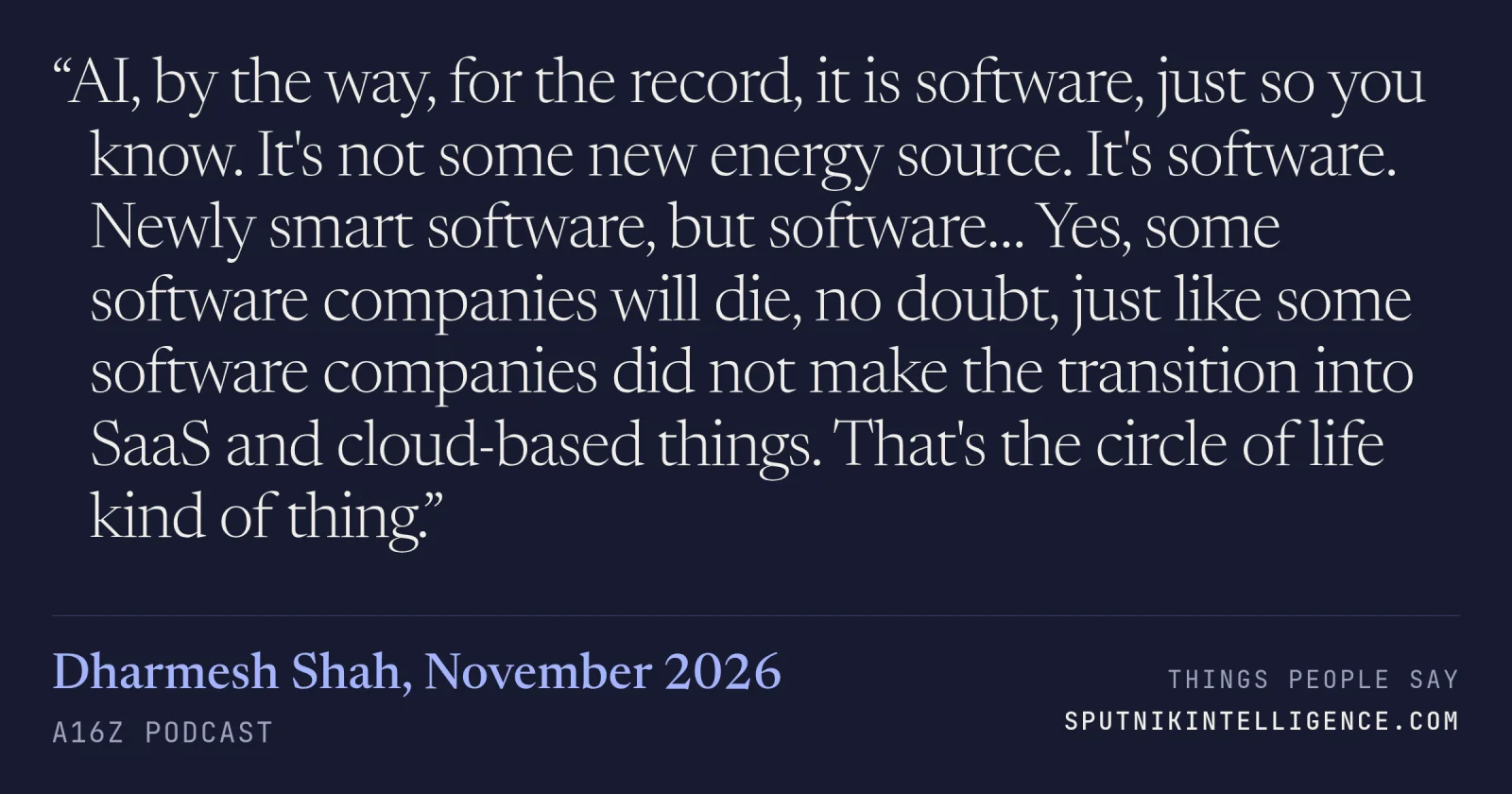
“AI, by the way, for the record, it is software, just so you know. It's not some new energy source. It's software. Newly smart software, but software… Yes, some software companies will die, no doubt, just like some software companies did not make the transition into SaaS and cloud-based things. That's the circle of life kind of thing.” — Dharmesh Shah, a16z Podcast

Dharmesh Shah offers this as his counter to the 'SaaS apocalypse' narrative, arguing that AI opens up problems software couldn't solve before rather than ending software businesses.

a16z Podcast · 2026-11-10 Permalink → Listen →
a16z Podcast Around 31:40 into the episode
Dharmesh Shah

…about this notion of having a second brain. What would the ingestion points be? How do you pull it together? What's the actual agents that you would produce or the work that you would sort of accomplish? But I think that underlying primitive is actually a powerful one. I think it applies to that.

Joe Schmidt

…so fascinating. And I think it's very valuable for that, particularly for this type of user. I mean, it's what they want, of course. How do you then take those learnings and like productize them at the mothership, if at all? And what processes do you need to put in place to make that happen?

Dharmesh Shah

Yeah. The way we've done it, which we've kind of stumbled over the years and tried various mechanisms, is to kind of pull on that original thread of this is a startup within a startup. So we do a couple of things. One is if the thing gets to scale, and we've had this happen multiple times before. So there was a product I launched a couple of years ago called agent.ai. And agent.ai was a marketplace for AI agents. Yes. Back in the day, this is one of my accidentally competed with Sam Altman stories. Although it was focused on go-to-market, it was too horizontal. But there were two parts to it. There was these kind of agent AI marketplace, and there was an agent builder that says, oh, can we let mere mortals actually build these kind of mix of deterministic, non-deterministic agents? And what we discovered is that half of the idea was right, but actually belonged and needed the full HubSpot team behind it. So we did effectively an acquisition, right? So he's like, we're going to take that, and now we're going to make Agent Builder a product within HubSpot or whatever. And that's what it lives at right now. So in the…

Joe Schmidt

It's free.

Dharmesh Shah

Exactly. So yeah, that's, and we sort of try to have an open mind about it. But the nice thing about doing it the way we do it is that. So you think it's like, why can't you just do it within the core core business? Is that those degrees of freedom are super important to be able to run the…

Joe Schmidt

It's so easy right now, especially with some of the national discourse to think negatively about AI and the impacts. But the reality is all the data that I've seen are so exciting. Growth is unbelievable. And I actually think USBot is a really good example of this potential growth, right? It's…

Speaker names come from our own diarization. The position is estimated from where the line sits in the episode.
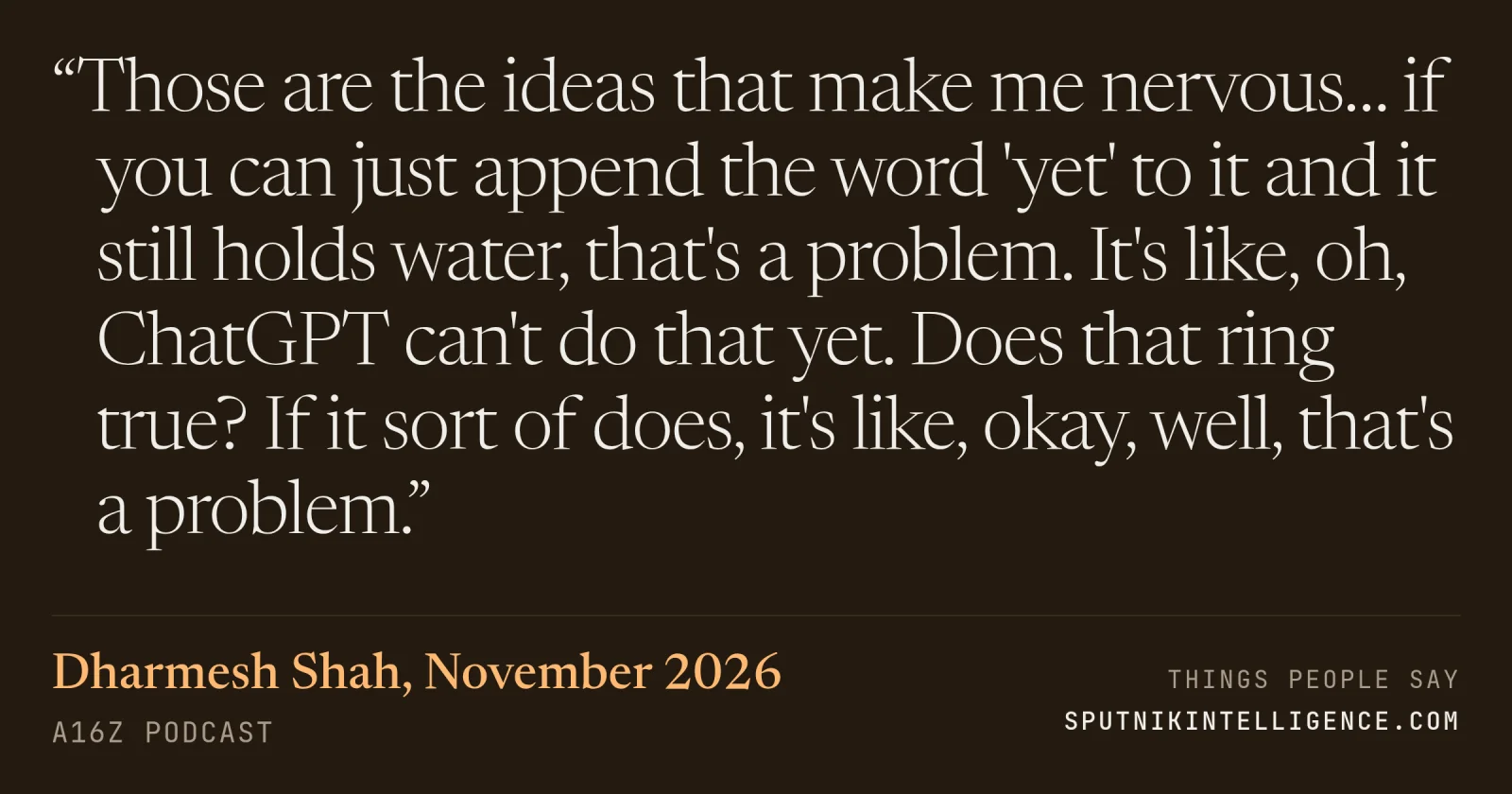
“Those are the ideas that make me nervous… if you can just append the word 'yet' to it and it still holds water, that's a problem. It's like, oh, ChatGPT can't do that yet. Does that ring true? If it sort of does, it's like, okay, well, that's a problem.” — Dharmesh Shah, a16z Podcast

Asked what worries him about startups building where the AI labs are heading, Dharmesh Shah offers a simple test for whether a product is built on a gap the labs will soon close.

a16z Podcast · 2026-11-10 Permalink → Listen →
a16z Podcast Around 21:07 into the episode
Dharmesh Shah

…joy for a developer. How fast can someone get to, oh, I got something working with the HubSpot APIs to the, oh, I made my first dollar, you know, working with the HubSpot within the HubSpot ecosystem. Whatever that is, can we compress that? Can we reduce the time to joy for that class of customer?

Joe Schmidt

…going after. And of course, there's many things inside of the HubSpot experience I think that those horizontal products are trying to pull in. And how you think about the area by which you want to defend and where you can kind of build the most durable value. So would love your commentary on that.

Dharmesh Shah

…the trillion dollar valuations and soon to be market caps. But there's so much opportunity outside of that. And so here's like a, I'm a framework kind of guy. Like here's a mistake I think entrepreneurs make on both sides of it. One, when they dismiss it, they say, oh, well, ChatGPT doesn't do this or Cloud Core doesn't do that. Well, we're going to do this. We're going to fill this gap. And those are the ideas that make me nervous, right? Because there's two things sort of, I think, misguided about that thinking. One is if you can just append the word yet to it and it still holds water, that's a problem. It's like, oh, ChatGPT can't do that yet. Does that ring true? If it sort of does, it's like, okay, well, that's a problem. That's thing number one. Thing number two is what I think of as measuring the product versus the…

Joe Schmidt

totally. And I think that the other piece of this, which you kind of touch on, it's like, okay, of course, with enough focus, but it's also just that the advances or the advantages you're going to build as a startup or as a HubSpot or whoever it is, if you're not building a foundation model, you're…

Dharmesh Shah

it's compounding loops all the way down, Joe. Of course. That's the entire name of the game before AI, after AI. But a couple of things I'll say. So I'm going to rewind. I pushed one idea on the stack. I'm going to pop it off and talk through it. Is that so? One of the questions we get back on the…

Joe Schmidt

said we're dating the recording for the audience. So you now know timestamped.

Speaker names come from our own diarization. The position is estimated from where the line sits in the episode.
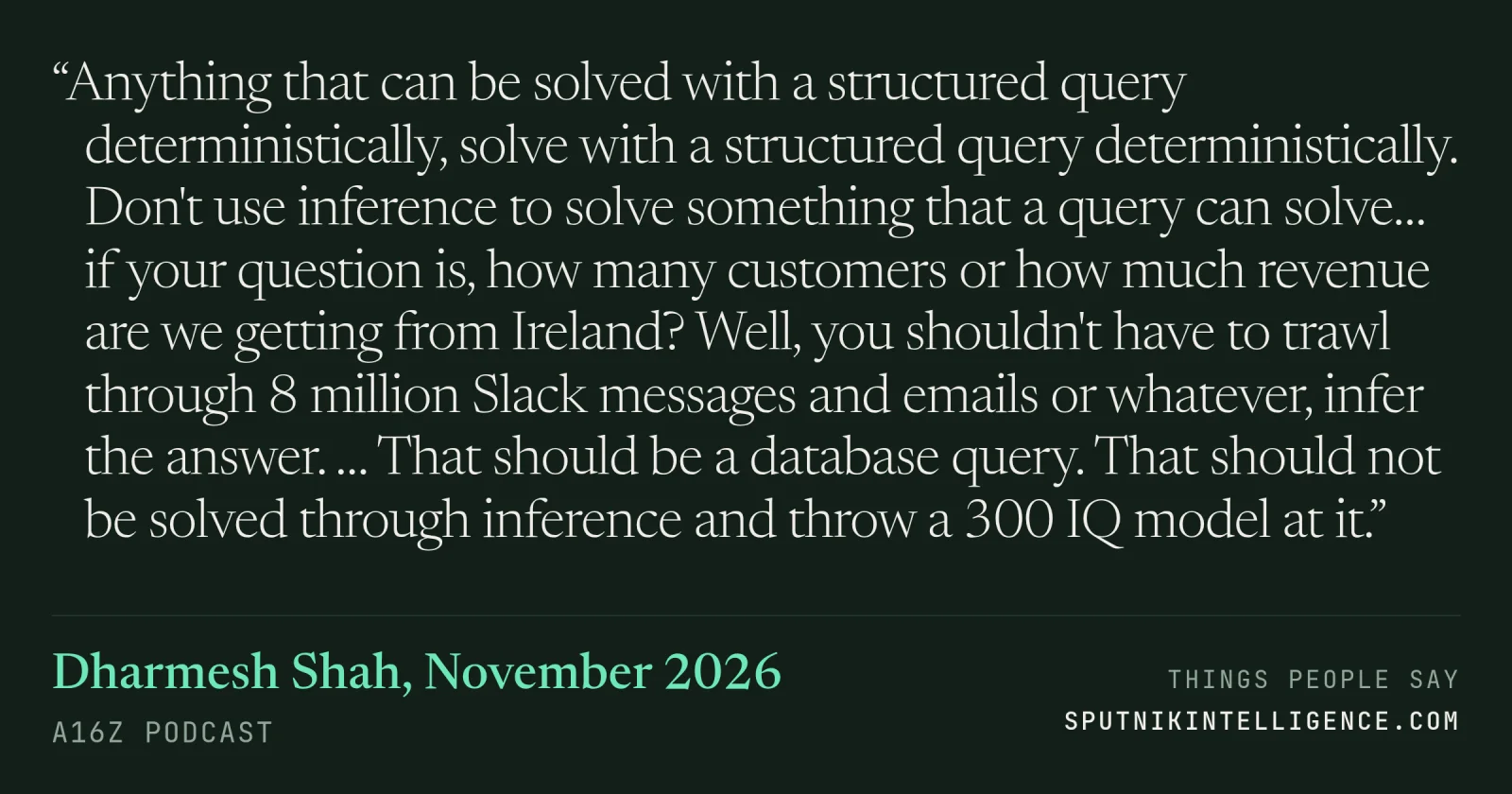
“Anything that can be solved with a structured query deterministically, solve with a structured query deterministically. Don't use inference to solve something that a query can solve… if your question is, how many customers or how much revenue are we getting from Ireland? Well, you shouldn't have to trawl through 8 million Slack messages and emails or whatever, infer the answer. … That should be a database query. That should not be solved through inference and throw a 300 IQ model at it.” — Dharmesh Shah, a16z Podcast

HubSpot co-founder Dharmesh Shah argues that business software should pick the cheapest, lowest-latency way to deliver an outcome. This is his rule of thumb for when not to use an LLM.

a16z Podcast · 2026-11-10 Permalink → Listen →
a16z Podcast Around 22:53 into the episode
Dharmesh Shah

…of great commercial products. So as long as you stay off the yellow brick road, it is completely possible now that you're not going to get margined out or whatever because you have options. There's not just one company providing the one key ingredient to building a. An AI, an AI-native company. No,

Joe Schmidt

…building some sort of increasing return to scale or compounding advantage at this layer. And so I'd love to hear how you think about this at HubSpot or any of the things you're working on as it relates to the loops you try to build in these products or the advantages you're trying to build. And

Dharmesh Shah

it's compounding loops all the way down, Joe. Of course. That's the entire name of the game before AI, after AI. But a couple of things I'll say. So I'm going to rewind. I pushed one idea on the stack. I'm going to pop it off and talk through it. Is that so? One of the questions we get back on the, if you're an entrepreneur kind of evaluating the ideas, it's like, okay, well, so today was OpenAI's dev day, by the way, September 30th. So right before this call is data recording. You're recording it. What's that? I

Joe Schmidt

said we're dating the recording for the audience. So you now know timestamped.

Dharmesh Shah

Exactly. You know exactly when this is being recorded. So HubSpot launched our, we were the first CRM company to do so our connector to ChatGPT over a year ago, and we have similar one for Anthropic. And one of the questions we get sometimes is like, oh, well, doesn't that sort of diminish the…

Joe Schmidt

And I think there's many companies that are navigating through this as they try to understand their own pricing and consumption ideas here, which could be its own dang podcast, I think, for that matter. Maybe last question on this, because I think it's really interesting you talk through this. The…

Speaker names come from our own diarization. The position is estimated from where the line sits in the episode.

Collections They Appear In