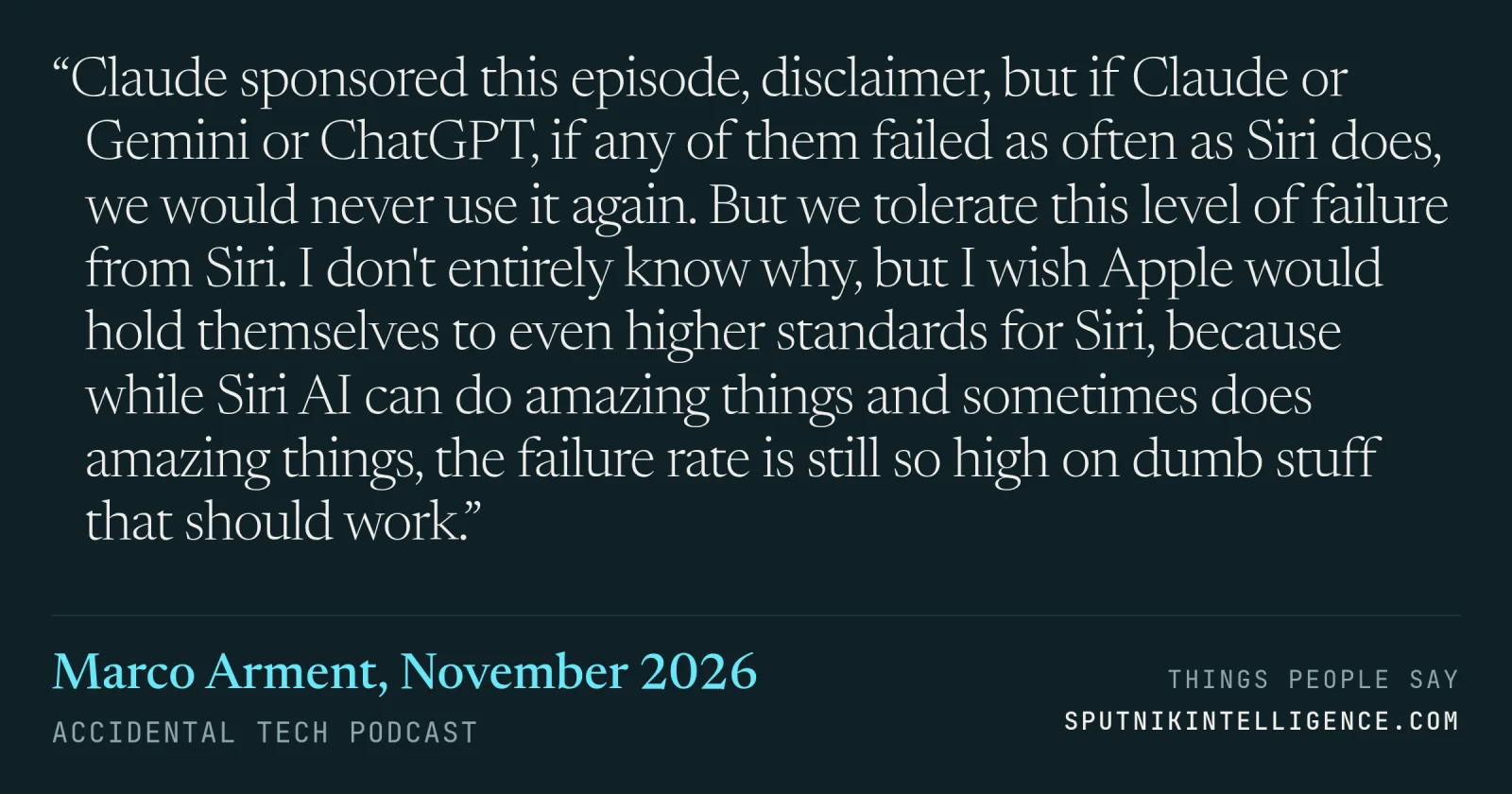
Marco had just listed a run of Siri AI requests, some that worked and some that failed, like walking directions that never came. He argues people tolerate from Siri a failure rate they would never accept from other AI assistants.
Marco Arment
Software developer and podcaster, creator of the podcast app Overcast and the earlier read-later app Instapaper. Was lead developer and CTO of Tumblr from its 2007 launch until 2010, and has blogged at Marco.org since 2006. Co-hosts Accidental Tech Podcast with Casey Liss and John Siracusa, and has hosted Under the Radar, Neutral and Top Four. Appears as a guest on The Talk Show With John Gruber and Mac Power Users.
Marco Arment hosts Accidental Tech Podcast . They have also been a guest on The Talk Show With John Gruber (14 times) , Mac Power Users (5 times) , The Vergecast , Upgrade , The Stack Overflow Podcast , Connected and Focused .
Recently: “716: Take the Null” on Accidental Tech Podcast (November 2026); “715: Diner Lobster” on Accidental Tech Podcast (October 2026); “714: Get the Bigger Pizza” on Accidental Tech Podcast (October 2026); “713: I Have Medium Hopes” on Accidental Tech Podcast (October 2026); “712: Mildly Technologically Traumatized” on Accidental Tech Podcast (October 2026); “711: Hot Dog on an Actuator” on Accidental Tech Podcast (October 2026).
Marco had just listed a run of Siri AI requests, some that worked and some that failed, like walking directions that never came. He argues people tolerate from Siri a failure rate they would never accept from other AI assistants.
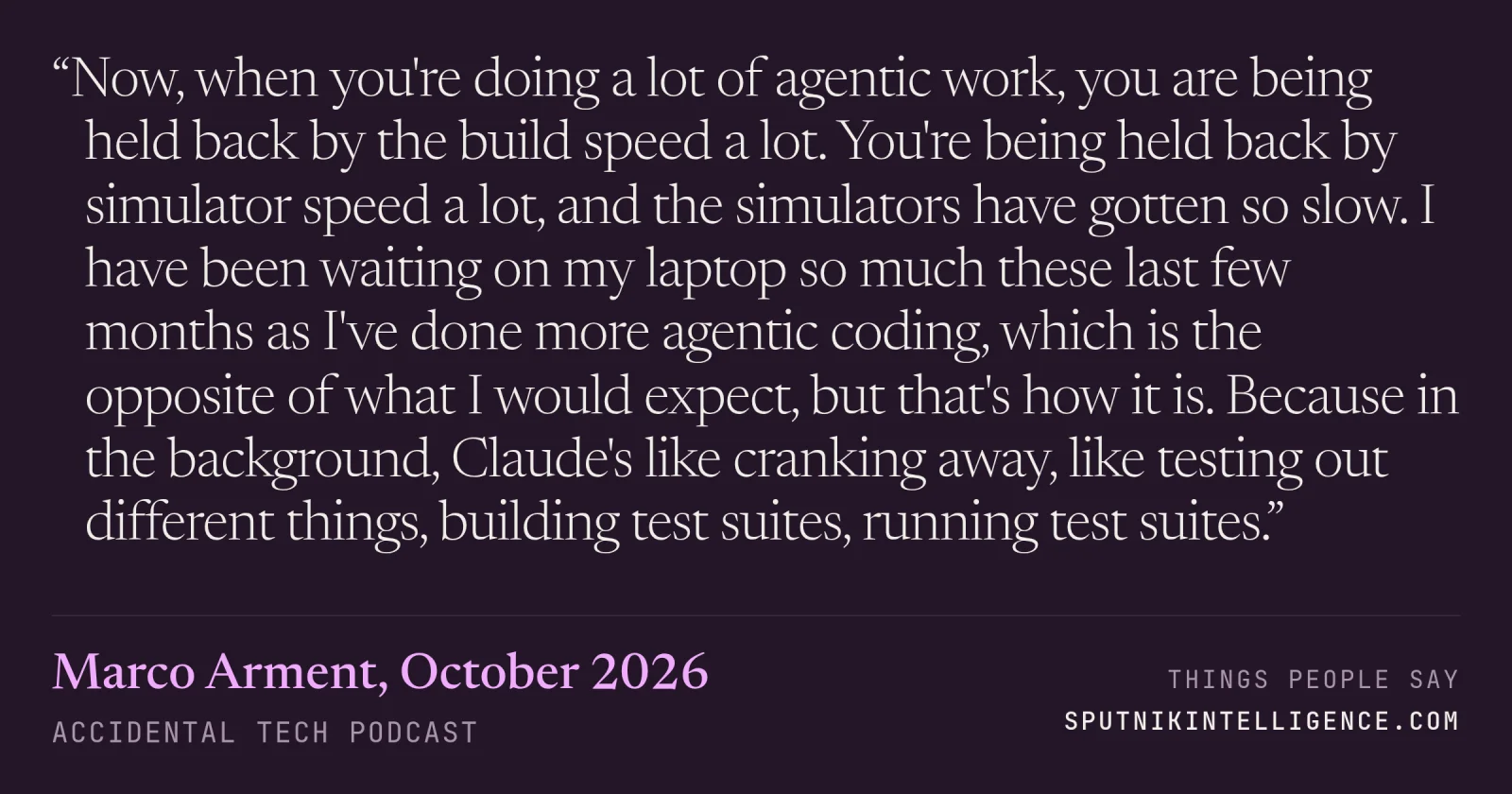
Arment was explaining why he ordered a new maxed-out MacBook Pro to replace two machines. His point is that AI coding agents running in the background make local build and test speed matter more than when he typed all the code himself.
It's very nice. So what I've been doing a lot recently, the number of times that I am away from home has just gone up in the last couple of years. I'm bouncing back and forth a lot more between the beach. I'm doing a lot more stuff, going back and forth with the city. Oh,
he got two of them.
And the other thing that's changed massively in the last six months is I'm doing a huge amount more agentic software development. And what that, so what I've had is desktop laptop and laptop laptop. Desktop laptop is the M3 Max, all decked out. I've used it as a desktop. It stays at my house most of the time. If I go to the beach for the summer, I'll bring it. But for the most part, I'm traveling with the smaller one when I'm just going somewhere for a day or a weekend or something. I'm bringing a smaller one. And I've liked having two different computers in a lot of ways. Casey Liss, you know, like I'd run the beta on the small one, but not the big one and stuff like that. Like I would, I would treat them differently. But one thing that's getting increasingly high of a pain in the butt is trying to coordinate clawed code between the two and trying to coordinate any kind of AI project and options. Operation between the two because these things just don't share well. And also, because like when I when I first got the travel one, the M4, the base model M4 14-inch, I wasn't writing that much code like on the train and on the ferry. But when I would, I'm like, well, there's only so fast I can type, and I'm not going to be held back that much by the build speed of…
This is the way.
And, you know, and look, this stuff is changing a lot. So it's possible in six months I might say that's no longer the right move. I don't know. Probably not, but who knows? But it is getting increasingly obvious to me that the best way for my current computing needs to continue is to have one…
you going to trade in the 16-inch, sell it? Or is someone in your house going to use it? Where has that gone?
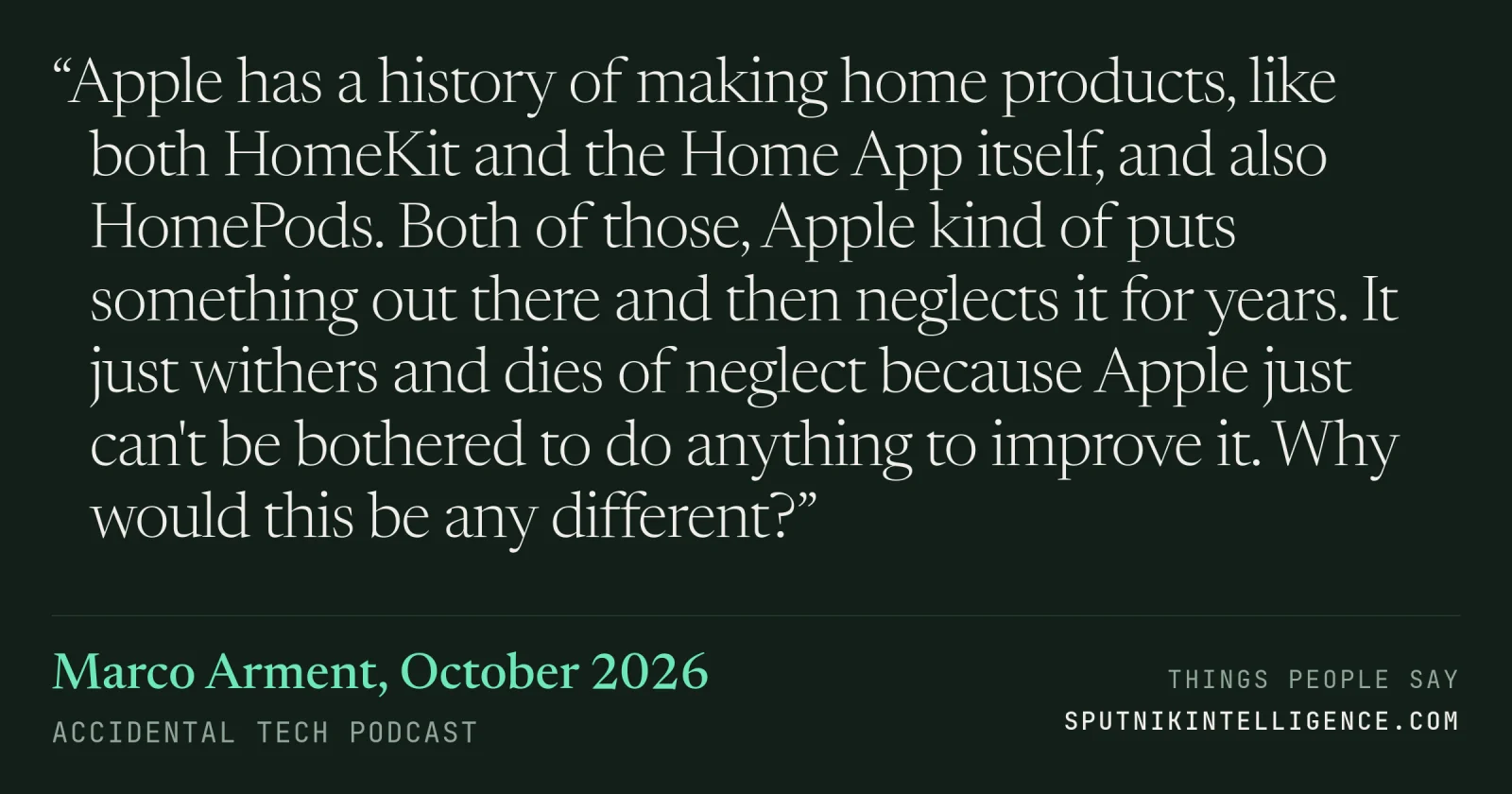
The ATP hosts are judging Apple's new HomeView, a home device built on Siri's AI. Arment says it could be great if Siri gets fast and Apple keeps supporting it, but Apple's track record makes it hard for him to believe in the product long term.
you know, I think it's over 50% of the time at Ask Me Now. It's madness.
…supporting it and it actually doesn't have a lot of bugs and Siri gets fast and is responsive and has a high success rate with what you ask it, this could be really great. But Apple has not shown a strong track record in any of those areas. So I Have a really hard time believing in it long term.
I think the slowness is actually slightly more tolerable for a thing that you're not taking out of your pocket or your phone. Because it's ambient, you can just kind of shout it. And if it takes a little while, as long as I Have the confirmation, I mean, I do this with my like Google Home thing. As long as I Have the confirmation that says, okay, timer is set for 20 minutes starting now. Like as long as I Have that within a few seconds, yeah, it is slow, but I'm okay with it. Whereas when I do it on my phone and I'm watching those stupid little white little leafy things rotate in a circle, I'm like, come on, come on, come on. So maybe the speed will be more tolerable. And in terms of speed, like, what does the, what does the big home pod have? I Have some like ancient watch chip in it or something.
I think it has like an like an S7 or something. I
mean, this has got an A18 in it, which should be a big step up from the other things that we used to talk to, the HomePod Mini and the big HomePod, which are just massively underpowered. I mean, eight gigs isn't a lot, but still an A18 gives me some hope that this will approach the speed of your…
But this thing, yeah, I'm
Arment, an independent app developer, is defending his use of AI coding tools against people who leave one-star reviews because an app was made with AI. His argument is that the tools are good at the tedious parts of programming and bad at deciding what to build and how it should feel. The art comparison is his reply to "anybody could make that".
the Comic Q, I'm like, this is so amazing. And, you know, you said it was a rebranded Pi KVM. It's more like in the way that Mac OS is rebranded Unix. It's like it is based on Pi KVM, but they did a really nice job around it. Yeah, yeah, yeah,
yeah. That's fair. That's fair.
…us is so much better than what a random person who has no experience developing software is able to make because we know what to ask it to do and we know what kind of standards to hold it to. People who are like, oh, it's useless, like anybody could make that. It's almost like when, like in the abstract art world, somebody can make abstract art and a casual observer can look at some, you know, some painting of some really cool looking circles and be like, well, I could have done that. That sold for $20,000. I could have done that. It's like, yeah, but you didn't do that. And the person who did that, their artistic contribution was not that they were the first people to ever think of putting circles on paper. They put those circles on paper in that way. They had that idea to do it at that time with those details and those methods and with that kind of story around it and that kind of marketing. And all of that, those are all really important parts of app…
I mean, I hear you. And certainly it's been a real help for me in Call Sheet. And I think that, you know, in talking to my peers and talking to Marco over the last 24 hours and talking to like underscore and talking to other people, it sure seems like not all of my peers, but a lot of my peers are…
I do not.
Okay.