SS

Susan Solomon

Things Susan Says on Podcasts

Works as a professor of environmental studies at MIT, studying atmospheric chemistry. Led the Antarctic expeditions in the 1980s that identified chlorine from CFCs as the chemical cause of the ozone hole, a finding that reshaped global environmental policy. Appeared on the Are We Doomed? podcast to discuss the political history behind the global ban on CFCs. Received the National Medal of Science in 1999 and shared the Nobel Peace Prize in 2007 as part of the Intergovernmental Panel on Climate Change.

Where to Find Them

Susan Solomon writes Your Undivided Attention . They have also been a guest on [ Center for Humane Technology ] (2 times) , StarTalk Radio , Future of Life Institute Podcast , A Climate Change with Matt Matern and Are We Doomed? .

Recently: “What Ever Happened to the Ozone Hole?” on Are We Doomed? (August 2026); “We Solved Global Crises Before. Can We Do It Again?” on [ Center for Humane Technology ] (September 2025); “The Crisis That United Humanity—and Why It Matters for AI” on [ Center for Humane Technology ] (September 2025); “The Crisis That United Humanity—and Why It Matters for AI” on Your Undivided Attention (September 2025); “The Crisis That United Humanity—and Why It Matters for AI” on Your Undivided Attention (September 2025); “157: Susan Solomon Discusses Renewables, Net Zero, and Climate Solutions” on A Climate Change with Matt Matern (August 2024).

What They Said

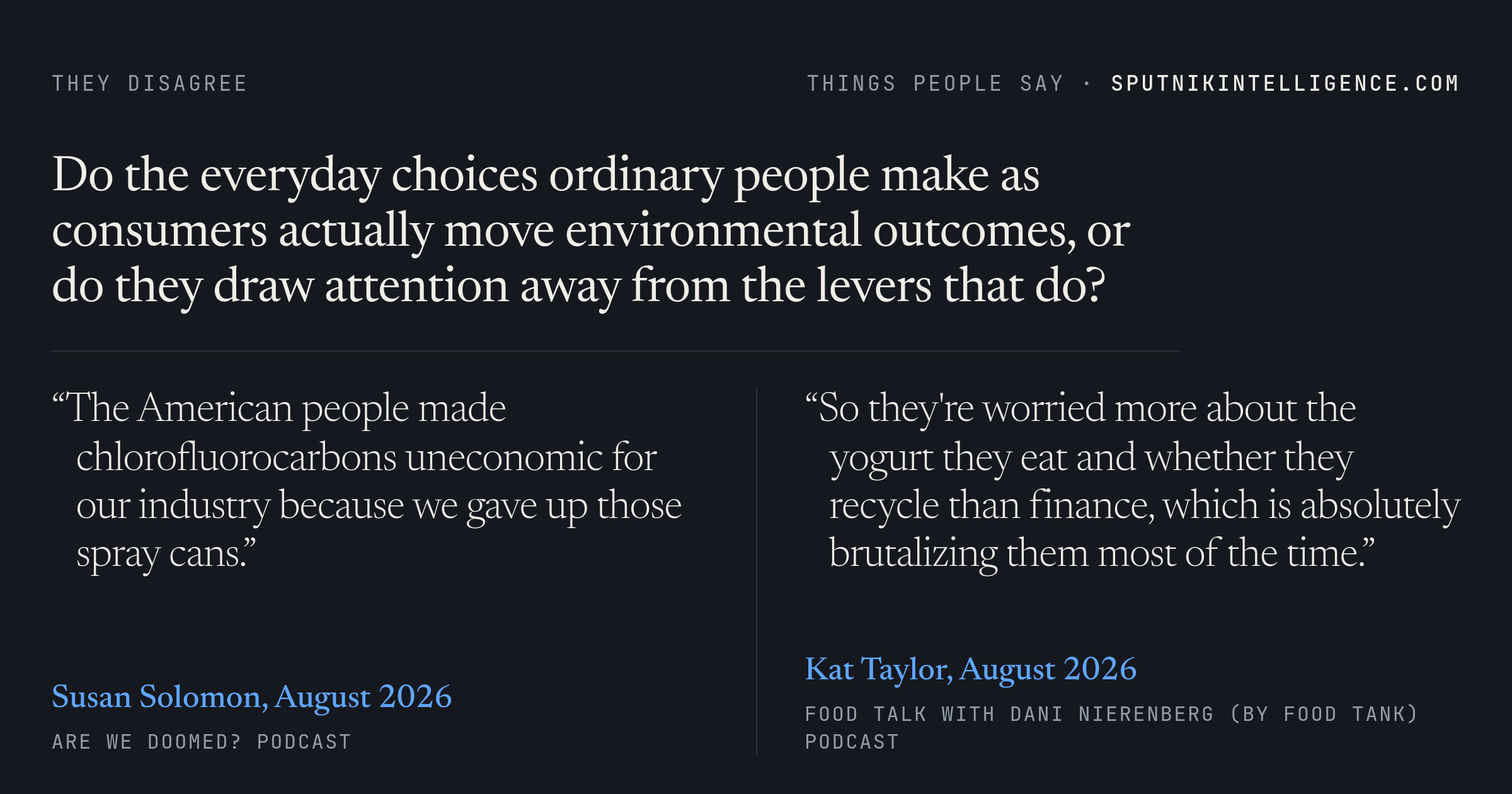
“The American people made chlorofluorocarbons uneconomic for our industry because we gave up those spray cans.” — Susan Solomon, Are We Doomed?

Susan Solomon explaining why the United States held disproportionate leverage in negotiating the global CFC ban: consumer boycotts had already killed the domestic market for the chemicals, so exporters couldn't rely on selling into it regardless of what the treaty said.

Are We Doomed? · 2026-08-18 Permalink → Listen →
Are We Doomed? Around 31:50 into the episode
Speaker 4

Just another way for the rich countries to impose costs on them.

Ben Bradford

Susan, watching the proceedings, saw the chance for agreement jeopardized. It wasn't until the final days of the conference that negotiators reached common ground. Developing countries would get more time before a cap went to effect. Producer nations would subsidize if there was higher cost. Europe came on board. And ultimately, Susan says the deciding factor there was the market power of the U.S.

Susan Solomon

The American people made chlorofluorocarbons uneconomic for our industry because we gave up those spray cans.

Ben Bradford

You couldn't sell here anyway. Then, over in the White House, whether to agree to the treaty also quietly hung on a knife's edge. President Reagan had campaigned precisely against more regulation. His first head of the EPA had dismissed ozone depletion as a threat. His Secretary of the Interior said people should just wear more sunscreen. His cabinet was split as to what he should do. It's not clear what ultimately tilted Reagan to support the treaty, although he loved riding horses on his ranch outdoors in the sunlight, and he just had his own bout with skin cancer right before the papers crossed his desk. The pessimist's version is: even with the science, even with public pressure, even with a visible hole in the sky, this almost failed. The pessimist's version is this was a training ground for later movements denying environmental threats. You could argue the loss on ozone galvanized later wins. In the years after the treaty, the House of Representatives held hearings about, quote, ozone myths. Influential voices grew louder mocking the science, such as radio commentator Rush Limbaugh.

Speaker 1

The ozone hole. Oh no, we're destroying the ozone with cans of hairspray. There is no ozone hole now.

Ben Bradford

And disbelief has survived all the way to the highest levels of government today.
Speaker names from our own diarization · position estimated from where the line sits in the episode
“Amazingly, the country that pushed the most was actually the United States of America.” — Susan Solomon, Are We Doomed?

Atmospheric chemist Susan Solomon, who discovered the chemical cause of the Antarctic ozone hole, describing which country ended up driving the hardest for the Montreal Protocol's global CFC phase-out. It happened during the deregulation-minded Reagan era, which is part of why she calls it surprising.

Are We Doomed? · 2026-08-18 Permalink → Listen →
Are We Doomed? Around 26:24 into the episode
Susan Solomon

hydrofluorolefins,

Ben Bradford

which seems to be better, such as progress. Anyway, it all added up to the largest producer of CFCs also being the nation leading the way to stop using them.

Susan Solomon

Amazingly, the country that pushed the most was actually the United States of America.

Ben Bradford

Cities and towns began enacting bans on CFCs. NASA used its tech to confirm and publish visualizations of the problem.

Susan Solomon

You know, you had these incredible satellite images of the hole in the ozone layer.

Ben Bradford

A giant dark blue wound across the bottom of the world splashed in the pages of newspapers and on TV. There were scientists still debating whether CFCs were the problem or whether the hole was natural. That's the nature of research. But no movement of denial gained a meaningful foothold. And so, action spread.

Speaker names from our own diarization · position estimated from where the line sits in the episode

They Are on One Side of This

Collections They Appear In