
JM

John Morley

Things John Says on Podcasts

Where to Find Them

John Morley has been a guest on On The Merits (2 times) , Odd Lots and Capitalisn't .

Recently: “Why a $2 Billion Law Firm Suddenly Collapsed” on Odd Lots (November 2026); “Trump Attacks Could Have Killed Law Firms, Yale Prof Says” on On The Merits (October 2025); “The Economics of Law Firms’ Resistance to Trump, with John Morley” on Capitalisn't (May 2025); “Trump Orders Could Implode Law Firms With Frightening Speed” on On The Merits (April 2025).

What They Said

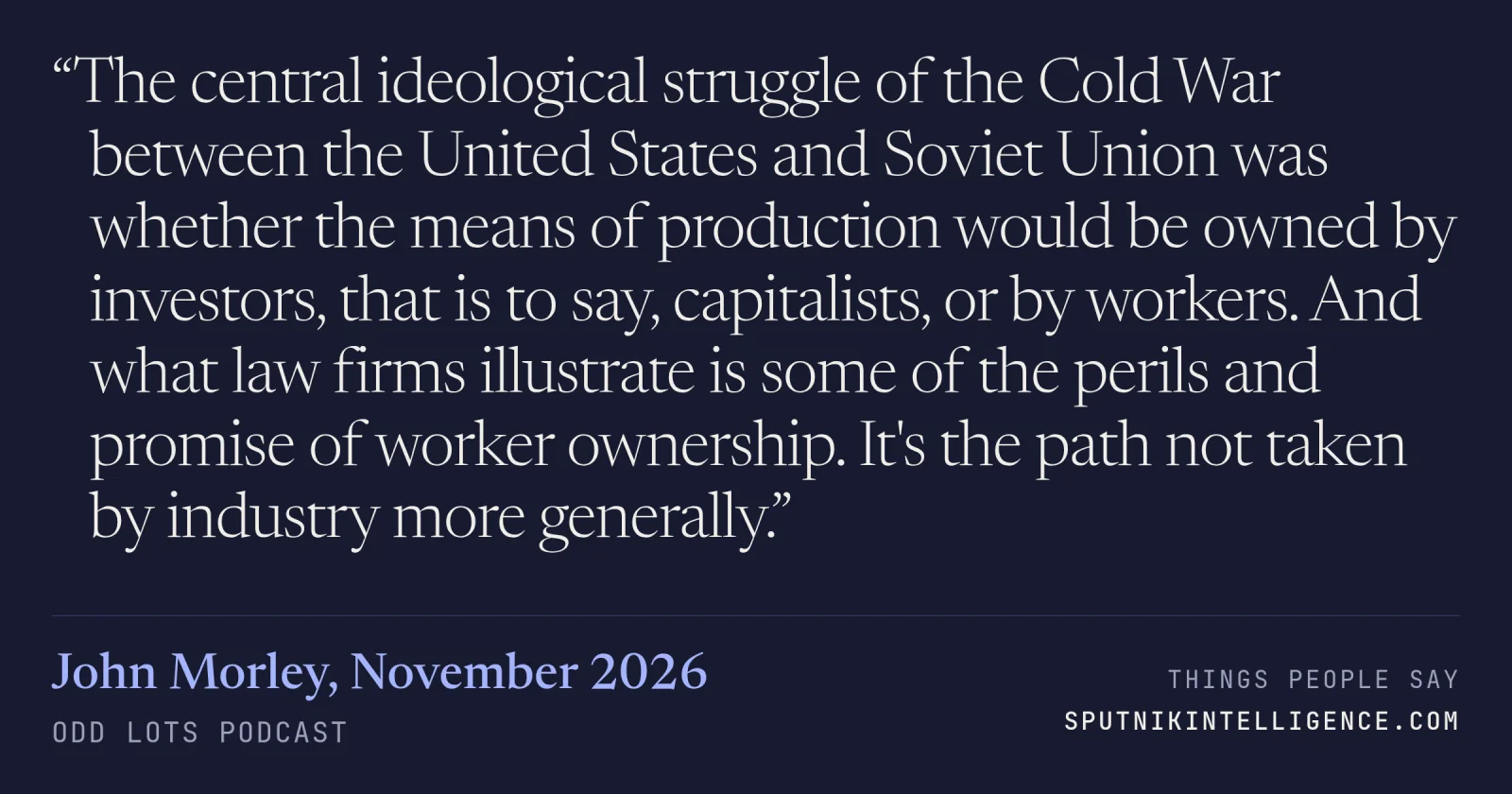
“The central ideological struggle of the Cold War between the United States and Soviet Union was whether the means of production would be owned by investors, that is to say, capitalists, or by workers. And what law firms illustrate is some of the perils and promise of worker ownership. It's the path not taken by industry more generally.” — John Morley, Odd Lots

Asked why anyone outside the legal profession should care about a big law firm collapsing, John Morley gives his broadest answer: partnerships are a live test of what happens when workers own the business.

Odd Lots · 2026-11-13 Permalink → Listen →
Odd Lots Around 46:36 into the episode
John Morley

Let's ask why people should care. Yeah.

Joe Weisenthal

Okay.

John Morley

I think there's a few reasons. One is it has happened to many other firms. We haven't talked about this, but this has happened to dozens of firms. In my paper, I studied three dozen firms. In the years since I published the paper, there's been more. Bingham, McCutcheon, Struoken, Strucken, Levan. There will be more. I promise you there will. Be more. The other is that what's happening at law firms is diagnostic of what's happening in the legal industry generally. Tremendous pressure on profitability, such that if you don't keep up, you're in the doghouse. Huge amounts of lateral partner movement. Also, law firms as microcosms of modernity. Yeah. I also think that what happens in law firms is consistent with what happens in other kinds of what I call impermanent equity businesses. So there's lots of businesses where equity interests don't last forever. Mutual funds and hedge funds, when you redeem, your interest terminates. Mutual insurance companies, which are sort of owned by their policyholders, if you stop renewing your policy, you're no longer an equity holder. They experience some of the same problems as law…

Speaker 2

All right. John Morley, thank you so much for coming on Outbots. Really appreciate it.

John Morley

Truly a pleasure.

Speaker 2

So, Joe Weisenthal thought that was an absolutely fascinating conversation. And I do feel like I need to emphasize just how prescient John's paper actually was. If you read it now, it's sort of line by line what seems to have happened at Wild Gottschall. I do think the question of how to…

Speaker names come from our own diarization. The position is estimated from where the line sits in the episode.
“Although AI will transform the practice of law, very little AI technology will be developed by law firms because it's really hard for the partners of today to incur a big expense for the benefit of the partners of five years from now. … Law firms renovate office space, they don't buy office space. Law firms will renovate AI, they won't buy or develop AI. They will rent it, they'll pay licensing fees to third-party providers.” — John Morley, Odd Lots

Joe Weisenthal asked whether big law firms can fund long-term AI bets out of senior partners' pockets. John Morley applies his theory of the conflict between partners about to retire and those who will stay.

Odd Lots · 2026-11-13 Permalink → Listen →
Odd Lots Around 43:08 into the episode
John Morley

…sister can leave, it feels less like a family. Or maybe in some weird way, it feels more like a family now that there's all these new stories about children cutting off their parents, right? It's a traditional family. It's a modern family is what it is, which is a very disconnected one. Yeah. This

Joe Weisenthal

…they're going to successfully make investments that will just like sort of kind of come out of the senior partner's pocket in a way they might never be long around long enough to see the fruits and actually like sort of like navigate a transition to some meaningfully different type of economics.

John Morley

So, if you believe my story about general conflict, you would predict as I do that although AI will transform the practice of law, very little AI technology will be developed by law firms because it's really hard for the partners of today to incur a big expense for the benefit of the partners of five years from now, because the partners of today and the partners of five years from now will be different. People will enter, people will exit. Okay, but that doesn't mean that law firms never invest at all. They invest in branding, they invest in the training of associates, they invest in the renovation of office space. They've always made investments, just not really big ones. And I predict that's how investment in AI will unfold. They will make investments, just not really big ones. A nice illustration is: law firms renovate office space, they don't buy office space. Law Firm Suddenly renovate AI, they won't buy or develop AI. They will rent it, they'll pay licensing fees to third-party providers. Now, let's talk about Kirkland and Latham, both of which have announced large investments in AI technology. Why are they able to do this? First off, the investments aren't that big in the scheme of those firms'…

Speaker 2

it's not like their outside shareholders are going to call them up on it and be like, You said 500 million. Okay, so just to wrap all of this up, a lot of people will hear us talking about the sudden collapse of a large law firm and think, okay, so what? Poor lawyers, right? Like, the last thing…

John Morley

Well, let me first explain why people do care. It's the wreck on the side of the road. You can't look away. Okay.

Joe Weisenthal

True. Other than Schadenfreude or just rubbernecking. Yeah, okay. I don't know. No, no, no, that's true. That's

Speaker names come from our own diarization. The position is estimated from where the line sits in the episode.
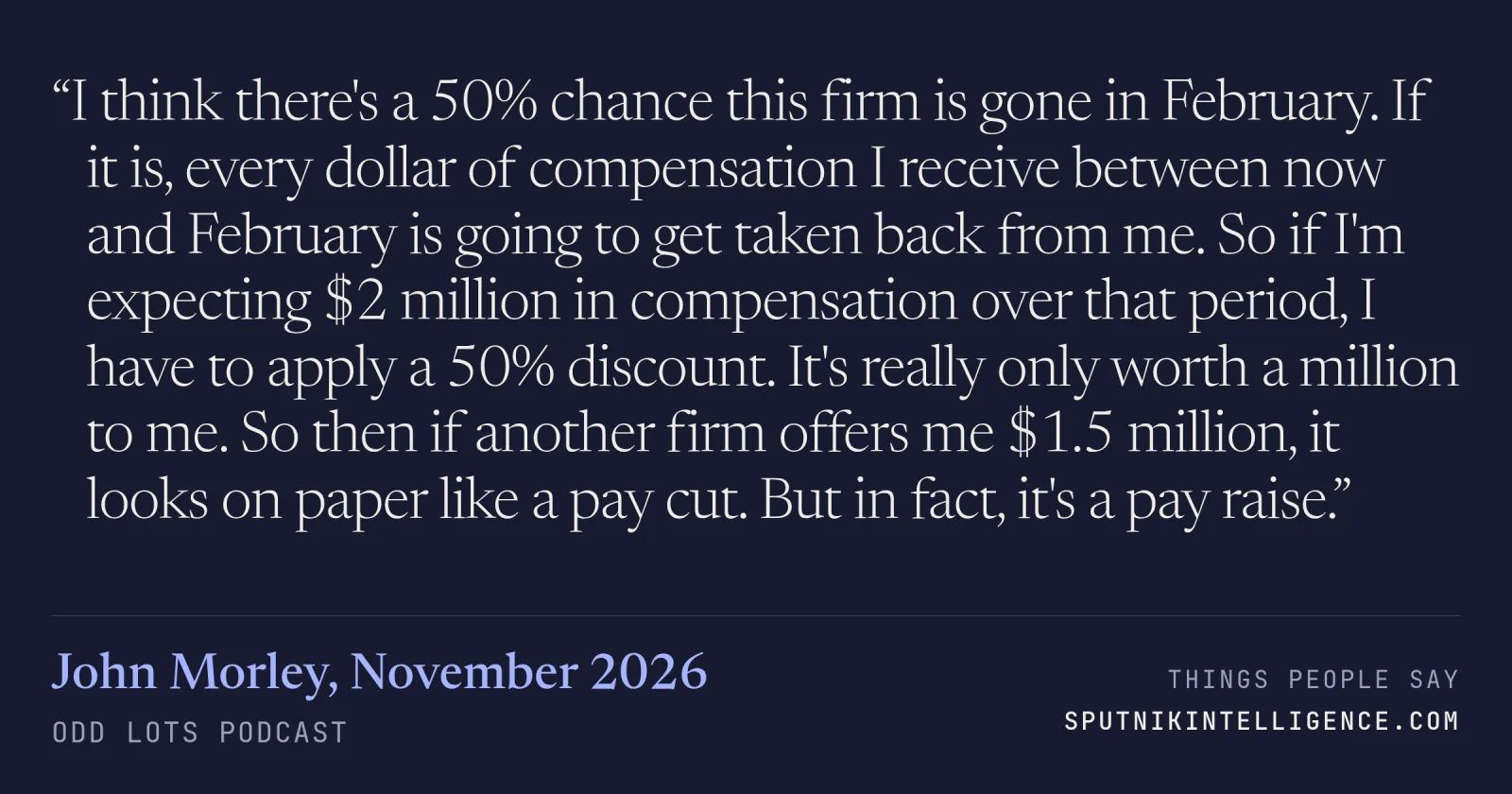
“I think there's a 50% chance this firm is gone in February. If it is, every dollar of compensation I receive between now and February is going to get taken back from me. So if I'm expecting $2 million in compensation over that period, I have to apply a 50% discount. It's really only worth a million to me. So then if another firm offers me $1.5 million, it looks on paper like a pay cut. But in fact, it's a pay raise.” — John Morley, Odd Lots

John Morley walks through what a partner thinks when a star colleague leaves a shaky law firm. Because pay can be clawed back if the firm fails, a lower offer elsewhere can be worth more, which is how a partner exodus turns into a run.

Odd Lots · 2026-11-13 Permalink → Listen →
Odd Lots Around 23:48 into the episode
Joe Weisenthal

…strengthen governance, and create the foundation AI needs to perform at scale. The result? Faster innovation, more efficiency, better business outcomes. Boomi turns a world of AI pain into a world of AI gain. As Boomi says, we got you. Head to Boomi.com to learn more. That's B-O-O-M-I.com.

Speaker 2

…of money to go to a competitor. Maybe I should be thinking about doing the same thing. But on the other hand, maybe I really like my firm. Maybe I really enjoy working in the structured finance unit of Allen and Overy or I don't know what. What are the sort of thoughts going through their heads?

John Morley

So this is what I call the leave-stay decision. You might not wake up as a law firm partner on a Wednesday morning and think, should I stay or should I go? But implicitly, you face that decision every day. And so you're going to walk through three kinds of calculus. The first is to say, well, because that guy left and took revenues with him and the costs of the firm are going to stay the same, we in the aggregate, me and my other partners, have to be paid less as a result. So I'm going to get paid less. But the amount I can get paid by moving across the street to Cravath is going to stay the same. So whereas previously I was making $5 million at Weill and being offered $4 million at Cravath, if now I'm making $3.9 at Weil, suddenly I might begin to move. The second thing I'll ask myself is, well, what about my liabilities? And I'll be saying, hmm, if everybody follows the same logic I'm following, they might leave before me. And then one guy leaves and another guy leaves and all of a sudden we're in a run on the bank. And if the firm ultimately collapses, I'm going to have to give back all or a portion of the money I received from the firm between now and the date of collapse. So suppose that I'm a…

Joe Weisenthal

That was excellent. And I love this idea of like, even though the lawyer doesn't think so, actually, in reality, every day they do wake up in the morning and make a decision whether they're going to leave or stay. Hard not to be reminded of the great 1882 essay, What is a Nation? by the French…

John Morley

I do. And I want to be clear, I don't have any inside knowledge about what I'm just speaking based on what I've read in news reports. But in

Joe Weisenthal

terms of the news reports in your framework.

Speaker names come from our own diarization. The position is estimated from where the line sits in the episode.

Collections They Appear In