SN

Samir Nurmohamed

Things Samir Says on Podcasts

Where to Find Them

Samir Nurmohamed has been a guest on This Week in Business and Hidden Brain .

Recently: “Just Watch Me!” on Hidden Brain (November 2026); “Employees Who Aren't the First Choice Hire Feel Less Included” on This Week in Business (October 2024).

What They Said

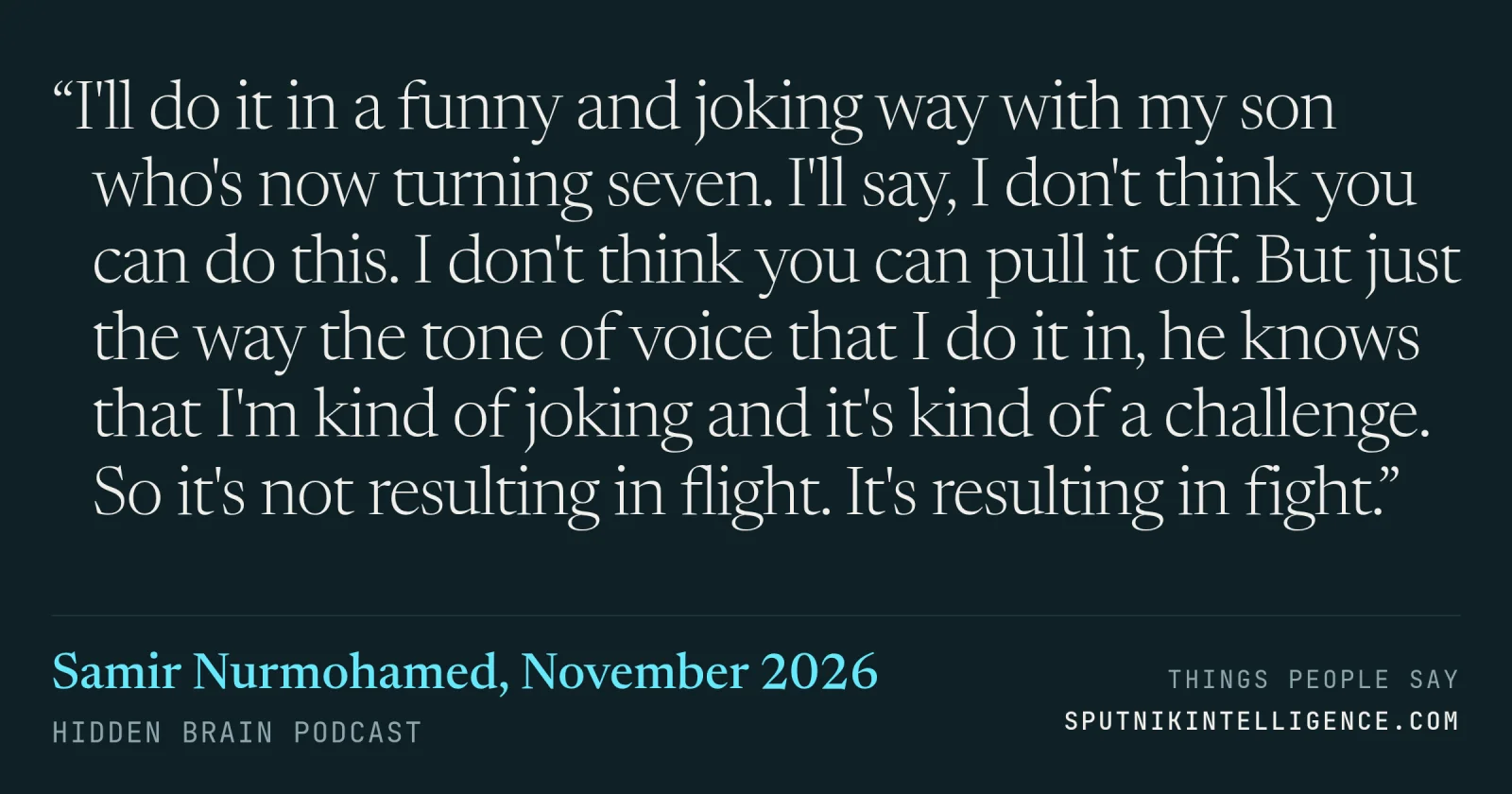
“I'll do it in a funny and joking way with my son who's now turning seven. I'll say, I don't think you can do this. I don't think you can pull it off. But just the way the tone of voice that I do it in, he knows that I'm kind of joking and it's kind of a challenge. So it's not resulting in flight. It's resulting in fight.” — Samir Nurmohamed, Hidden Brain

Asked whether he goes looking for slights to motivate himself, he describes how he deliberately and playfully doubts his young son. It shows the underdog effect being used on purpose, with tone doing the work.

Hidden Brain · 2026-11-16 Permalink → Listen →
Hidden Brain Around 53:02 into the episode
Samir Nurmohamed

…you know, out of sync with the rest of the company, but because they were older, essentially. But as a group, they kind of used that as a rallying cry to be motivated by others' expectations and lean on each other and learn from each other. And that ended up motivating them to be more successful.

Shankar Vedantam

I'm wondering, given all of this research, Samir, whether you go actively searching for slights and criticism to give yourself a motivational boost?

Samir Nurmohamed

I don't know if I still, I think I did that when I was younger, but maybe not to the same day. But I think this is baked in a lot of us. You know, there are, for example, as a faculty member, you know, when I teach, I get my evaluations at the end of the semester. And even when the course goes really well, I'll focus on those one or two pieces of criticism. And sometimes I'll use that to rub me up for the next semester. You know, the other example is at home. I have this funny thing with my kids. I don't constantly go around making them the underdogs at all, but I'll do it in a funny and joking way with my son who's now turning seven. You know, I'll say, I don't think you can do this. I don't think you can pull it off. But just the way the tone of voice that I do it in, he knows that I'm kind of joking and it's kind of a challenge. So it's not resulting in flight. It's resulting in fight.

Shankar Vedantam

Samir Nurmohamed is an organizational scientist at the University of Pennsylvania's Wharton School. Samir, thank you so much for joining me today on Hidden Brain.

Samir Nurmohamed

It was a pleasure to have this conversation with you, Shankar. Thanks so much for having me.

Shankar Vedantam

Samir's research suggests that when we're doubted by others, we can turn that doubt into a dare. We can challenge ourselves to stretch outside our comfort zone, prove the naysayers wrong. We can turn our underdog story into a hero's journey. Stories in which characters transform from underdogs into…

Speaker names come from our own diarization. The position is estimated from where the line sits in the episode.
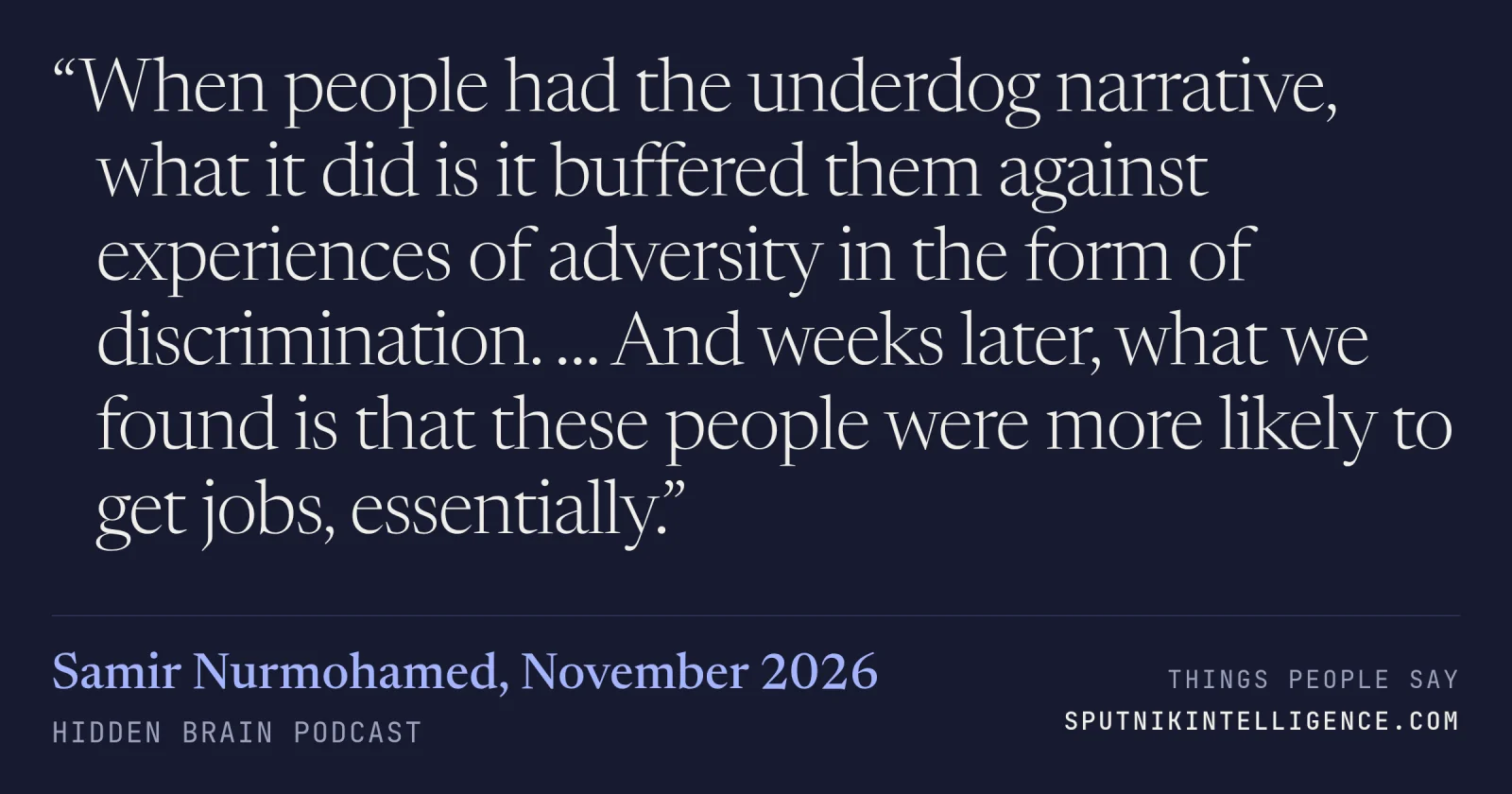
“When people had the underdog narrative, what it did is it buffered them against experiences of adversity in the form of discrimination. … And weeks later, what we found is that these people were more likely to get jobs, essentially.” — Samir Nurmohamed, Hidden Brain

He was describing a field study at re-employment centers, where job seekers wrote either a story of being believed in or a story of defying low expectations. The underdog story protected their confidence and was followed by more job offers.

Hidden Brain · 2026-11-16 Permalink → Listen →
Hidden Brain Around 43:02 into the episode
Samir Nurmohamed

…those low expectations and ended up being successful. So, we had people think of stories like this from their lives, and we also had them reflect on those experiences: what lessons did they learn, what themes came up from it, and how they would apply that to their own job search going forward.

Shankar Vedantam

And what did you find?

Samir Nurmohamed

So, what we found was really interesting. So, we did these one-hour-long interventions, these workshops. And what we found is that when people had the underdog narrative, what it did is it buffered them against experiences of adversity in the form of discrimination. And what ended up happening is that this adversity didn't impact themselves as negatively. So, it actually buffered them against their drop-in self-confidence in the job search. And weeks later, what we found is that these people were more likely to get jobs, essentially.

Shankar Vedantam

In other words, triggering the underdog effect almost was inoculating people against the effects of discrimination.

Samir Nurmohamed

Yeah, absolutely. And that's, you know, we did this in the field in these re-employment centers, and then we did some follow-up studies to better understand what was going on. And we saw this consistent finding across different settings.

Shankar Vedantam

You also have looked at some fascinating work when people are selected for something, but then they later discover that they were not the first choice. Tell me about this work, Samir.

Speaker names come from our own diarization. The position is estimated from where the line sits in the episode.
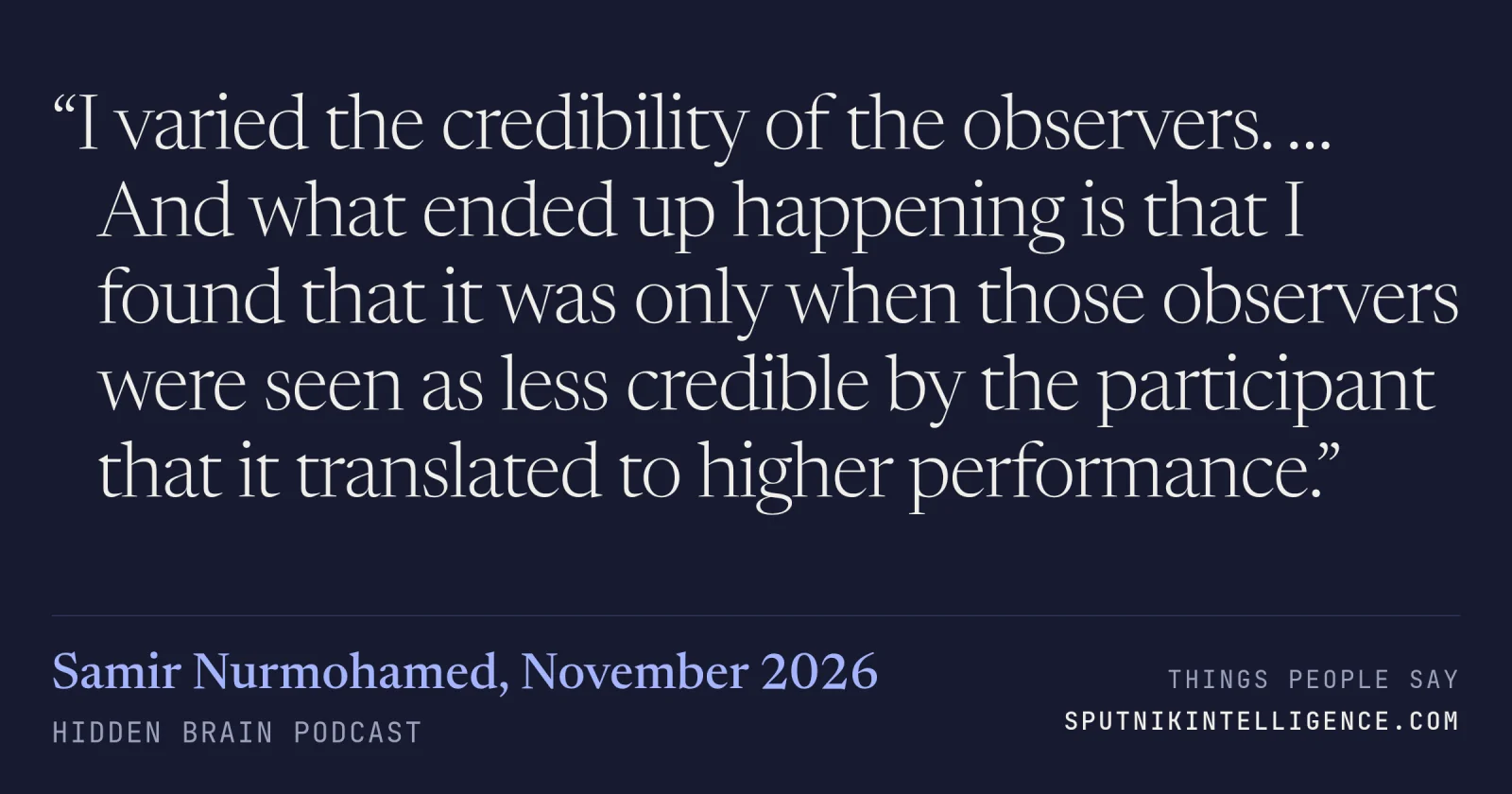
“I varied the credibility of the observers. … And what ended up happening is that I found that it was only when those observers were seen as less credible by the participant that it translated to higher performance.” — Samir Nurmohamed, Hidden Brain

He was explaining a study that tried to reconcile the "underdog effect" with older research on self-fulfilling prophecies. Being doubted pushed people to perform better only when the doubter wasn't seen as credible, which is his answer to why criticism sometimes crushes us and sometimes fires us up.

Hidden Brain · 2026-11-16 Permalink → Listen →
Hidden Brain Around 34:01 into the episode
Samir Nurmohamed

…lab, if you're coming into one of my studies, researchers are giving you this assessment, but they don't know much more about you than that. So there was something different here about the credibility of who holds the expectations. And that might be the key to understanding why I was finding these

Shankar Vedantam

…basically is that when the criticism comes from somebody with high credibility, it might have more of a self-fulfilling prophecy effect. But when the criticism comes from someone who potentially has low credibility, it might prompt us to fight back, to disagree with it, to find contrary evidence.

Samir Nurmohamed

Yeah, that's exactly right. And that's what I tried to do in the last study that I had. So in addition to giving people different sets of expectations, whether they were seen as likely to succeed or less likely to succeed, I varied the credibility of the observers. You know, how accurate were they as forecasters and whether they were seen as experts or not. And what ended up happening is that I found that it was only when those observers were seen as less credible by the participant that it translated to higher performance. One example of this was Allie Raisman, who is a gymnast for the U.S. Olympic team. After the 2012 Olympics, she had just missed out on placing on the podium. And, you know, for gymnasts, you're often thought your careers are rather short. Gymnasts retire rather early in their lives. But Allie Raisman returned for the 2016 Olympics. It was funnily enough, critics started calling her the grandma…

Shankar Vedantam

Being dismissed can make us curl up into a ball and give up. But sometimes being dismissed makes us rise to the occasion and stand up and fight. Underdogs who have a chip on their shoulder don't perform well in spite of being doubted, they perform well because they've been doubted. When we come…

Samir Nurmohamed

Yeah, so Jalen Brunson was a player who actually played for Villanova and won a national championship with them as a basketball player. And then he was drafted by the Dallas Mavericks, but was, you know, kind of like Tom Brady drafted in the second round, not sixth round at least. But there were…

Shankar Vedantam

Now, of course, we're recording this interview a few weeks after the Knicks won the NBA championship with Jalen Brunson at the helm.

Speaker names come from our own diarization. The position is estimated from where the line sits in the episode.

Collections They Appear In