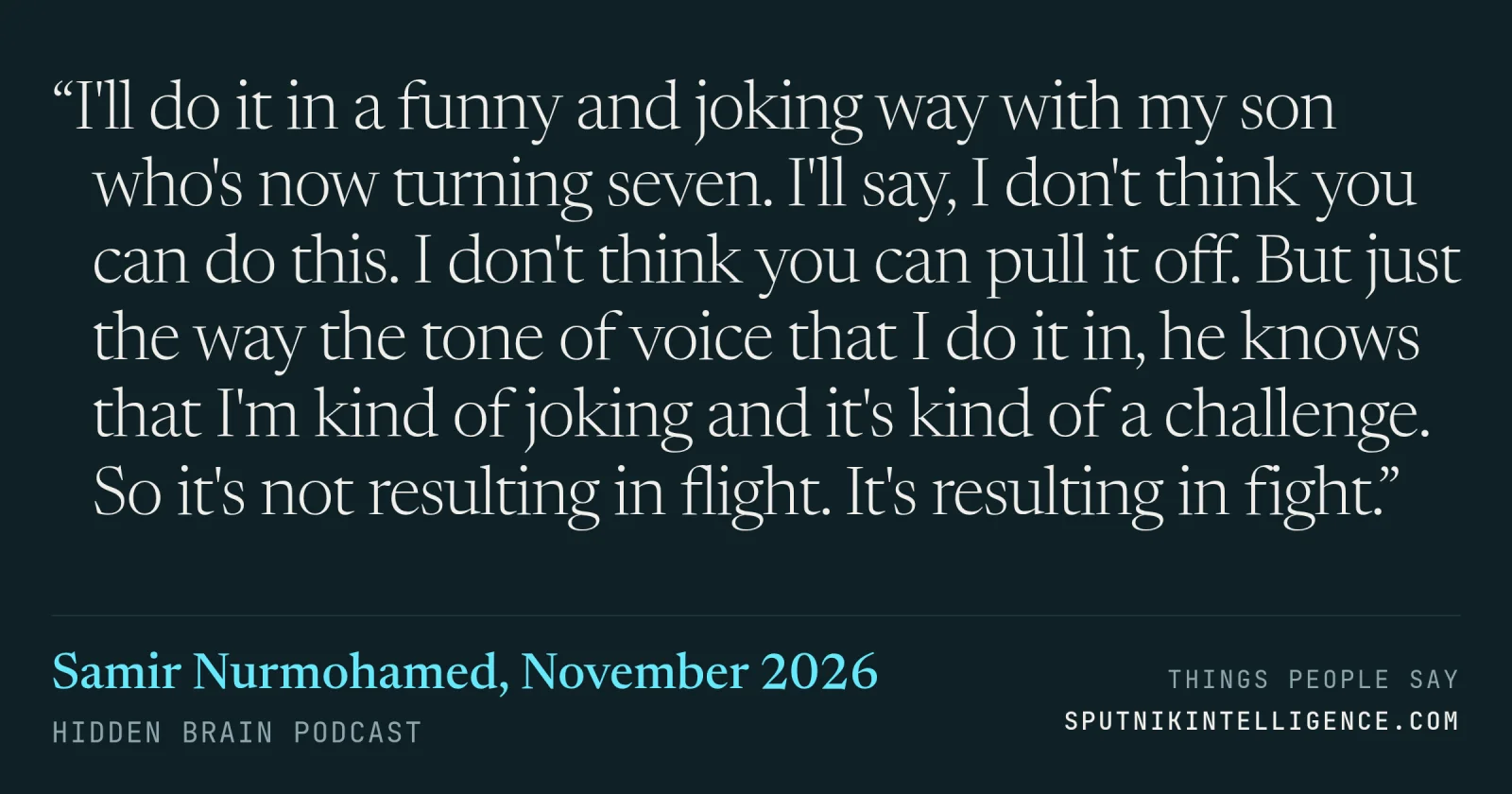
“I'll do it in a funny and joking way with my son who's now turning seven. I'll say, I don't think you can do this. I don't think you can pull it off. But just the way the tone of voice that I do it in, he knows that I'm kind of joking and it's kind of a challenge. So it's not resulting in flight. It's resulting in fight.”
Hidden Brain · Ideas & Essays · November 2026
Context
Asked whether he goes looking for slights to motivate himself, he describes how he deliberately and playfully doubts his young son. It shows the underdog effect being used on purpose, with tone doing the work.
Transcript
…you know, out of sync with the rest of the company, but because they were older, essentially. But as a group, they kind of used that as a rallying cry to be motivated by others' expectations and lean on each other and learn from each other. And that ended up motivating them to be more successful.
I'm wondering, given all of this research, Samir, whether you go actively searching for slights and criticism to give yourself a motivational boost?
I don't know if I still, I think I did that when I was younger, but maybe not to the same day. But I think this is baked in a lot of us. You know, there are, for example, as a faculty member, you know, when I teach, I get my evaluations at the end of the semester. And even when the course goes really well, I'll focus on those one or two pieces of criticism. And sometimes I'll use that to rub me up for the next semester. You know, the other example is at home. I have this funny thing with my kids. I don't constantly go around making them the underdogs at all, but I'll do it in a funny and joking way with my son who's now turning seven. You know, I'll say, I don't think you can do this. I don't think you can pull it off. But just the way the tone of voice that I do it in, he knows that I'm kind of joking and it's kind of a challenge. So it's not resulting in flight. It's resulting in fight.
Samir Nurmohamed is an organizational scientist at the University of Pennsylvania's Wharton School. Samir, thank you so much for joining me today on Hidden Brain.
It was a pleasure to have this conversation with you, Shankar. Thanks so much for having me.
Samir's research suggests that when we're doubted by others, we can turn that doubt into a dare. We can challenge ourselves to stretch outside our comfort zone, prove the naysayers wrong. We can turn our underdog story into a hero's journey. Stories in which characters transform from underdogs into…
More from Hidden Brain