
Galloway asked whether blue states really build less than red states. Sunderji takes on the argument in Ezra Klein and Derek Thompson's book Abundance, saying it doesn't survive the data: expensive cities around the world share density, high incomes and geographic limits, whatever their politics.
Yeah, I would agree with that. I don't think they're a huge chunk of the market. They're a very like visible and very easily vilified group. Who likes Wall Street investors? Dunking on them is pretty safe politically. But I just don't think it's a huge factor on the market.
…regulation. And a blue state, it's everything's a historic district. And if there's some muskrat that was seen here, we need to do a study on it. Is it really that simple? Are we really seeing that kind of bifurcation in the ability to build between traditionally blue and traditionally red states?
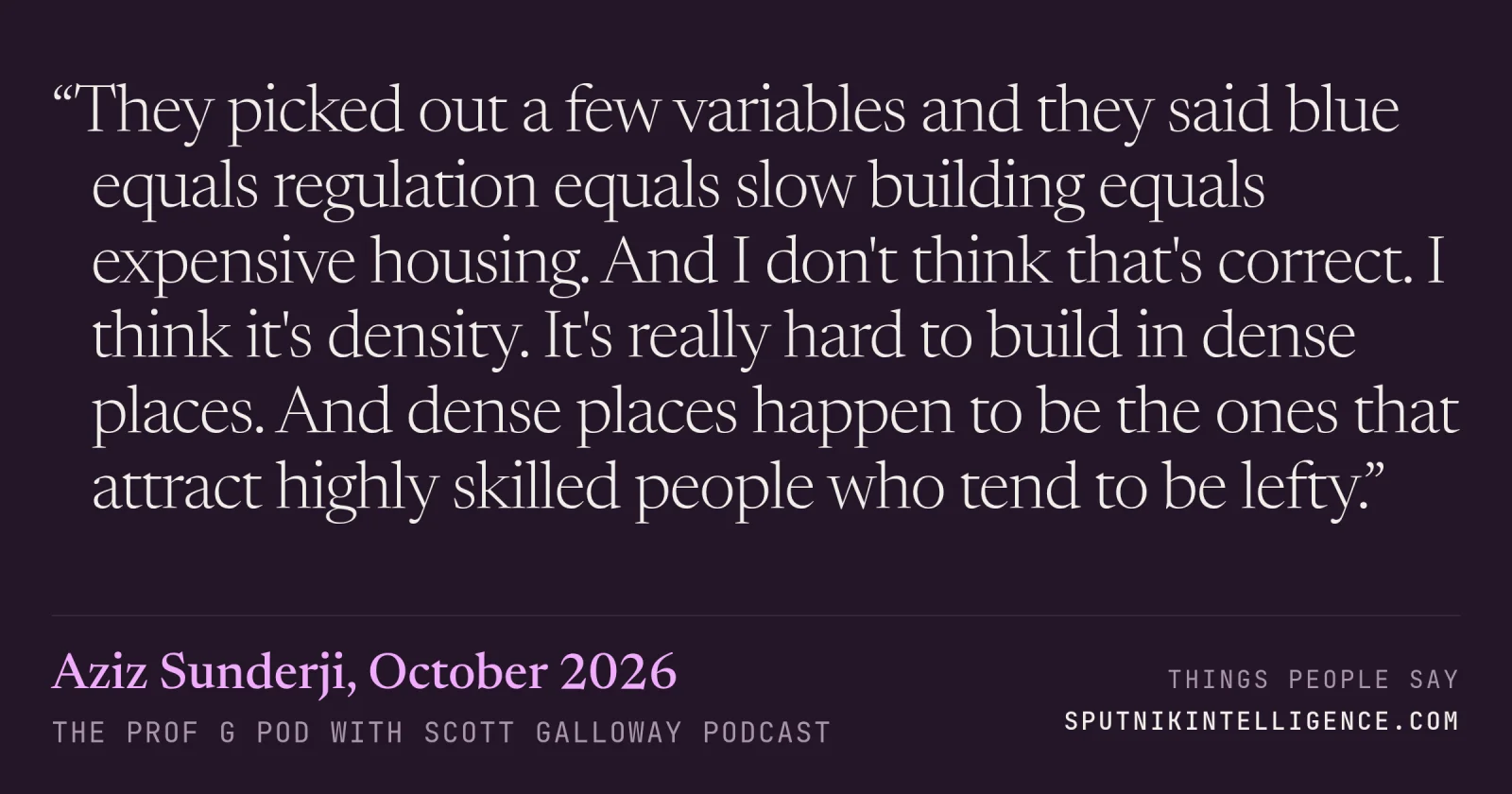
…really expensive. It's true about San Fran. It's true about Seattle, Miami. It's true about Paris and London and Copenhagen and Sydney. These are characteristics you see around the world. And actually in all these places, they may not be Democratic voters, but they're lefty. And so, you know, what Ezra Klein and Derek Thompson did was they like they wove a very compelling narrative out of this. They picked out a few variables and they said blue equals regulation equals slow building equals expensive housing. And I don't think that's correct. I think it's density. It's really hard to build in dense places. And dense places happen to be the ones that attract highly skilled people who tend to be lefty. So, you know, I'm Canadian. I can't vote in this country, but if I could, I'd be a Democrat. And my worry is that the kind of vilification on like, you know, weak empirical grounds is turning a bunch of people away from Democrats when it's partly their fault. Maybe Democrats do regulate a little bit more, but a lot of it is just the fabric of these big, dense cities full of people who are in…
And Kyla, before you weigh in here, isn't some of it also that young people, I don't think we can really ever appreciate the impact that Instagram is having on the world. And that is people see a life and think that's not a 0.01% life that's aspirational. That is a normalized life that I should…
I mean, you see the stats on how much money younger folks feel like they need to be successful. It's like double, I think, even what millennials need. I think part of that is inflation. I think part of that is inflated expectations. We have two types of inflation there. But I don't know if all of…
Yeah, I think part of it, like to be fair, to the folks who do want to live in the West Village or New York City or San Francisco or wherever is that there's been a concentration of economic activity in cities. And so, you know, if you want to, yeah, if you want to have a seat at the table, like…