Ian Landsman

Things Ian Says on Podcasts

Founder of HelpSpot, a bootstrapped help desk software company he has run since 2005 with no outside funding. Also built LaraJobs and, more recently, Outro. Co-hosts Mostly Technical, a weekly show mixing Laravel development, running a small software business, and whatever else comes up that week. Also co-hosts Token Town. Has guested on Talking Businessly, the Laravel Podcast, Laravel News Podcast, The Business of Laravel, Build Your SaaS and others, mostly talking about bootstrapping, customer support software, and building an AI-assisted developer tool business over two decades.

Where to Find Them

Ian Landsman hosts and writes Mostly Technical , hosts and writes Token Town and writes Laravel Podcast . They have also been a guest on Laravel News Podcast (2 times) , The Business of Laravel (2 times) , Build Your SaaS (2 times) , The Panel , Pragmatic AI with Matt Stauffer , Notes On Work - by Caleb Porzio , Talking Businessly and Startups For the Rest of Us .

Recently: “154: Ian Laravel New'd Again!” on Mostly Technical (October 2026); “153: 13 Billion Tokens” on Mostly Technical (October 2026); “152: Feel The AGI” on Mostly Technical (October 2026); “152: Feel The AGI” on Mostly Technical (October 2026); “151: Tokenmogged” on Mostly Technical (September 2026); “151: Tokenmogged” on Mostly Technical (September 2026).

What They Said

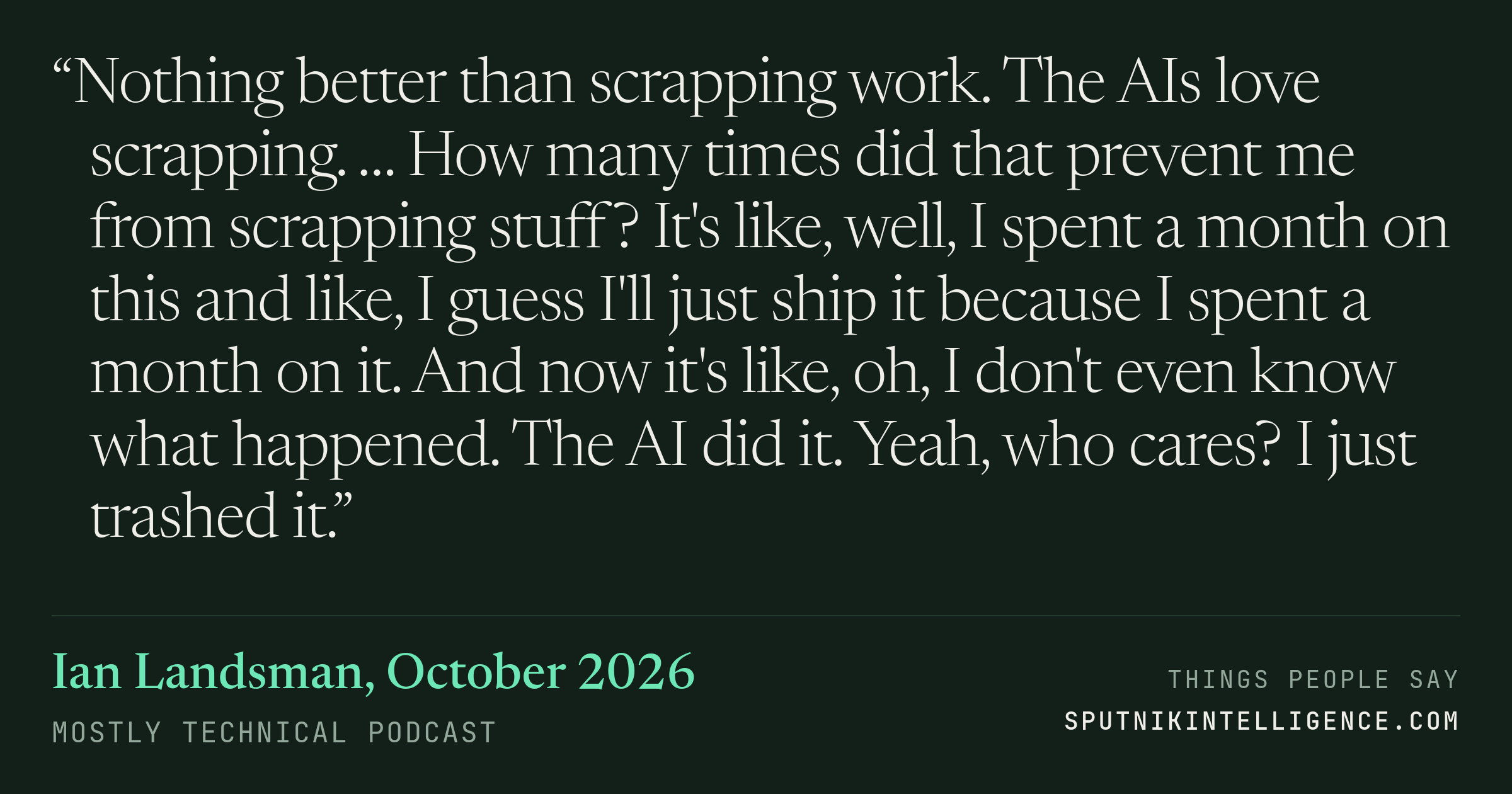
“Nothing better than scrapping work. The AIs love scrapping. … How many times did that prevent me from scrapping stuff? It's like, well, I spent a month on this and like, I guess I'll just ship it because I spent a month on it. And now it's like, oh, I don't even know what happened. The AI did it. Yeah, who cares? I just trashed it.” — Ian Landsman, Mostly Technical

During the HelpSpot rebuild, Landsman converted the product's "knowledge book" feature, then scrapped it for a plain knowledge base the AI can search. With an agent doing the work, the sunk cost that used to make him ship things anyway is gone.

Mostly Technical · 2026-10-13 Permalink → Listen →
Mostly Technical Around 58:17 into the episode
Ian Landsman

…it more heavily about like where, where does this go in this book? And like, I might have a book with a thousand pages. That's weird. Like, so it just kind of breaks down. So the books got scrapped and the books are being converted to a knowledge base, a more traditional pile of shit. Pile of crap.

Aaron Francis

Pile of crap. Put

Ian Landsman

…rebuilt. So yeah, so there's a lot of other. And I actually converted the knowledge books first. So that just got done as a conversion. But then I, because I wanted that there just in case, even though I knew I'd probably do knowledge base. Anyway, decided to do knowledge base, scrapped all that knowledge book stuff. Nothing better than scrapping work. The AI is love scrapping. Love scrapping. How many times did that prevent me from scrapping stuff? It's like, well, I spent a month on this and like, I guess I'll just ship it because I spent a month on it. And now it's like, oh, I don't even know what happened. The AI did it. Yeah, who cares? I just trashed it. I

Aaron Francis

just orbed it six hours ago. Who cares?

Ian Landsman

Exactly. It doesn't matter. So trashed all that. Have the base version, blah, blah. And all that. It's like, so it's all new UI. So again, like the AI sort of helps you, but still not, there's just a lot of stuff to do to make it work well, in my opinion. So doing all that stuff. Lots of…

Aaron Francis

When are we going to merge?

Speaker names from our own diarization · position estimated from where the line sits in the episode
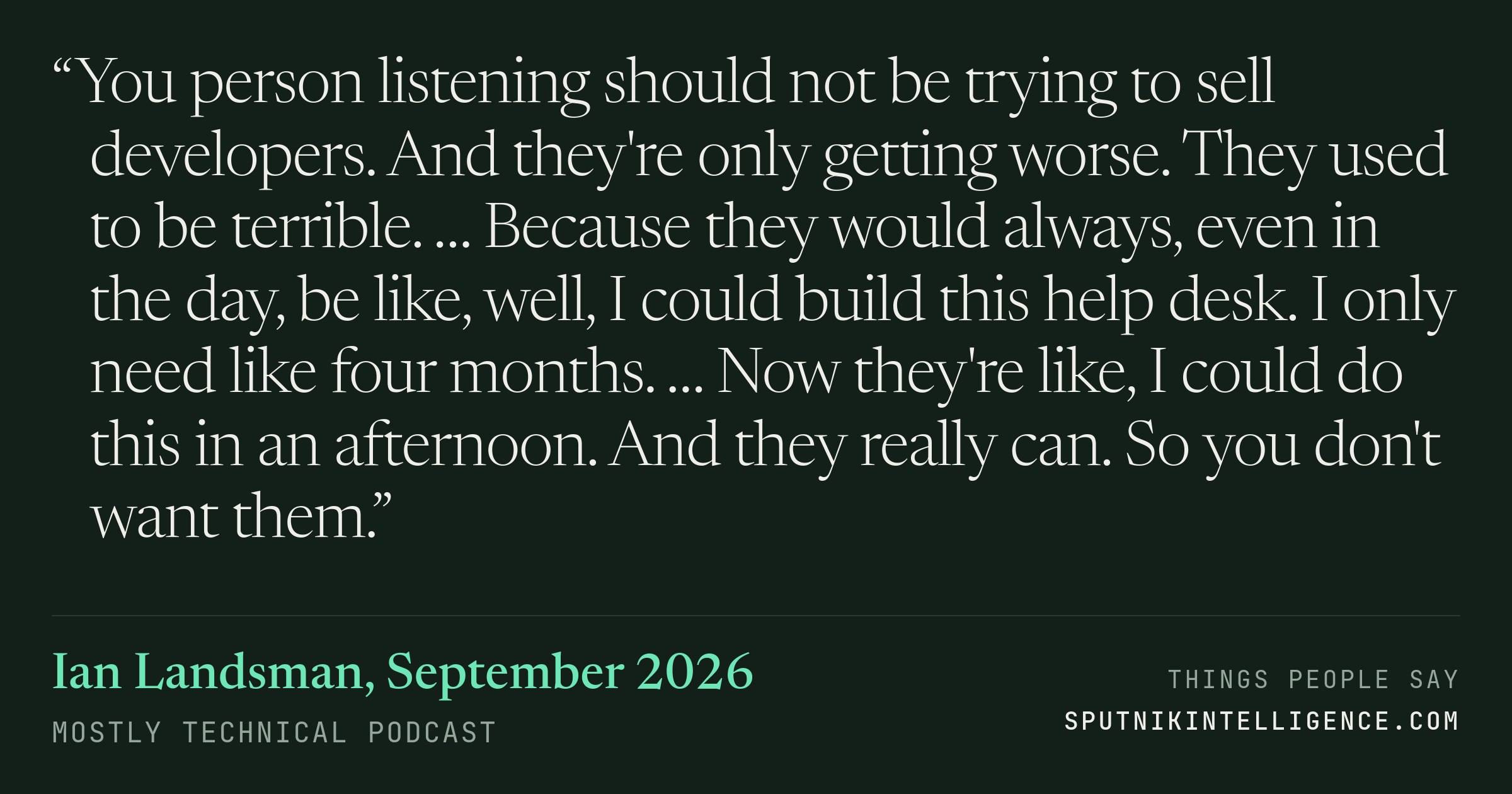
“You person listening should not be trying to sell developers. And they're only getting worse. They used to be terrible. … Because they would always, even in the day, be like, well, I could build this help desk. I only need like four months. … Now they're like, I could do this in an afternoon. And they really can. So you don't want them.” — Ian Landsman, Mostly Technical

Landsman, who has sold help desk software for years, says he loves developers but they're terrible customers. Aaron Francis's reply: don't sell software to developers, sell them infrastructure.

Mostly Technical · 2026-09-29 Permalink → Listen →
Mostly Technical Around 03:49 into the episode
Ian Landsman

Why would you even,

Aaron Francis

you don't, the problem is you don't want to sell. You don't want to sell to developers.

Ian Landsman

Oh, you hate developers. You hate developers. I love developers. They're my people. Don't get me wrong. I love developers, but you're terrible customers. Yes, I know. You could all point to Taylor Otwell and the three other people who made money selling developers. That's fine. You person listening should not be trying to sell developers. And they're only getting worse. They used to be terrible. They are getting worse. They're way worse than they were before. Way worse. Way worse. Because they would always, even in the day, be like, well, I could build this help desk. I only need like four months. I could do this. Right. Now they're like, I could do this in an afternoon. And they really can. So you don't want them.

Aaron Francis

They really can. Get them the hell out

Ian Landsman

of here. You don't want them in your plans being like, oh, I'm going to sell all these developers. Look at the chart. Go up to the right. No, no developers.

Aaron Francis

I will say this. Don't sell software to developers. Sell infrastructure to developers. Yeah,

Speaker names from our own diarization · position estimated from where the line sits in the episode
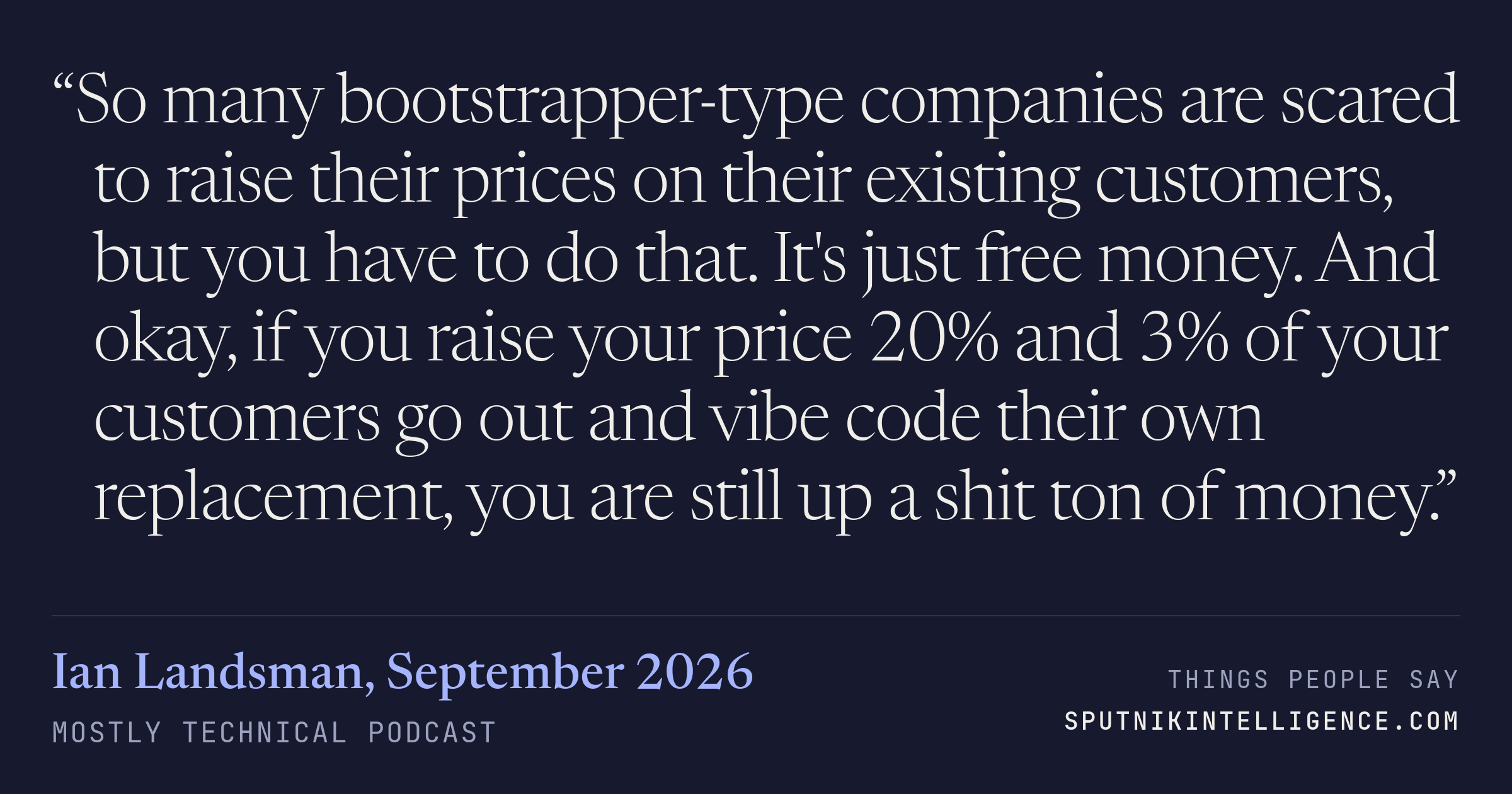
“So many bootstrapper-type companies are scared to raise their prices on their existing customers, but you have to do that. It's just free money. And okay, if you raise your price 20% and 3% of your customers go out and vibe code their own replacement, you are still up a shit ton of money.” — Ian Landsman, Mostly Technical

Landsman was answering a tweet arguing this is the worst time to raise software prices. His case: inflation and big vendors like QuickBooks, Salesforce and Microsoft raising prices give cover, and the vibe-coding threat is small next to the extra revenue.

Mostly Technical · 2026-09-22 Permalink → Listen →
Mostly Technical Around 1:09:41 into the episode
Ian Landsman

Oh, we're going to talk about this a little bit. This is Ian

Aaron Francis

…Jesse had a tweet about, you know, this is basically the worst time to raise your prices. You should be lowering them. Ian comes in over the top with a quote tweet, slam dunk, and says, 100% wrong. No freaking way. Raise your prices. Laura Roeder weighs in. All right. What's the story here?

Ian Landsman

I didn't technically say 100% wrong, but I do think that it is a good time to raise prices because you have a lot of cover from inflation. Everybody's raising their prices. QuickBooks has raised their prices twice this year. Salesforce just raised their prices. Microsoft just raised their price. Like lots of companies and software companies are raising their price. Mintlify apparently just raised their prices, right? Like, and we've talked about this on the show before. It's just a math problem. And so many, like so many sort of bootstrapper-type companies are scared to raise their prices on their existing customers, but you have to do that. It's like just free money. And okay, if you raise your price 20% and 3% of your customers go out and vibe code their own replacement, you are still up a shit ton of money. So that's fine. It's fine if that happens. So, and if you raise your price 20% and you lose 50% of your customers, I think there's something else going on there because very few industries are the customers that price sensitive. Obviously, exceptions, developers are…

Aaron Francis

It's a good name. But

Ian Landsman

anyway, yeah. So I don't know. I just think that there's a lot of cover for that. First of all, second of all, if you're integrating AI and you're bringing efficiencies, this is why software charges more. It's literally the reason, right? It's like, hey, if you implement our software, you are going…

Aaron Francis

I think we found, I think we've found the root of all issues.

Speaker names from our own diarization · position estimated from where the line sits in the episode

Collections They Appear In