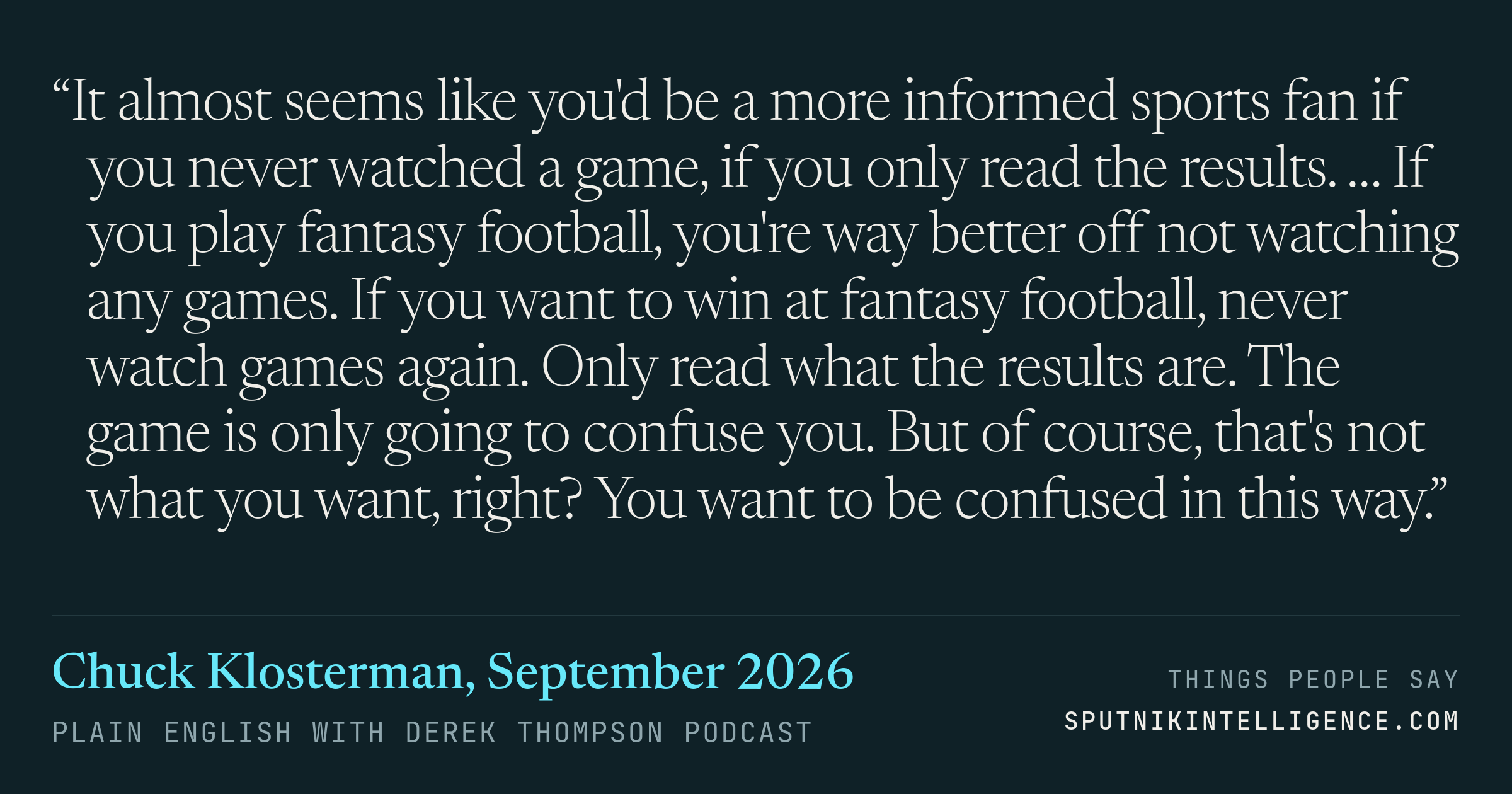
Thompson had asked what is lost when MVP voters all defer to a single analytics number they don't fully understand. Klosterman answers that sports have gone so far toward the stats that watching has become almost a disadvantage, even though watching is the reason anyone follows sports.
Like, like, about half the time it does work and about half the time it doesn't. It's not that different. And it was also, you know, I mean, I guess this is a different argument, talking about like how important these things are. Now, in some ways, especially at the pro level, you know, the amount of bonuses and the way, like, it's millions and millions of dollars between winning the MVP and placing second in the MVP in baseball and all like, you know, but it's, it's like a, we're already starting from a flawed premise with the phrase, most valuable player. We're already using a word that sort of can mean a lot of different things. Like valuable to what? Valuable to your team? Valuable to like your team succeeding at the highest possible level. I remember talking with Simmons one time when it was the, when it was the Russell Westbrook and James Harden year for the NBA voting for MVP. And I still, I still say this. I mean, it was like Russell Westbrook was the most valuable player for the league. Like, because every morning I would wake up to see if he got a triple double because he was trying to do this for the first time. It was like, it was the most valuable thing for the experience of watching and following pro basketball. Now, a lot of people hear that and they're like, that's insane. It's supposed to be how valuable you are to like winning a championship. It's like, I don't know. Where does it say that? It's like, I mean, it's like most, you know, it's, I find it very interesting that in the NCA basketball tournament, it's the MOP. It's the most outstanding player. In some ways, that is like significantly more specific because it'd be sort of like, you don't got to be on the winning team. You have to be the most out. You have to stand apart the most. Baseball has, I mean, in terms of the way it is covered and discussed by people who care, it has totally surrendered to the analytical paradigm. That is the whole thing. You just like, you know, and every other sport is kind of taking half measures and half steps toward that. So baseball is in kind of a, like, I think, you know, baseball's advantage for a long time was that it was the only sport where you could really compare modern players from players from the past. And it wasn't like, well, okay, we got to factor in all these other things. Like you can sort of imagine, you know, Joe DiMaggio playing in the 80s or whatever. And it was like, what, but now that has changed too. That's totally different now. I mean, the way the guys throw and the way the guys look, they've kind of like taken all the other sports where you can. only measure against who they are playing with in this specific era and by going solely by the numbers because in baseball they're so measurable i mean it is it's just this a series of one-on-one events you know pitcher against hitter and then the ball's in play so it's fielder against ball it's like um i'm not surprised that that has happened i don't i have no idea why that is preferable but i'm not that big of a baseball fan but like i i have no idea why people would prefer the idea that this can be more accurately explained and proven because we all know that when it comes down to the last game of the world series or the ncl is reverse like you have to throw all those things away it's like you know like the past performance is no indication of future returns at least for this at bat so i i don't know what i'm not again i'm not sure if i answered the question that you were just saying like what do i think about it that's what i think you know
no i think that's great i mean i um i wrote a piece a while back called the dark side of moneyball where i talked about how you know baseball by as you said buying into the analytics paradigm um solved itself like a math problem and now i think the commissioner's office is trying to unsolve it by adding inefficiencies to make the game more interesting and i think to a certain extent you know moribal and basketball obviously this has been talked about a lot in a lot of simmons podcasts and the thousand podcasts but um you know the the rise in threes i think similarly represents basketball trying to solve itself like a math problem and i'm i'm interested in how um and by the way i should say i think folks at netflix and disney hire way more people in analytics departments than they had in the 1970s 1980s and they are also pouring over demographic data international data and um preference data and trying to solve their own problems like a math problem and i am interested in this question of what is gained and what is lost when we turn more human problems into math problems um and i've obviously i think that there's um connections to what's going on with artificial intelligence with more people essentially relying on inscrutable black boxes of algorithms to solve problems in their own life whether it's professional problems or personal interpersonal problems and in trying to sort of like wrestle down this like big idea of like what is won and what is lost when we turn over more of our decision-making power to mathematical systems we only partly understand and trying to like find like what is what is a nugget that i could begin this essay with to help people try to see the thing that i am seeing i thought you know it's kind of funny that when i read these articles about who should win mvp they all say well the war number on fan graphs says 10.7 so the answer is the person with the 10.7 then i think i don't know what the that means i don't know what 10.7 war actually means i do know what a home run is and i know what a batting average is and know what an rbi is but and i and i and i assume that those numbers are being fed into this final like war number but i the numbers i understand weigh less and less and less in mvp voting and the numbers i don't understand weigh more and more to the point that as you said they become determinative every voter just seems to like pull up the same web page to sort the wars and then votes for the person at the top and then everyone agrees now on who the mvp is and so in a way you could say mvp voting has gotten better because we're no longer making the mistake of like awarding someone with a two war over someone who has an 11 war so maybe voting is getting better but there's also something interesting happening where we are reaching a consensus by relying on a number that the individual voters themselves don't understand and isn't that like kind of weird and interesting and so i'm just interested in this larger question of like what happens as we turn more of human decision making over to mathematical systems that we trust to be correct even though we don't understand what they are in the first place
i mean i suppose there would be the counter to that somebody would be like well learn what these numbers mean and if you learn you will believe that you'll see what and maybe that is the case but i mean i generally agree like like the netfix is a netflix example that's very easy to understand why that is only good for like the shareholder of netflix i mean it's like this okay so i'm one thing that i always bothered me it's going to seem like a weird analogy but i think they're the same i would hear people who went to say like oh creative writing programs or writing workshops and they would workshop their writing work and there was this idea that when somebody read a story the other people would respond and everybody kind of had to respond with something and what seemed to always happen is people would respond either you know with like to whatever was the most outside of the expectation like they'd be like whatever was the thing about the writing That was sort of stood out to them, you know, the voice or maybe a detail or something that they would be like, kind of like they would kind of sand those off. It would be all these people sort of noticing the things that kind of go outside of coloring outside the lines or whatever. They'd say, I noticed this. And as a consequence, what the ended product ends up being is sort of like something that has lost all the things that made it different. The Netflix algorithm is like that, figuring out what people want and all these things. It's like, it's just, it is figuring out what the highest number of people will find acceptable or to watch or whatever, but that's going to decrease the likelihood that something we didn't strange is going to come through. I mean, how it applies to baseball, I don't really know. I mean, that way, I guess, because the game is just happening and this, you know, this is just sort of like looking at the statistics and then making a decision based on this. But I'm intrigued by sort of the when I was a little kid, for example, and you'd watch a game on television and the color announcer was always like talking about the guy's grit and like who wants it more and all that. And I'd be like, they should actually be following statistics more. Like James, like James Wilder of the Tampa Bay Buccaneers, he's not a very famous running back, but actually you should maybe give him more attention than Tony Dorset because look at him. And as a kid, I was like this. I was like, I wanted to pour through the sporting news and sort of see these, like the reality of what was happening. But then as time moved on, it's like it went too far in that direction to the thing where it's like all these other kind of intangible things, which is the draw to sports, they're gone. And like what's on the paper only matters. And now it just seems busy. It just seems strange to me. It seems like I, it almost seems like you'd be a more informed sports fan if you never watched a game, if you only read the results, that you would actually be in a better position to vote for MVP than somebody who watches baseball all day, every day. And that makes no sense. Like, and I think you know exactly, I think you agree with me. I think that for, you know, that you would actually like, like, you know, because that's how it is. Like, if you, if you play fantasy football out there, you're way better off not watching any games. If you want to win at fantasy football, if you're listening to this right now and you're like, I want to win on my fantasy football team, never watch games again. Only read what the results are. The game is only going to confuse you. But of course, that's not what you want, right? I mean, you want to be confused in this way.
It's funny how in a way, without my planning for it in the slightest, we've somewhat returned to a distinction between the nonfiction and fiction books, that there's something about certain nonfiction books that exist to be summarizable. What happened in World War II? How do I lose weight? What is the secret to living a life of good habits? And there's other titles that can't be summarized that have to be experienced the way you experience a football game. And so it's funny that, yeah, there's something about this theme that I want to do more on, about the distinction between the parts of life that need to be experienced and the parts of life that are susceptible to these technologies of summary. That's a cool distinction. So maybe for next time, Chuck, thank you very much. This is a lot of fun.
This episode is brought to you by Whole Foods Market. Now, this is a player in the food space that has championed winning food standards and quality since 1980. That means no added growth hormones or antibiotics in their meat and no synthetic nitrates or nitrites in their deli meats, hot dogs, or sausages, plus all their seafood is responsibly farmed or wild-caught. They've even banned some ingredients store-wide to make sure there's nothing to mess with the flavors you want. Shop Whole Foods Market in store or online.