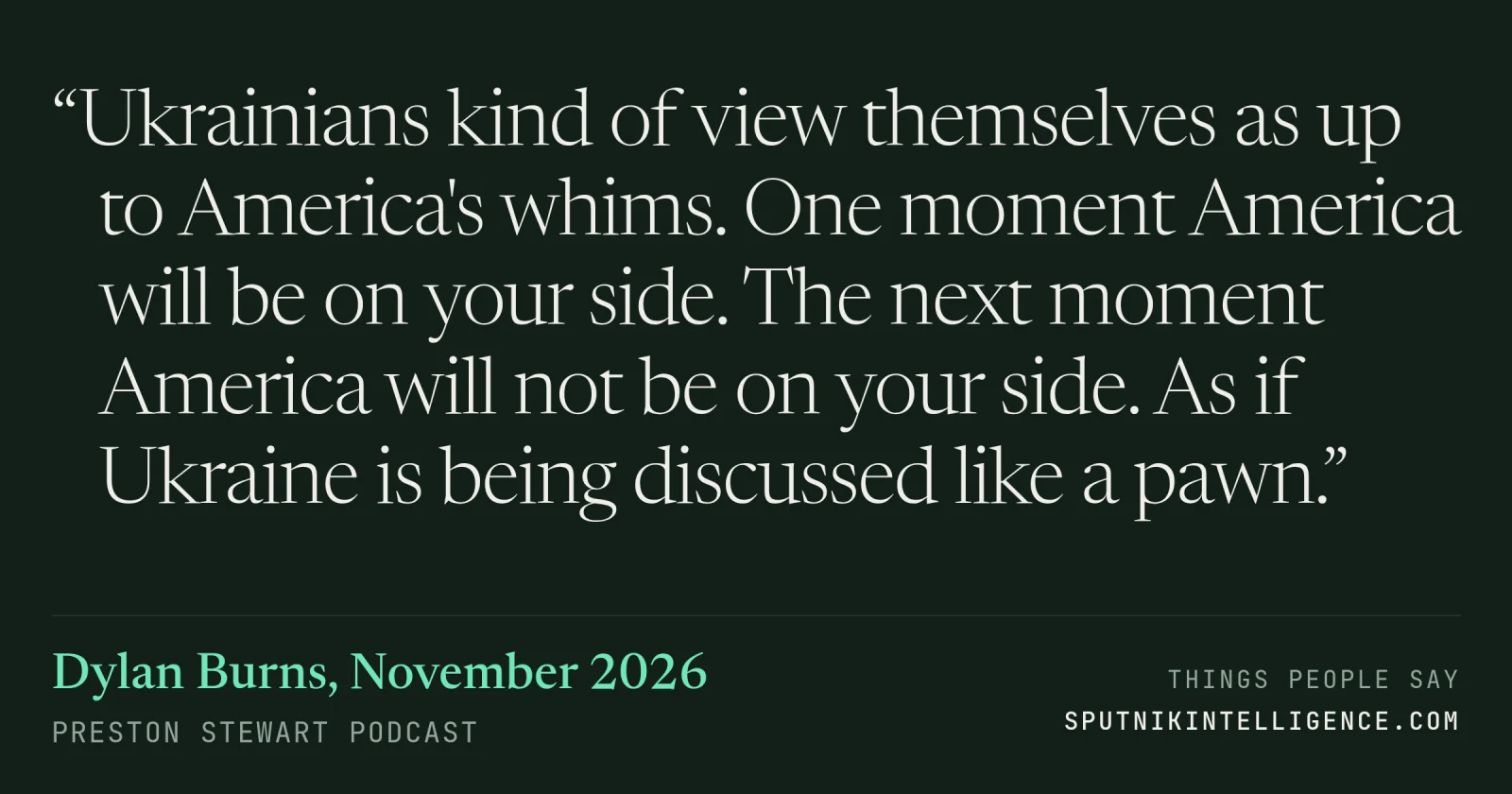
Asked whether the Ukrainians he meets have changed how they see America, he describes what he hears: that US support is transactional and unreliable. It's his account of Ukrainian views, not his own policy position.
…even if marginal, out in Ukraine. So I think those are some of the biggest areas of social tension in Ukraine as of right now. But the general consensus is that the war is here and victories like the long-range war effort against the Russian refineries have definitely been a recent morale booster.
Preston Stewart
…or lack thereof of Ukraine, especially over the last two years. Are you hearing much from the soldiers or the citizens changing perception how they view America? Are they still optimistic that we'll come around? Are they just not thinking about us at all? Which I wouldn't judge them for that. The
Dylan Burns
Ukrainians kind of view themselves as up to America's whims. One moment America will be on your side. The next moment America will not be on your side. As if Ukraine is being discussed like a pawn. Even now, as Trump talks about negotiating a deal with Europe or with Ukraine, it doesn't seem like he's talking about with Europe as in they're going to be included, but we're going to make a deal on Europe. We're going to make a deal on Ukraine. We're going to make a deal for them. And there's a lack of inclusion. And ever since the new administration has come in, there's been a lot of…
Preston Stewart
Probably a good place for them to get to, unfortunately. It was almost more painful in the period of time where we were kind of waiting, like, is something good going to happen? Is this going to turn around? And it's in a weird way, almost. I wonder if it's almost better to just come to acceptance…
Dylan Burns
I think my favorite moment in the film would probably be just there's this quiet moments in between walking on the front with the infantry where they kind of sit back and they smoke a cigarette and there's just little moments of tranquility. And these images are burned very deeply into my mind…
Preston Stewart
It's really important. You hit on it early on, Dylan Burns it's so important to document what's happening there and to have someone like you out there. I mean, risking your life to be able to share this story with the rest of the world, not just today, but this is the kind of thing people are going…
Speaker names come from our own diarization. The position is estimated from where the line sits in the episode.
Asked whether he wears press markings at forward positions, he says he does, to uphold the profession's standards, but that they offer little protection from drone operators.
…I more comfortable going in on foot. And when we went in on foot, we had probably at least over a dozen experiences, interactions with drones zooming around us or directly trying to target us. And that was just one day of walking into and out of that axis. So it's probably 25, 30 kilometers.
Preston Stewart
Do you make yourself known as press? Like, do you wear a press badge when you're doing this?
Dylan Burns
…worker killed there. Journalists killed there. Good luck. And that's just very, it is just the threat is very, very present there. It's very difficult to operate. So I can wear press identifiers and I do. I'm not going to wear camouflage. I'm not going to decorate myself like the Ukrainian armed forces because of the law and I want to uphold the law. But ultimately, none of that matters at all. I've seen journalists get attacked while clearly marked as press. I've seen civilians get killed for no reason whatsoever. Grandmas on their morning shuffle through the neighborhood get blown up in Herson. It is very, very, very common. It is kind of the name of the game. So like talking about like dressing up as press is just like, it's just like a different costume in some video game to a lot of drone pilots. Not all, not all Russian drone pilots. I don't want to like demonize like the Russian soul in and of…
Preston Stewart
It's such a weird dynamic because when you think about, I mean, press in a war zone. And to be, for everyone listening, and I know who you said, you weren't in Konostanthinivka, you were just around the sides of it. Like to be clear, kind of what he said is we weren't in the area that's borderline…
Dylan Burns
Yeah, no, I mean, I remember my first embed, I wore like reflective press press covering, and they were telling me, take that off. Are you crazy? You know, it'll bring attention to you. And the last thing you want to do is bring attention to yourself. So what I try to do is just try to be…
Preston Stewart
I mean, I'm all about more press being there, but at the same time, Dylan, like you're dodging FPBs, you know, like that is, it is crazy. It feels like magnitudes beyond. What our professional press corps has done in conflict zones recently. Like we had in Afghanistan, we had reporters in bed with…
Speaker names come from our own diarization. The position is estimated from where the line sits in the episode.
Explaining why walking into front-line towns is now safer than driving, he lists the road threats: mines, drones hunting vehicles, and the speed people drive to escape them.
…the Kharkiv region. It would free up that flank for the Russian army's advance. And this is a big concern for a lot of the locals in the area. So I really wanted to make sure that for a year, I focused on that axis. And that's why the title of the film is One Year on the Kostiantynivka Frontline.
Preston Stewart
Did you get into Konstantinivka recently?
Dylan Burns
Recently, it is impossible to get into Konstantinivka now as a foreign journalist. The last time I was in Konstantinka would be very early this year, late last year, with a lot of aid missions evacuating people. The closest I've been to Konstantinivka as of recently is within the villages and the tiny suburban communities right next to it. Like you're talking about Druzhkivka and the areas around Druzekivka right before Konstantinivka. And when you're walking on that axis, you're going to deal with a ton of drone threats. And the safest way to go in there now is walking. You can go in on vehicle, but when we went in on a vehicle, there was a vehicle behind us that was hit shortly after we passed it. There is a lot of dangerous, dangerous threats on the road. You could run over an anti-vehicle mine. You could be hit by an FPV that's coming to hunt your vehicle. You could just crash when you're traveling at extremely high speeds. Half of the casualties that I've personally seen on the front…
Preston Stewart
Do you make yourself known as press? Like, do you wear a press badge when you're doing this?
Dylan Burns
It doesn't matter. It doesn't really matter if you mark yourself as press, but I still feel like I have to uphold certain standards because there is a reputation to uphold of the press. You don't want to give any excuses for the crimes that are going to be committed, and it's a question of going to…
Preston Stewart
It's such a weird dynamic because when you think about, I mean, press in a war zone. And to be, for everyone listening, and I know who you said, you weren't in Konostanthinivka, you were just around the sides of it. Like to be clear, kind of what he said is we weren't in the area that's borderline…
Speaker names come from our own diarization. The position is estimated from where the line sits in the episode.
Comparing Ukraine with earlier wars, he says drone warfare creates a different kind of trauma, built on months of constant surveillance rather than single firefights.
…because the mainstream press, to be quite frank, have a problem with the liability that comes with sending their journalists out to the front line as often as I think there should be footage coming from the front line. So there needs to be more independent press on the front. I really believe that.
Preston Stewart
…we had in Afghanistan, we had reporters in bed with us. Ah, you know, they had pretty hot meals and we kind of joked around with them at night, but like they weren't really in that much danger. We made sure they didn't go on certain patrols and all that. But this is an entirely different beast.
Dylan Burns
…bombardment, constant underground living, constant buzzing as you know that there's like someone hunting right outside your trench for any sign of movement and you're scared to even come out at night because you can't see anything, but they could see you. That constant feeling of being watched. And then you remove somebody after nine months in that environment and some men have done that. It's a totally different psychological dilemma versus somebody who had a traumatic experience with a firefight in Kandahar. Now, these are both things that deserve treatment and psychological review. It's just the type of skills and investment and research that's necessary to deal with this will require so much time and investment. And so it's of the utmost importance that everyone pays attention to what's happening
Preston Stewart
here. And in fairness to the good journalists that are out there at these major organizations, because there are plenty of solid ones, most of the time, in my understanding, is it's not their individual call. It's, we'll call it the Associated Press or the Washington Post. It says, absolutely not.…
Dylan Burns
Yeah, nobody should have ever let me onto the front line at the start of the war. That was insane that they did that. You know, some streamer comes over here, like, I want to meet a war journalist. And, you know, they said, okay. And it worked out five years later and making full-fledged films. I…
Preston Stewart
What about risk tolerance? How much of that are you able to determine? I mean, you mentioned a second ago that it's practically impossible for foreign journalists to get into Kostantinivka. I'm sure there's been a number of places where at some point there's a line drawn and foreign press isn't…
Speaker names come from our own diarization. The position is estimated from where the line sits in the episode.
The host said the war in Ukraine keeps getting worse in ways he doesn't expect. The war reporter compares today's front with the one he first covered in 2022, naming drones as the main change.
…pneumonia pipelines or it is digging tunnels yourself. So there's different aspects where I will go out on the limb and it'll take a little bit of risk within, of course, due caution, knowing that, you know, I have to, of course, control whatever risk I am taking and claim responsibility for it.
Preston Stewart
…get worse. It's worse. Like the idea of crawling around through a tunnel to get to an enemy position seems so much like that is so far down the list of something I want to do. But if you, you know, going from the beginning of the war to now, it just progressively gets nastier and nastier, it seems.
Dylan Burns
…about in reference to the amount of violence done. Because since there was a new president in the White House, there's been a lot of escalation in the amount of drones used, escalation in the amount of missiles fired, a lot of escalation and a lot of military action. But the language used by states isn't in the same level of escalatory rhetoric. And so it's not viewed as much as escalation. But on the front line, the amount of drones I've seen has escalated to a point where it's not even comparable to 2022. It's a totally different war. The war has to be told more in chapters now than in one clear dividing line. Because if you took somebody from 2022 and threw them into this battlefield, they'd be killed almost instantaneously.
Preston Stewart
I'd be interested in your thoughts on your perception of Ukrainian soldier morale. That's a very difficult question for a lot of us to dig into, because even if you do get the opportunity to interact with a group of soldiers, you then have a snapshot. And soldiers, just like anyone else, they can…
Speaker 3
I think morale right now is a mixed bag. I think on one level, there is a complete tiredness with the war where everybody
Dylan Burns
wants to see it over. I don't know anybody that is, you know, super excited about the war extending. Everybody wants the war to be over. There are very few people that I know who want the war to be over and are willing to give up anything for the war to be over immediately. For example, giving up…
Speaker names come from our own diarization. The position is estimated from where the line sits in the episode.